
Transforming words and transforming worlds at the first Transformation Dialogue
2026-05-18 On the 6th of May, the kick-off Transformation Dialogue successfully took place at Leuphana University of Lüneburg. Prof. Dr. Gretchen Bakke (Humboldt-Universität zu Berlin) and Prof. Dr. Matthias Schmelzer (Europa-Universität Flensburg) discussed with an audience of over 40 people how transformation figures into our language and political activism.
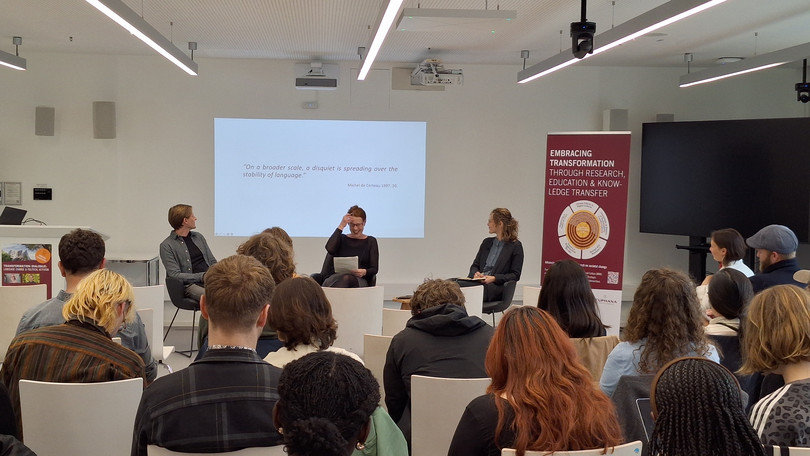
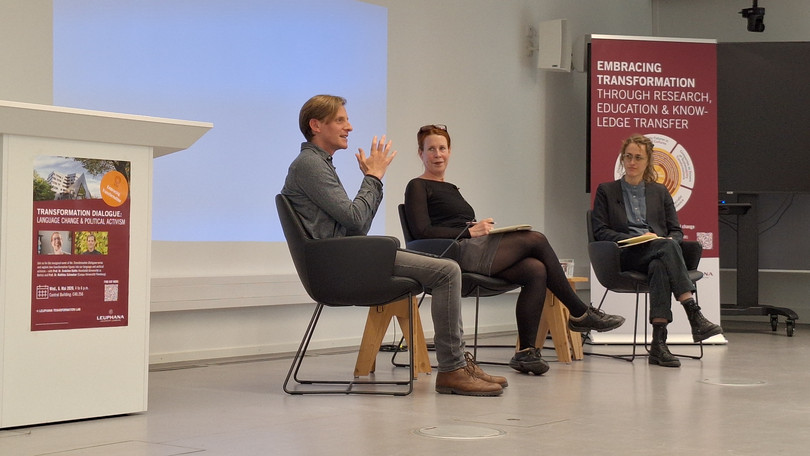
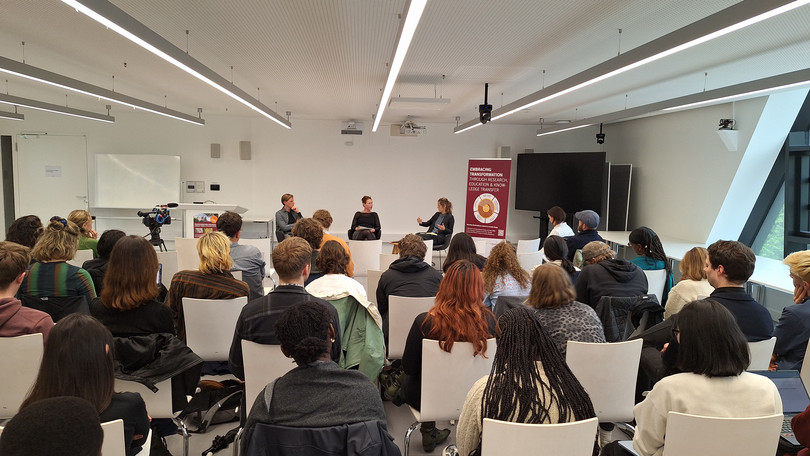
The event was chaired by Dr. Anke Gruendel, academic coordinator of the Leuphana Transformation Lab, and marks the beginning of the Transformation Dialogues series. This series is hosted by the Lab, a cross-faculty institution dedicated to researching transformation and creating space for interdisciplinary exchange. By embracing a plurality of perspectives and allowing productive tensions to emerge, the event challenged us to think critically about the term “transformation” in contemporary discourse.
Prof. Dr. Gretchen Bakke, an anthropologist whose work examines how morphological changes in language help produce new worlds, opened the vibrant discussion by asking: “Which words should we use to talk about a world that we would like to see coming but that we cannot yet name?”
By continually coining new terms that diagnose unwanted social conditions and articulate alternative visions of more just, sustainable, or equitable futures, scholars and activists attempt to transform worlds by transforming words.
Prof. Dr. Matthias Schmelzer argued that finding words for a desired world is of relevance for political activism. “We cannot organize around and defend something that we cannot name,” said the economic historian and transformation researcher whose work explores the growth paradigm, fossil mentalities, and degrowth.
The scholars who gathered for the first Transformation Dialogue are confronted with these conceptual shifts every day in their research. Together with the audience they engaged in an enriching discussion about the question whether conceptual innovation enables change or substitutes for it.
The Transformation Dialogues series
The Transformation Dialogues bring together two scholars from different disciplines and create a space for interdisciplinary exchange, in which each scholar’s distinct research focus contributes to a dynamic discussion about transformation. Information on the next Transformation Dialogue will be announced shortly.