
Ethnografien des Weltraums: Postplanetare Zukünfte verorten
16. Sept. - 18. Sept.
C25.019 + C25.021 (Trafos) + Kunstraum + Scala Kino
Was bedeutet es, an den Grenzen des Planetaren zu denken? Diese internationale Konferenz bringt Wissenschaftler*innen aus der Weltraumforschung zusammen, um sich in wissenschaftlichen Beiträgen sowie multimodalen, künstlerischen und audiovisuellen Formaten an der Leuphana Universität Lüneburg, im Kunstraum und im Scala-Kino mit dem Postplanetaren auseinanderzusetzen.
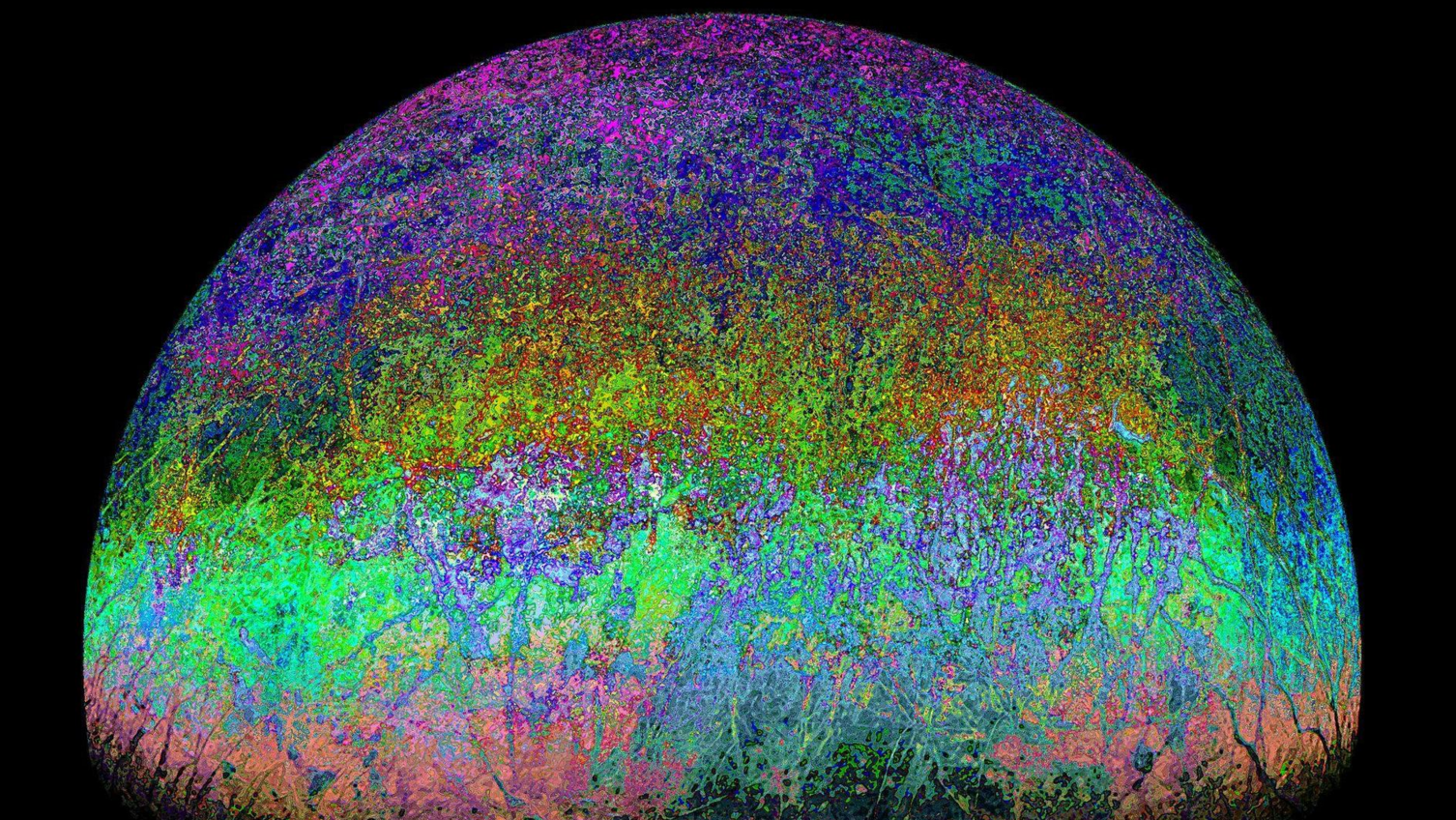 ©NASA/JPL-Caltech/SwRI/MSSS, Kevin M. Gill / Fernando Garcia Navarro CC BY 2.0
Da der Weltraum zunehmend zu einem umkämpften Schauplatz der Rohstoffgewinnung, Spekulation und Governance wird, wächst der Bedarf an kritischen Ansätzen, die den sich abzeichnenden Herausforderungen postplanetarer Zukünfte gerecht werden. Diese internationale Konferenz bringt Wissenschaftler*innen aus den Sozialwissenschaften, den Künsten, den Ingenieurwissenschaften und dem internationalen Weltraumrecht zusammen, um an den Grenzen des Planetaren zu denken, zu forschen und zu handeln.
Das Konzept des Postplanetaren umfasst die Verflechtung der politischen und ökologischen Systeme der Erde mit extraterrestrischen Prozessen in dreifacher Hinsicht: als kritische Perspektive, um zu untersuchen, wie sich die Beziehungen zwischen Erde und Weltraum neu konfigurieren; als zeitlicher Horizont, der durch das Anthropozän eröffnet wird und Klimazerstörung, Artensterben und spekulative Zukunftsszenarien jenseits dieses Planeten in den Blick nimmt; und als konzeptionelle Bewegung über die Erde als selbstverständlichen Bezugsrahmen für Politik, Ökologie und Gemeinschaft hinaus.
Zu den zentralen thematischen Schwerpunkten zählen aufkommende extraktive Ökonomien und ihre politischen Implikationen; Infrastrukturen der Weltraumnutzung über ihren gesamten Lebenszyklus hinweg, einschließlich Instandhaltung, Verfall und Reparatur; die Governance- und Rechtsrahmen, die den Zugang zum Weltraum und dessen Kontrolle bestimmen; sowie das koloniale und geopolitische Erbe, das postplanetare Vorstellungswelten sowohl übernehmen als auch neu gestalten.
Im Mittelpunkt der Konferenz steht eine situierte und empirisch verankerte Wissensproduktion, die dominante Narrative und konventionelle Unterscheidungen zwischen Erde und Weltraum, Oberfläche und Volumen sowie Nähe und Distanz infrage stellt.
Indem die Konferenz wissenschaftliche Beiträge mit multimodalen, praxisbasierten und künstlerischen Formaten – darunter Installationen, Performances und Filme – zusammenführt, schafft sie einen transdisziplinären Raum für Austausch.
Die Konferenz wird vom Forschungsprojekt „Ruins in Space, Sustainability, and Outer Space Imaginaries“ des KSA Climate Futures in Digital Cultures (Embracing Transformation), geleitet von Prof. Dr. Anna Lisa Ramella und ihrem Team Suzanne Schaaf, Rosa Areal M., Lotte Brauer und Kiera Scherer, ausgerichtet.
Programm
Wednesday 16 September
12.00 Registration
13.00 – 13.30 Welcome & Opening Remarks
Anna Lisa Ramella, Suzanne Schaaf, Rosa Areal M. (Leuphana U Lüneburg)
13:30 – 15:00 : Panel 1: Narrating | Curating | Enacting
Discussant: Daniel Irrgang, Climate Futures in Digital Cultures, Leuphana U Lüneburg
David (Jeeva) Jeevendrampillai (U Manchester): Curating Earth, curating world
Tara B. M. Smith (U Leicester): Lives Beyond Revelation: Cosmic Conduits and Alien Anthropologists in Spiritualism and Science Fiction
Felipe Cervera (UCLA): Terraformance
Hannah Schmalstich (U Vienna): IRIS-ing in and out: Narrating and performing the bounds of Europe through the IRIS2 satellite constellation
15:00 – 15:30 Coffee
15:30 – 17:00 Panel 2: Imagining | Speculating
Discussant: Juan F. Sálazar, Director Institute for Culture and Society, Western Sydney U
Veronika Nowak (Vienna): Imagining Cislunar Futures: A City on the Moon and its Postplanetary Society
Ingrid M. Tolstad, Aina Landsverk Hagen (U Oslo): The speculative space of feminist imaginaries: A science fiction literature intervention towards post-patriarchal ways of organizing society
Jan Beek, Céline Molter, Konstanze N’Guessan (U Mainz): Learning anthropology from our colleagues in speculative outer space
Jake Jansen (U of Texas, San Antonio): Planetary Life Support: Extraterrestrial Anticipation and the Governance of Hostile Environments
17:15 – 18:15 Workshops
Ralo Mayer (Vienna)
Space Acts: A multimodal arts-based approach to meteorites and space mining as un·Earthing
Stelios Lekakis (Ionian U, Corfu)
A Fanfare at the Edge of the World: Object Stories, Heritage Loss
18:30 Reception, Lecture & Exhibition (Kunstraum)
Michael Hirschbichler (HafenCity U Hamburg)
Contaminated Cosmologies: Red River – Red Planet
Thursday 17 September
09:00 – 10:30 Panel 3: Re|Learning
Discussant: Roger Norum, Environmental Humanities, U Oulu
Matjaz Vidmar (U Edinburgh): The (Place-)Making of Transplanetary Ecology [ONLINE]
Aaron Parkhurst (University College London): Let the Dancer Fly: Sweat Helmets, Skinsuits, Vibrations and Boundaries in 0g
Lauren Reid (U Leicester): Lobster Eyes and Petripods: Nonhuman Life and Planetary Estrangement in Space Research
Daniel Irrgang (Leuphana U Lüneburg): Cosmic Rays
10:30 – 11:00 Coffee
11:00 – 12:30 Panel 4: Making | Practicing
Discussant: Charlotte Bewick, Head of Science, Exploration and Space Safety Missions, OHB System AG
Feng Schöneweiß (MPIWG Berlin): Lunar Anthropocene with Chinese Characteristics
Pepijn Deroo (U Vienna): The spacecraft behind the screen: modelling as a meaning-making practice in space engineering
Helene Sorgner (U Vienna): “A taxi at the price of a bus ride”: Imagining and constructing the market for future European launchers
Natalie Treviño (Open University, Milton Keynes): Luna Roots: Practices of Everyday resistance to Lunar Colonialism [ONLINE]
Eleanor S. Armstrong (U Leicester): Misogyny and Space Research: A View from the Epstein Files
12:30 – 13:30 Lunch
13.30 – 15:00 Panel 5: Un|Knowing
Discussant: Bernhard Schmidt-Tedd, Honorary Professor for International Space Law, Leuphana U Lüneburg & former Head Legal Support, DLR Space Agency
Laura Bullon-Cassis (Graduate Institute Geneva): Accessing the Planet: UN Big Tech Partnerships and the Postplanetary Politics of Climate Adaptation
Anna Szolucha (Jagellonian U, Krakow): The Monsoon and the Magnet: Tactical Accuracy at the Trivandrum Observatory
Renne Vantola (Finnish Geospatial Research Institute / University of Lapland): A Space Debris Mitigation Ghost Story
Judith Lange (TU Berlin): Refiguring the Planetary through satellite constellations: Relational spatialities of the infrastructuring of orbital spaces
15:00 – 15.30 Coffee
15.30 – 16.30 Walk and talk
16.30 – 18.30 Panel 6: Audiovisual contributions (SCALA cinema)
Discussant: Suzanne Schaaf, Climate Futures in Digital Cultures, Leuphana U Lüneburg
Bethany Rigby (Goldsmiths, London): Surface Imaginaries
Sitraka Rakotoniaina (Central St. Martins, London): When Terrain Becomes Ground
Matthias de Groof (U Antwerp): Tantalum: Space colonization from the Congolese mine to Mars
Angelo Vermeulen (Delft U), Diego Maranan (U Philippines), Pieter Steyaert (U Copenhagen), Karine Van Doninck (U Bruxelles) and SEADS: Cultural Immortality and the Alien Other: A Video Essay on Space Settlement Imaginaries
7.30 Delegates Dinner
Friday 18 September
9:00 – 10:30 Panel 7: Re|Framing
Discussant: Rosa Areal M., Climate Futures in Digital Cultures, Leuphana U Lüneburg
Julia Bradley (U Exeter): A Gendered Analysis of Artemis II
Brad Tabas (Institut Polytechnique, Paris): The Constitution, and Constitutive Difficulties, of the Postplanetary Episteme
Anne W. Johnson (U Mexico City): Cosmic Diplomacy in the Ruins of the Planetary: The Autonomous International Space Agency as Postplanetary Critique
Anna Bark Persson (Uppsala): Straightening the Post-Planetary Future? Towards a Conceptualization of Space as Queer
10:30 – 11:00 Coffee
11:00 – 12:30 Panel 8: Governing | Postplanetary Politics
Discussant: Lesley-Jane Smith, President International Institute of Space Law (IISL) & Professor for International Economic Law (Em.), Leuphana U Lüneburg
Diliara Valeeva (U Amsterdam): For all humanity–or for those who can pay? Moral geographies of outer space exploration
Réka Patrícia Gál (TU Munich): Clocked in Space: Skylab and the Labour Politics of Communication in Orbit
Annika Pohl Harrisson (U Southern Denmark): Bordering More Than Space: UAP and Postplanetary Imaginaries
Christina Zschieschang (Bielefeld U): The Role of the Future in World Politics: A Study on the Case of Deep Space Exploration Politics
12.30 – 14:00 ECR focused Lunch
14:00 – 16:00 Business meeting SSOS network (Social Studies of Outer Space)
Anmeldung
Wenn Sie teilnehmen möchten, melden Sie sich bitte hier an: https://forms.office.com/e/T9fUF1qCMZ