
Dis/appearance and the Evidentiary Aesthetics of Satellite Imagery (Lila Lee-Morrison)
26. May
The Centre for Digital Cultures (CDC) invites you to the upcoming Climate Futures Talk “Dis/appearance and the Evidentiary Aesthetics of Satellite Imagery: The Repurposing of Satellite Images from Reconnaissance to Environmental Monitoring” by Lila Lee-Morrison (The Cooper Union, New York).
- Tuesday, May 26 / 2 – 4 pm / C40.530
- The event will be held in a hybrid format. If you’d like to join online, please contact us at cdcforum@leuphana.de to receive the login credentials.
- Registration is not necessary.
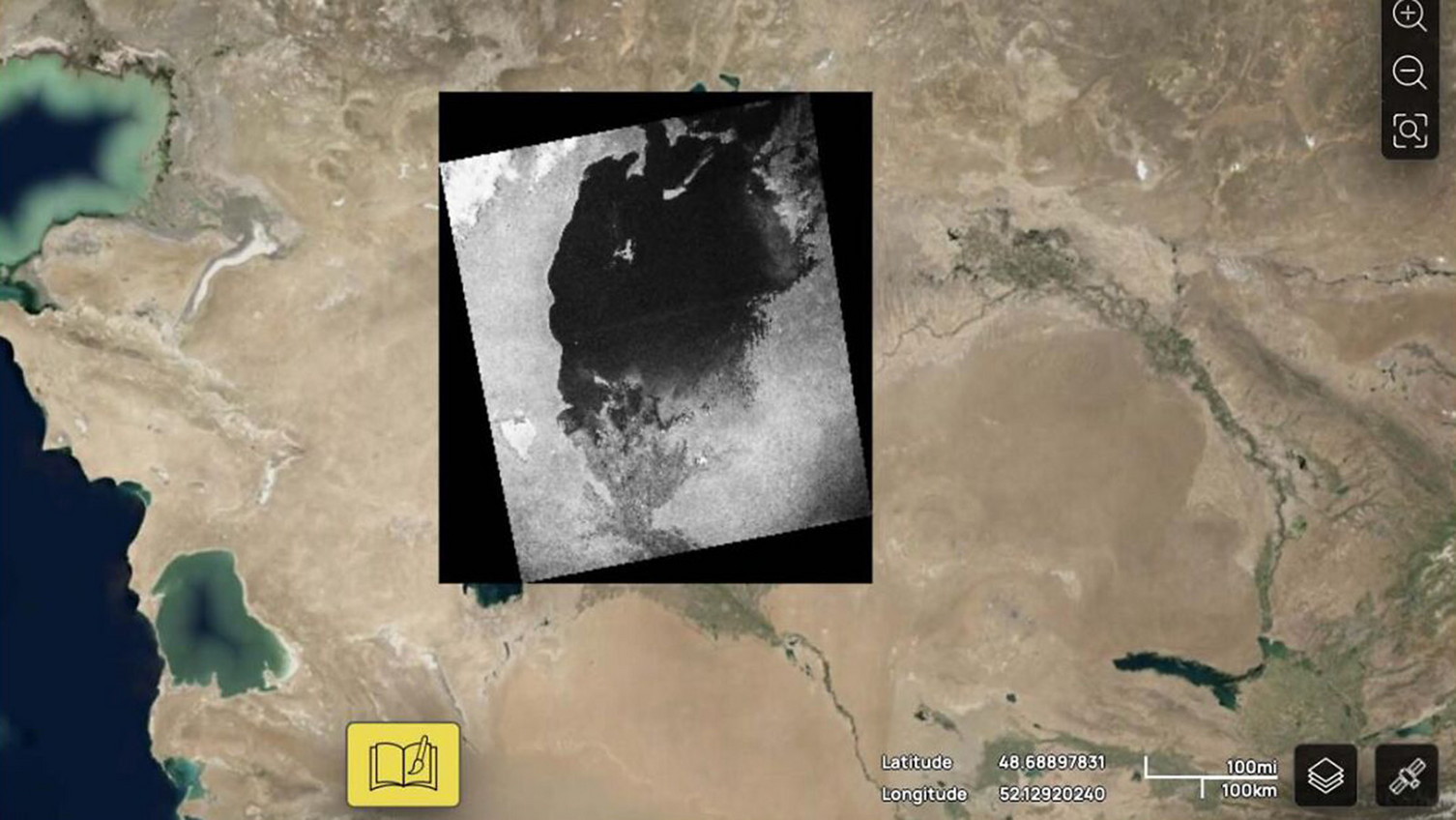
This lecture concerns a study on the emergence of previously classified, satellite reconnaissance images through the semantic lens of disappearance. Taken during a decade of the Cold War, these images were declassified through the MEDEA program in the 1990s and then repurposed within contexts of the earth sciences and environmental monitoring. Their declassification marked the sudden appearance of a trove of images that provided a new baseline for assessing the pace and scope of planetary change. This inquiry traces the evidentiary aesthetics of these images and their afterlives as they shift from the operational context of Cold War surveillance to scientific research and environmental monitoring. Through multiple registers of disappearance including modes of censorship by intelligence agencies, degradation of digital mediation, the visual logics and gaps of the before and after image and the depiction of the gradual loss of landforms, I argue that the repurposing of historical satellite data is generative of a satellite aesthetic, in which disappearance produces the very basis of appearance. This opens a discussion on the legibility of planetary landscapes and its mediatic entanglements between the technological and geological. The discussion concludes with the ways in which semantics of disappearance continues in a form in the present, with current geopolitics and modes of censorship of satellite data in contexts of climate science.
Lila Lee-Morrison(she/they) is a writer, scholar and art historian. Her research interests include investigating the visuality of contemporary technologies of machinic and algorithmic perception and the sociopolitical and cultural contexts of its application and material infrastructures. She is author of the book, Portraits of Automated Facial Recognition: On Machinic Ways of Seeing the Face (Transcript Verlag, 2019) and has published with MIT Press, Artforum, Liverpool University Press, and Distanz Verlag. She graduated a Ph.D. in Art History from Lund University and is based in Malmö, Sweden. She is currently an Associate Professor, Adjunct at The Irwin S. Chanin School of Architecture at The Cooper Union in New York.
An event organised in collaboration with the Centre for Digital Cultures and the research area Climate Futures in Digital Cultures