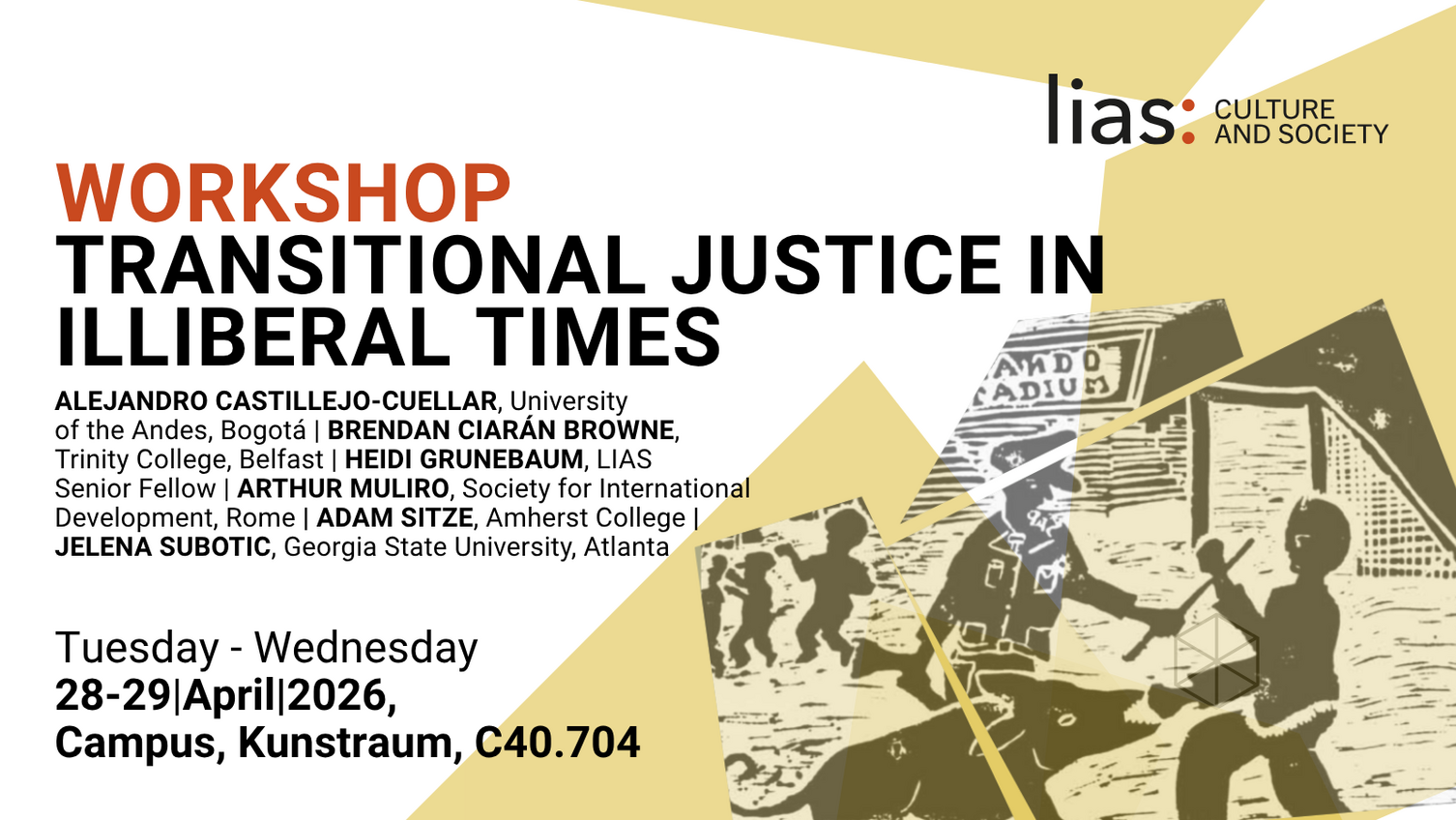
LIAS Workshop: "Transitional Justice"
TRANSITIONAL JUSTICE IN ILLIBERAL TIMES
28. Apr
LIAS Workshop with Heidi Grunebaum and Adam Sitze, Professor of Law, Legal Studies and Social Sciences, Amhurst College, MAss., LIAS Fellow Ini Dele-Adedeji and LIAS Senior Fellow Premesh Lalu
Date: Tuesday, 28 and Wednesday 29 April 2026
Ort: Campus, Kunstraum, Central Building, C40.704
Registration: lias.event@leuphana.de
The term “transitional justice” rose to prominence after 1995, when the United States Institute of Peace (USIP) published its three-volume series Transitional Justice (Kritz, ed). In the decades since and corresponding to the end of the Cold War and defeat of the Soviet Union, the field appeared to flourish. Scholars produced hundreds of dissertations and monographs exploring its core concepts, ethical dilemmas, and paradigmatic cases. Institutional entrepreneurs established well-funded centres in the epicentres of global commerce and knowledge. Activists and lawyers across the erstwhile West operationalized its frameworks across dozens of political and constitutional transitions, generating what some described as a “justice cascade.”
This expansion, however, was predicated on a number of conceptual blind spots. Transitional justice and its “enterpreneurs” (Madlingozi) rarely achieved self-consciousness about its own presuppositions as a field, most especially the end for which its various “mechanisms” were presumed to be means. During the 1990s and early 2000s, that end was largely taken for granted: transitional justice operated within a historiography which assumed that history would either bend, or could be made to bend, toward the goal of increasing respect for human rights, pluralism, openness, and tolerance. Wherever these terms predominated, there was little need for the field to define its core concepts with precision or rigor, for the meanings of both “transition” and “justice” were largely secured in advance by a broadly liberal and cosmopolitan teleology – one that occluded the structural historical conditions of inequity, for example, and marginalized alternative models and intellectual traditions of justice.
Beginning at least in the mid-2010s, however, this teleology began to come into question. Many established democracies have since witnessed the rise of what Marlene Laruelle (2020) defines as illiberalism: a thin but coherent ideology that positions itself as a permanent backlash against liberalism and embraces exercises of sovereign power in the name of majoritarian nationalism and cultural homogeneity. On these terms, “transition” need not culminate in liberal consolidation, and “justice” need not be tethered to cosmopolitan norms.
One question that presents itself at this juncture is what becomes of transitional justice when its animating teleology dissolves and its blind spots no longer occlude radical alternatives. Another, counterintuitively, is how might a certain illiberalism have been internal to transitional justice from the outset.
Transitional justice, after all, has often authorized departures from ordinary liberal legal norms in the name of political necessity. As a field, it has tolerated retroactive criminalization and creative reinterpretations of legality, embraced exceptional or hybrid tribunals detached from ordinary constitutional courts, justified lustration policies that restrict political participation without individualized criminal conviction, relied on expansive executive discretion in negotiating amnesties, endorsed truth commissions that trade procedural guarantees for narrative authority, and sometimes has subordinated due process, equal protection, and the presumption of innocence to the imperatives of semblances of historical reckoning and collective transformation.
Do these departures from liberal legal norms represent temporary, prudential suspensions in service of liberal restoration? Or do they reveal a deeper affinity between transitional justice and forms of sovereign exceptionalism more commonly associated with illiberal politics? If it’s true that transitional justice embraced the suspension of liberal legal norms as a means to the end of its own liberal and cosmopolitan ends, how then do we understand its relation to the exercises of sovereign power we witness today, which suspend those same norms for very different ends? To what extent, if at all, might the field’s self-confidence in its own liberal goals have obscured the ways in which it normalized some of the same extra-legal “mechanisms” that illiberal regimes have since appropriated for their own goals? To what extent, if at all, might the illiberalism of our present oblige us to rethink transitional justice itself? And might alternative conceptions of time and justice that are neither liberal nor illiberal yet be discerned in a moment of rising illiberalism?
This workshop seeks to excavate this predicament through provocations by and discussions amongst invited scholars and practitioners from across a number of settings in which late 20th century experiments with technologies of transitional justice have surfaced the questions raised above.
Kritz, Neil J., ed. Transitional Justice: How Emerging Democracies Reckon with Former Regimes. 3 vols. Washington, DC: United States Institute of Peace Press, 1995.
Laruelle, Marlene. “Illiberalism: A Conceptual Introduction.” East European Politics 36, no. 3 (2020): 303–327.
Madlingozi, Tshepo. “On Transitional Justice Entrepreneurs and the Production of Victims.” Journal of Human Rights Practice 13, no. 2 (2010): 209–226.
28 April
2–2:30 p.m.
Arrival and Listening to the Sound Installation “Murmurs, or the Scar of Nature”
Sound Installation by Alejandro Castillejo-Cuellar
Campus | C25 Kunstraum
2:30–3 p.m.
Introduction
Adam Sitze | Heidi Grunebaum (moderation)
Campus | C25 Kunstraum
3–3:45 p.m.
“Listening to the Trouble with Transitional Justice”
Discussion of the Sound Installation with Heidi Grunebaum
Campus | C25 Kunstraum
3:30–5:30 p.m.
PANEL I: “Propositions on Transitional Justice in Illiberal Times”
Adam Sitze (discussion lead)
Campus | C25 Kunstraum
29 April
9:30–11:30 a.m.
PANEL II: “On the Duration of Violence”
Alejandro Castillejo-Cuellar, University of the Andes, Bogotá
“Violence as Continuum: On the Rainforest’s Elusive Testimony”
Ini Dele-Adedeji, LIAS, Leuphana University Lüneburg
“Neither Victims Nor Perpetrators: Transitional Justice and the Collapse of Categories”
Campus | C40.704
12–1:30 p.m.
PANEL III: “On Time”
Arthur Muliro, SID, Rome
“On the Burden of History and the Foreclosure of Futures”
Campus | C40.704
2:30–4 p.m.
Brendan Cierán Browne, Trinity College, Belfast
“Transitional (in)justice and Enforcing the ‚peace‘ on Palestine”
Campus | C40.704
4:30–6 p.m.
PANEL V: “On Restitution”
Jelena Subotic, Georgia State University, Atlanta
“Global Politics of Restitution in Illiberal Times”
Campus | C40.704
6:30–7:30 p.m.
Concluding Reflections
Adam Sitze | Heidi Grunebaum (moderation)
Campus | C40.704