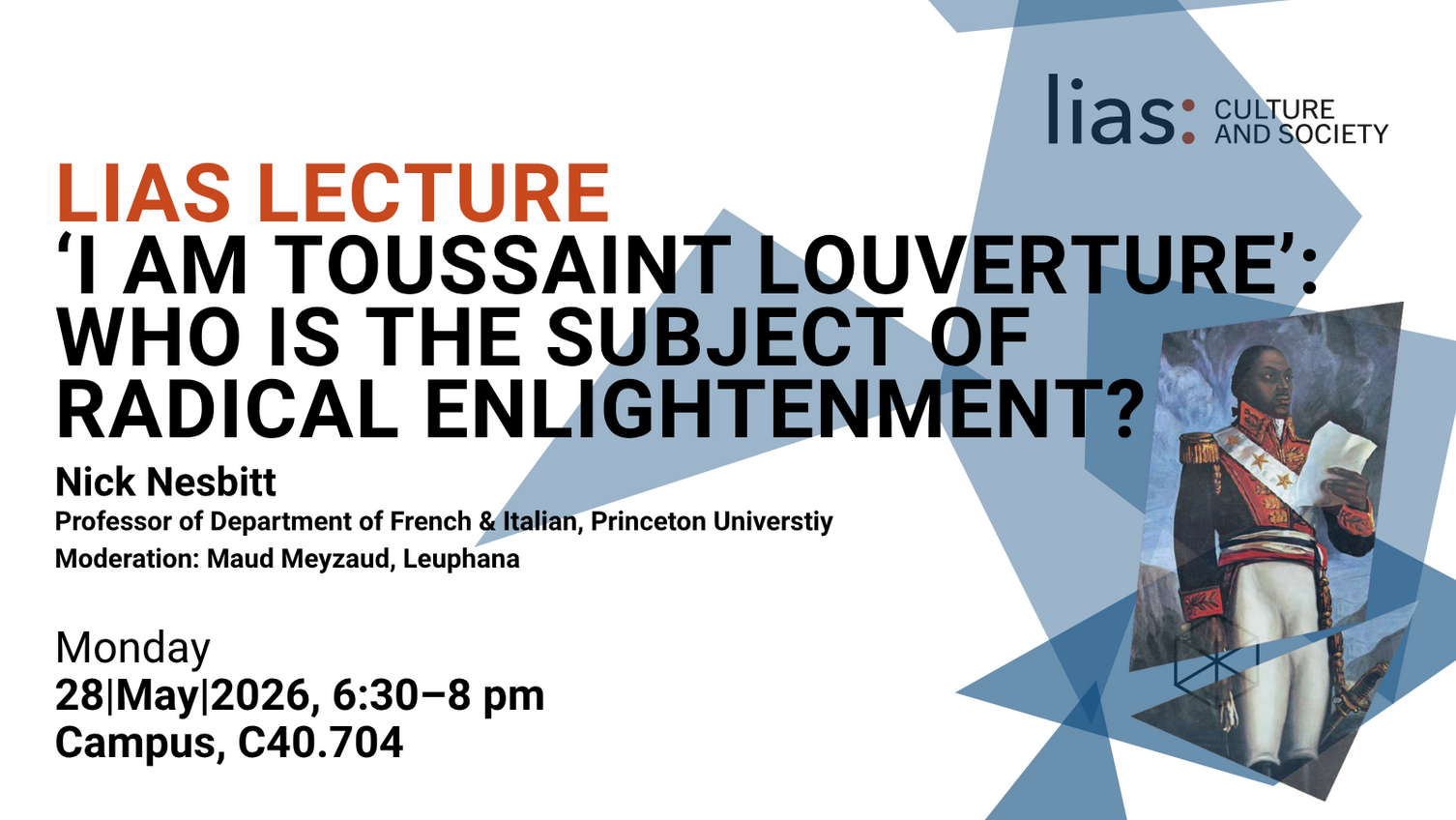
LIAS Lecture: "'I am Toussaint Louverture': Who is the Subject of Radical Enlightment?"
28. May
Nick Nesbitt, Professor, Department of French & Italian, Princeton University | Maud Meyzaud, Professor German and Comparative Literature, Leuphana (Moderation)
Date: Wednesday, 28 May 2026, 6–8 p.m.
Location: Campus | Central Building | C40.704
The Radical Enlightenment was arguably initiated in the Malian Mande Charter of 1222, which asserted centuries before the English, American, and French Revolutions the universal right of all human beings to be free from enslavement. In a second moment, Spinoza’s Ethics of 1677 asserted, against the incipient concept of natural right, an ethics of human beatitude and social existence beyond all moralism of good and evil. This Spinozist Radical Enlightenment was in turn first actualized, if all too briefly, in the 1793 Jacobin revolution and its never-adopted constitution. I wish to argue in this talk, however, that it was only with the coming of Toussaint Louverture and the Haitian Revolution (1791-1804) that the promise of this Mande-Spinozist- Jacobin Radical Enlightenment first fulfilled its promise as universal emancipation.
For it was only in 1793, in St. Domingue, that Toussaint Louverture famously announced, in the wake of the initial slave uprising of August 1791, that the political struggle of the former slaves, in whose name he spoke, was not for the particular rights of some, for a continuation of the politics of caste and privilege, but for the general, even universal abolition of slavery for all, a promise that was first actualized with the creation of the Haitian state on January 1, 1804. For all its force and originality, however, this radical insurgency remained at every moment subject to the demands of global capitalism, first manifest in the labor proclamations of Sonthonax and Louverture, and subsequently in Henry Christophe’s Code Henry. In the context of continued and even reinforced Atlantic slavery and expanding global capitalism, to sustain real freedom from enslavement—the world-historical accomplishment of the Haitian Revolution—immediately required the production of cash crops (i.e., sugar) to bankroll a fragile post-slavery state. The freedom of the Haitian radical enlightenment thus immediately foundered upon the neo-slavery of global capitalism and the antagonism of surrounding slave states, in a Haitian dialectic of Radical Enlightenment that continues into the present.