
The AI-powered search assistant
Leuphana relies on innovative and at the same time responsible technologies to continuously improve its digital services for students, staff and visitors. The new AI search assistant answers your questions about studying, deadlines and university procedures in full sentences, directly on the website and based exclusively on the official Leuphana pages.
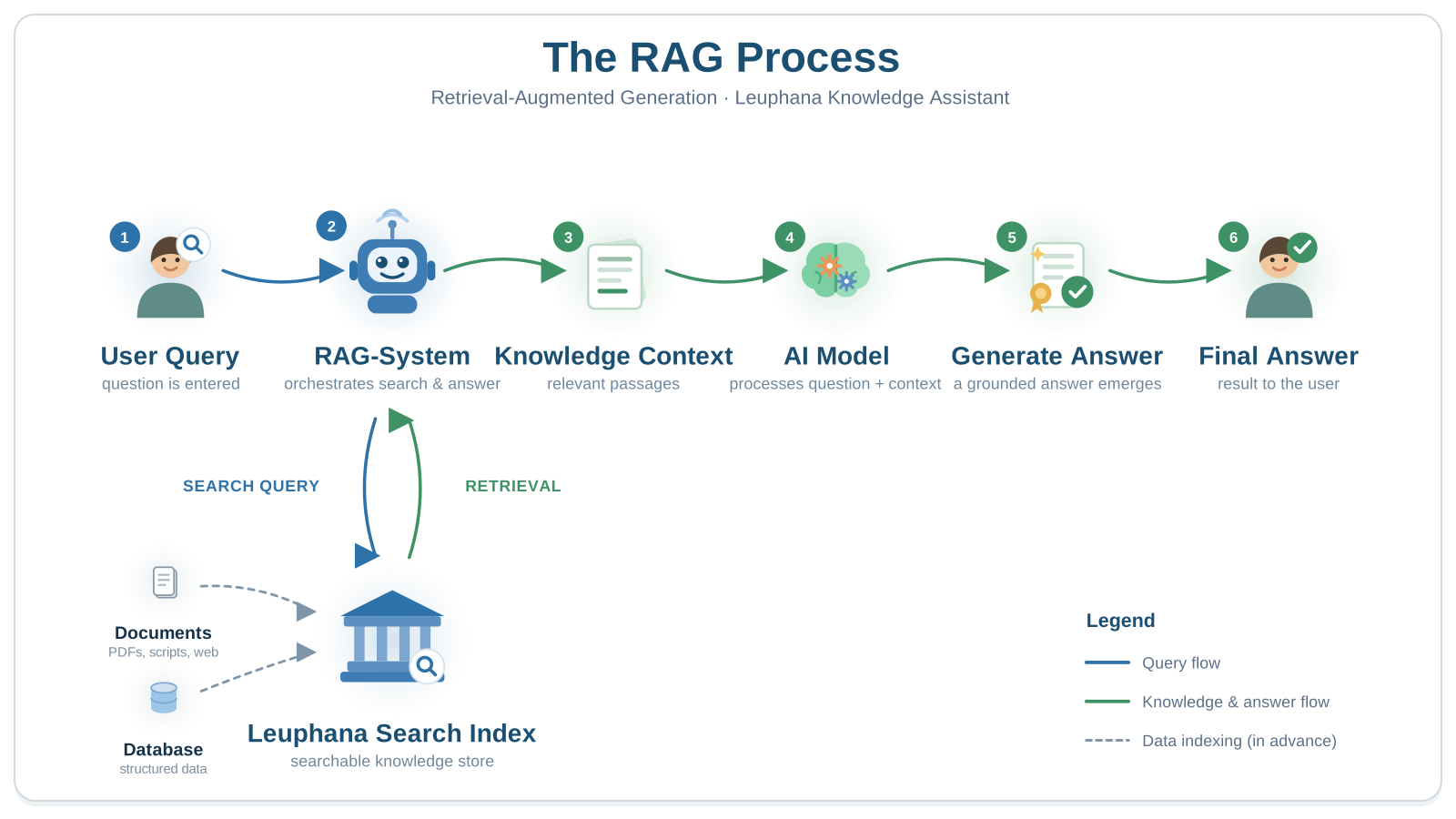
How does the assistant work?
To make sure the system does not invent any false information (so-called hallucination), it is based on the innovative RAG method (Retrieval-Augmented Generation) combined with our university's own search technology (Apache Solr).
The principle is simple: for every query, the system searches the official, publicly accessible university web pages for matching passages within milliseconds. A modern AI model hosted in Germany reads this knowledge context and formulates an easily understandable answer from it. To answer questions, the assistant uses exclusively the publicly accessible content of the Leuphana website.
FAQ
Well-known AI chatbots usually base their answers on knowledge they have memorised from across the internet. This can sometimes lead them to give outdated information or, in the worst case, simply invent facts (this is called hallucination).
Our assistant instead uses a method called RAG (Retrieval-Augmented Generation). The AI is not allowed to simply guess freely:
- Search first: When you ask a question, the system first searches the official university web pages for the answer.
- Binding basis: These original texts are then given to the AI as a binding basis of knowledge.
- Formulate the answer: The AI reads this text and formulates an easily understandable, direct answer from it. So it only knows what we provide from the official sources at that moment.
Protecting your data is our top priority:
- Secure hosting in Germany: Your questions are processed exclusively in strictly secured, data-protection-compliant data centres in Germany. No data is forwarded to servers outside the EU.
- No AI training: The system is configured so that the AI model is not trained on your input. Your questions remain confidential.
- Public data only: The assistant does not read any protected content. It only accesses information that is freely and anonymously available on the internet anyway. The intranet and protected areas are completely off-limits to the AI.
- Data sovereignty: The AI service we use runs in data centres in Germany and is subject to German and European law. It is audited against recognised security standards (including ISO 27001 and the German BSI Cloud Computing Compliance Criteria Catalogue, C5) and relies on open technologies to avoid dependence on individual providers.
That can happen. The assistant automatically summarises the content it finds and may misunderstand or shorten a point in the process. That is precisely why it is labelled as “beta”:
- Verifiable: For each answer, it names the original pages used and notes that the answer is AI-generated.
- Check important details: For topics such as deadlines, amounts or applications, please do not rely on the summary alone, but follow the linked sources.
The assistant uses a method called RAG (Retrieval-Augmented Generation). This means the AI can only generate answers based on the documents and information made available to it:
- Gap in the knowledge base: If a topic is missing, is incomplete, or uses outdated terms, the assistant cannot build a suitable answer from it.
- No invented facts: Ideally, it does not invent any facts, but instead tells you that it could not find any information on the topic.
A search index works essentially just like the keyword index at the back of a thick reference book:
- Why an index? If the system had to search all of the university's thousands of web pages live for every question, an answer would take far too long. That is why a background program regularly reads in all pages and stores the words in sorted order in a lightning-fast database, the so-called index.
- Apache Solr: is the name of the university's own search technology that manages this index. Solr is, so to speak, the assistant's library service: it finds exactly the text passages on the university pages that match your question within milliseconds and passes them on to the AI.
The assistant understands and answers in German and English. Simply ask your question in the language in which you would like to receive the answer.
No, quite the opposite. As a public institution, we use our resources carefully. The assistant has been deliberately built to run very cheaply:
- Only what is actually used: There are no fixed monthly or licence fees. Billing is based solely on the amount of text actually processed. If the assistant is not used, no costs arise.
- Very low cost per answer: A single answer costs us only about 0.15 to 0.30 cents. That means: 100 questions cost around 20 cents in total, 1,000 questions about 2 euros.
- Free for repeated questions: Many questions recur. Once answered, a question is cached and costs nothing the next time.
Overall, the running costs remain very low and are capped at a fixed upper limit.
The system is protected against this too. Several automatic safeguards ensure that neither individual users nor automated waves of requests can overload the system or cause unnecessary costs:
- Rate limiting: A very large number of requests in a very short time is automatically throttled. This is typical of bots and untypical of real people.
- Daily cap: The total number of answers per day is capped, so costs remain fixed even in the event of an attack.
- Length limit: Every answer has a maximum length. No one can force the system to generate pages of text.
For security reasons, we deliberately do not state the exact thresholds.
Yes. The assistant deliberately started as a “beta” and is being continuously improved, especially in terms of speed and answer quality. Planned improvements include:
- Better semantic search: so that the assistant finds the right thing even when you use different words from those on the website.
- Follow-up questions: the option to ask follow-up questions in a conversation without having to rephrase your question.
- Even better AI models: we regularly test new models and providers to make answers even more accurate and faster.
Your feedback helps us with this. Feel free to write to us at websupport@leuphana.de.