
LIAS Conference: "From the Global to the Planetary"
01. Jul
Concept and organization: LIAS Faculty Fellow Vera-Simone Schulz. The symposium is dedicated to the recent theoretical shift in the humanities and social sciences from the global to the planetary. It brings together scholars from the humanities and social sciences as well as artists and architects to jointly discuss the turn toward the planetary in these fields. Its aim is to foster dialogue between different disciplinary perspectives, to sound out new research approaches, and to create a space for future collaborations across disciplinary and continental boundaries.
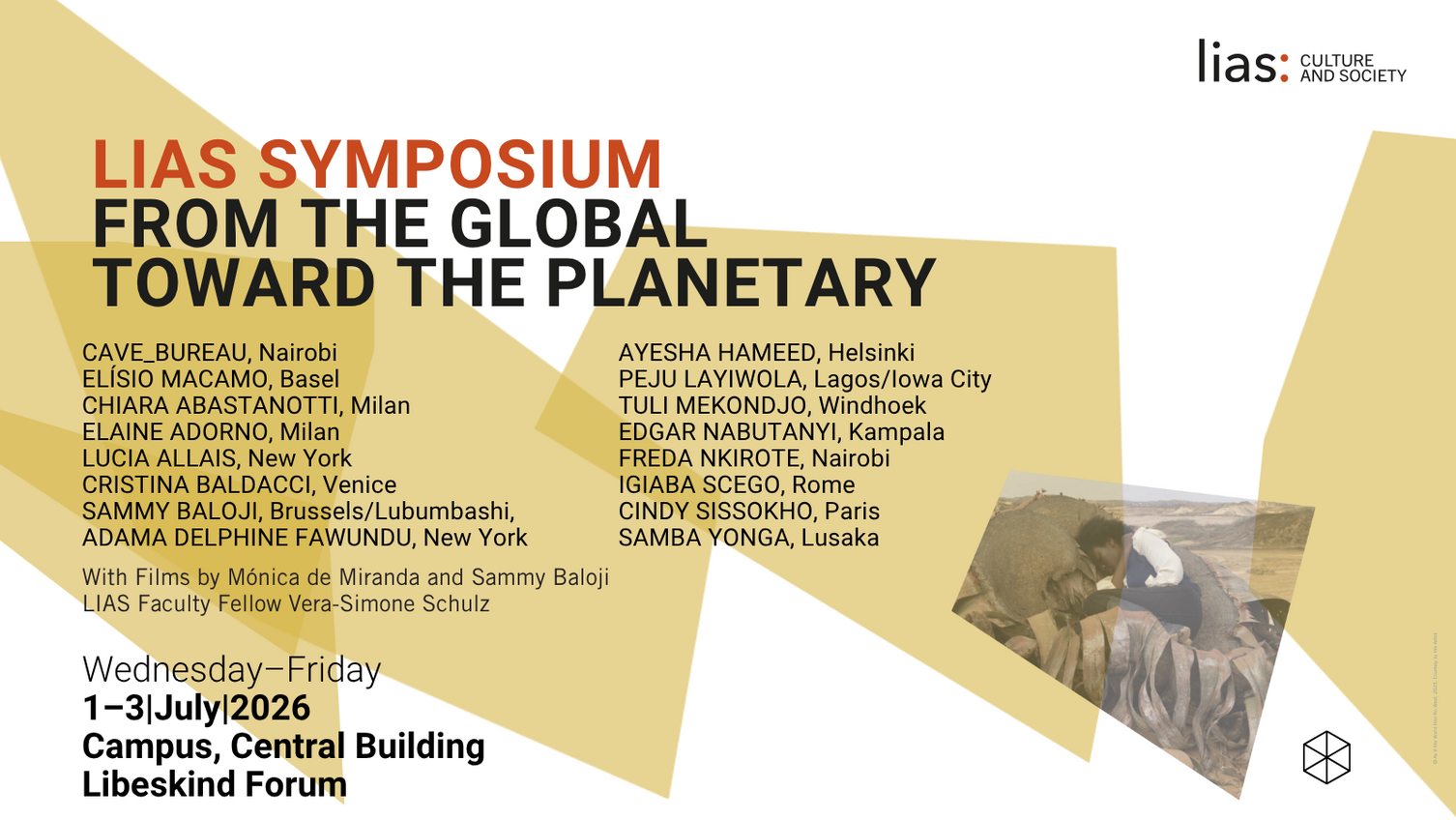
Wednesday, 1 to Friday, 3 July 2026
Campus | Central Buildung Libeskind Forum
The symposium is dedicated to a recent theoretical shift in the humanities and social sciences: the movement from the global to the planetary. It takes as its starting point the observation that research approaches with a global outlook have made a crucial contribution to questioning nationalisms and Eurocentric canons, while at the same time raising new questions about the limits of global models of thought. The symposium proceeds from the assumption that the debate on the planetary offers a productive framework for renegotiating these questions.
The planetary is understood here as an epistemic orientation that foregrounds Earth systems, material entanglements, more-than-human relations, and deep time. Since understandings of the planetary are by no means uniform across and within disciplines, different positions and conceptual approaches are explicitly invited for discussion.
The symposium will center approaches from the planetary humanities and the planetary social sciences in dialogue with art history, architecture, critical museology, and the arts. The discussion will address how the objects, methods, and scales of these fields change when planetary ecologies, material and immaterial infrastructures, and long-term environmental transformations are given greater weight. What new perspectives emerge for the analysis of artistic and architectural practices? How can colonial afterlives, extractive processes, and environmental change be examined within planetary constellations? And what possibilities, but also what limits, does the turn to the planetary offer?
Particular attention is given to concepts and fields of research such as the Blue Humanities, posthumanist and more-than-human approaches, as well as debates surrounding the Anthropocene, stratigraphies, toxicity, and environmental justice from an interdisciplinary perspective.
At the same time, the symposium asks about the normative and political implications of planetary perspectives. To what extent can they contribute to a critical reflection on established orders of knowledge? What role do concepts such as epistemic violence, relational ethics, or climate and social justice play in this context? And how can global, colonial, and ecological entanglements be rethought without losing sight of on-going power asymmetries?
The symposium brings together scholars from the humanities and social sciences as well as artists and architects. Its aim is to foster dialogue between different disciplinary perspectives, to sound out new research approaches, and to create a space for future collaborations across disciplinary and continental boundaries.
Programme
Wednesday, 1 July 2026
10–10:30 a.m.
Vera-Simone Schulz, LIAS Faculty Fellow
Welcome and Introduction
10:30 a.m.–12 p.m.
Keynote Lecture
cave_bureau (Kabage Karanja | Stella Mutegi), Nairobi
“Eulogy to Architecture: Return to Earth Spirit Practices”
1–1:45 p.m.
Film Screening
As If the World Had No West
Director: Mónica de Miranda, 2024
1:45–2:30 p.m.
Cindy Sissokho, Paris
“Affective Ecologies: Bodies as Territories in the Work of Mónica de Miranda”
3–4:30 p.m.
Panel I: More-Than-Human Worlds and Multi-Species Memories
3–3:45 p.m.
Cristina Baldacci, Ca’ Foscari University of Venice
“The Planet’s Memory: Deep Time and More-Than-Human Archive”
3:45–4:30 p.m.
Chiara Abastanotti, Milan | Igiaba Scego, Rome
“Children of the Forest: A Graphic Novel about Early Italian Colonialism”
7–10 p.m.
Film Screening
The Tree of Authenticity
Director: Sammy Baloji, 2025
SCALA Arthouse Cinema | Apothekenstraße 17 | 21335 Lüneburg
Thursday, 2 July 2026
10 a.m.–12:30 p.m.
Joint Visit to the Kunstkammer at Museum Lüneburg with Ulfert Tschirner, Museum Lüneburg (speakers only)
2–2:45 p.m.
The Tree of Authenticity (2025)
A Conversation with Sammy Baloji, Brussels | Lubumbashi
3–4:30 p.m.
Panel II: New Relational Ethics: From Object-Centred to People-Centred Approaches
3–3:45 p.m.
Peju Layiwola, University of Lagos
“Shards of History: Thinking Beyond Benin Art as Objects”
3:45–4:30 p.m.
Samba Yonga, Women’s History Museum Zambia
“From Petrified Archive to Living Knowledge: Liberating Colonial Collections Through Museum Practice and Epistemic Repair”
4:45–6:15 p.m.
Panel III: Performing Planetarity
4:45–5:30 p.m.
Tuli Mekondjo, Windhoek
“In the Struggle”
5:30–6:15 p.m.
Elaine Adorno, Milan | Ivna LaMart, Milan
“ORI: A Ritual Cartography of Belonging”
6:30–8 p.m.
Keynote Lecture
Élisio Macamo, University of Basel
“From Eurocentrism to Planetary Responsibility: Toward an Ethics of Intelligibility”
Friday, 3 July 2026
9–11:15 a.m.
Panel IV: Earthly Stratigraphies, Seabeds, and Planetary Archives
9–9:45 a.m.
Freda Nkirote M’Mbogori, The National Museums of Kenya | Paul Jeremy Lane, University of Cambridge
“Beyond the Anthropocene: Relational Landscapes and Indigenous Environmental Knowledge in Eastern Africa”
9:45–10:30 a.m.
Adama Delphine Fawundu, Columbia University
“Vibrations from the Deep: Ancestral Wisdom and Art Making”
10:30–11:15 a.m.
Ayesha Hameed, Goldsmiths, University of London | University of the Arts Helsinki
“An Oceanic Grammar”
11:45 a.m.–1:15 p.m.
Panel V: The Planetary in Relation to Architecture, Infrastructures, and the Built Environment
11:45 a.m.–12:30 p.m.
Lucia Allais, Columbia University
“Inflating the Late Colony: The ‘Bubble Homes’ Experiment in Dakar, ca. 1950”
12:30–1:15 p.m.
Edgar Nabutanyi, Makerere University
“Literary Activism, Fresh Registers and Uganda Ecological Crises Public Discourses”
2:15–3:30 p.m.
Final Remarks and Outlook
“From the Global Toward the Planetary Humanities”