
M.Sc. Sustainable Chemistry: How coffee waste is turned into cosmetics
2025-12-03 Chemical engineer Adnan Akin Akcay is optimising the extraction of valuable raw materials from coffee products at a Danish biotech company. He is benefiting from the knowledge he gained during his part-time studies at Leuphana Professional School.
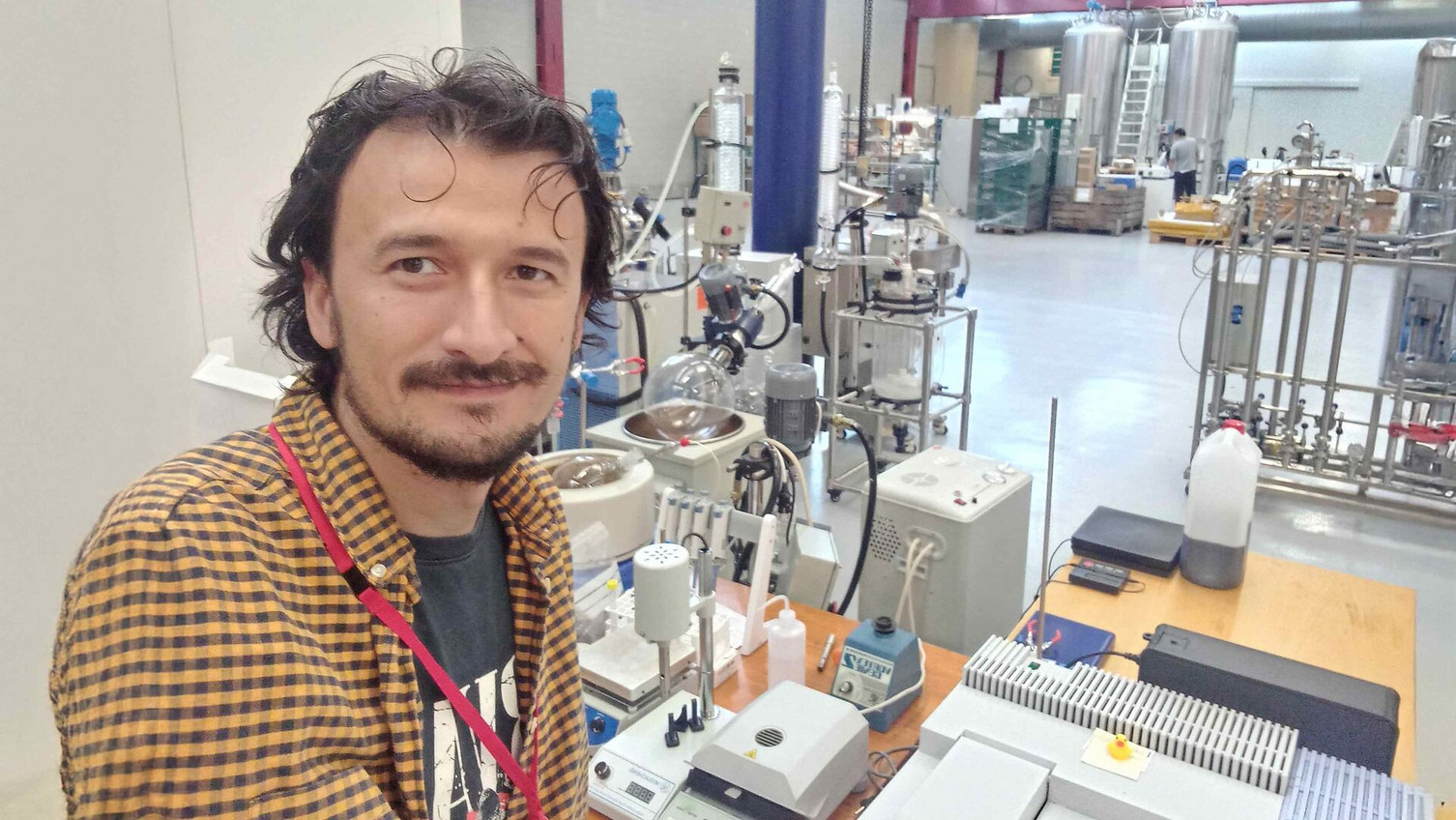
According to estimates, up to 40 million tonnes of coffee bio-waste are produced worldwide every year – a raw material reservoir that has hardly been exploited to date. ‘These organic residues contain valuable ingredients that can be reused in the cosmetics industry, for example,’ explains Adnan Akin Akcay.
The Turkish chemical engineer is Chief Technology Officer (CTO) at a Danish biotech company that specialises in the recycling of coffee waste. Using chemical extraction processes, he extracts lipids, polymers and carbohydrates from residues originating from roasters or cafés, for example.
The company is supported by public research funds, but has also long since achieved commercial success: for example, it developed a coffee-based shampoo for a cosmetics manufacturer in Hamburg. During a visit to Germany, Adnan Akin Akcay heard about the part-time Master's programme in Sustainable Chemistry at the Leuphana Professional School.
‘The content fits perfectly with what I do at the company,’ says Adnan Akcay. ‘I was particularly impressed by the Benign by Design approach – designing chemicals to be environmentally friendly from the outset. Just because a product is made from sustainable raw materials does not automatically make it sustainable. It may not be biodegradable, for example. That's why we as chemists have to keep an eye on the entire system.’
In the part-time master's programme, Akcay is not only deepening his knowledge of sustainable product development, but also of economic and regulatory issues. One important tool he learned about at Leuphana Professional School is life cycle assessment (LCA). ‘We have calculated that our coffee oil – which can replace argan oil in the cosmetics industry – has a significantly lower carbon footprint because we only use waste.’
But the potential of coffee is even more diverse: ‘The remaining sugar can be used as fertiliser,’ explains Adnan Akcay: ‘The released carbohydrates, especially mannose, improve the root chemistry of plants and promote their nutrient uptake.’
In his studies, he also deals with regulatory systems and sustainability standards. ‘Sustainable chemicals also need supportive legislation,’ he says. The European REACH regulation in particular plays a central role in this: ‘Many solvents, such as hexane, are cheap but not sustainable. We have therefore tested alternatives such as bioethanol.’
Adnan Akcay will soon complete his studies and draws a positive conclusion: ‘There is actually no course content that I have not been able to apply in my work,’ he emphasises, continuing: ‘From laboratory practice to stakeholder analysis to business models – the knowledge I have gained from my studies helps me to think sustainably about the entire value chain.’
In his master's thesis, he will soon be researching circular economy models for coffee waste and their sustainable impact. The exchange with students from all over the world who work with wood or food waste, for example, inspires him even more. ‘We learn from each other how to create new value from waste.’
The Danish company works with hotels, for example: they deliver their coffee waste and in return receive hand soaps, cleaning products or cosmetics made from precisely these residues. ‘This way, guests can see directly that waste can be turned into something valuable,’ explains Akcay.
He wants to use his knowledge to initiate sustainable projects across Europe – for example, in his native Turkey: ‘Olive oil production and fig cultivation also generate large amounts of organic waste. They are full of valuable raw materials.’