Critical Studies MA.: Linn Felgendreher: Living Experiences
2026-07-09 The 26-year-old is a research intern at the Museum of Modern Art (MMK) in Frankfurt. She attributes landing this coveted position not only to her college degree: “Grades are important, but in the end, the experiences you’ve gained also count.” Leuphana opened up numerous opportunities for her to gain that experience. Prospective students can apply for the master’s program “Cultural Studies: Critical Studies” until August 31, 2026.
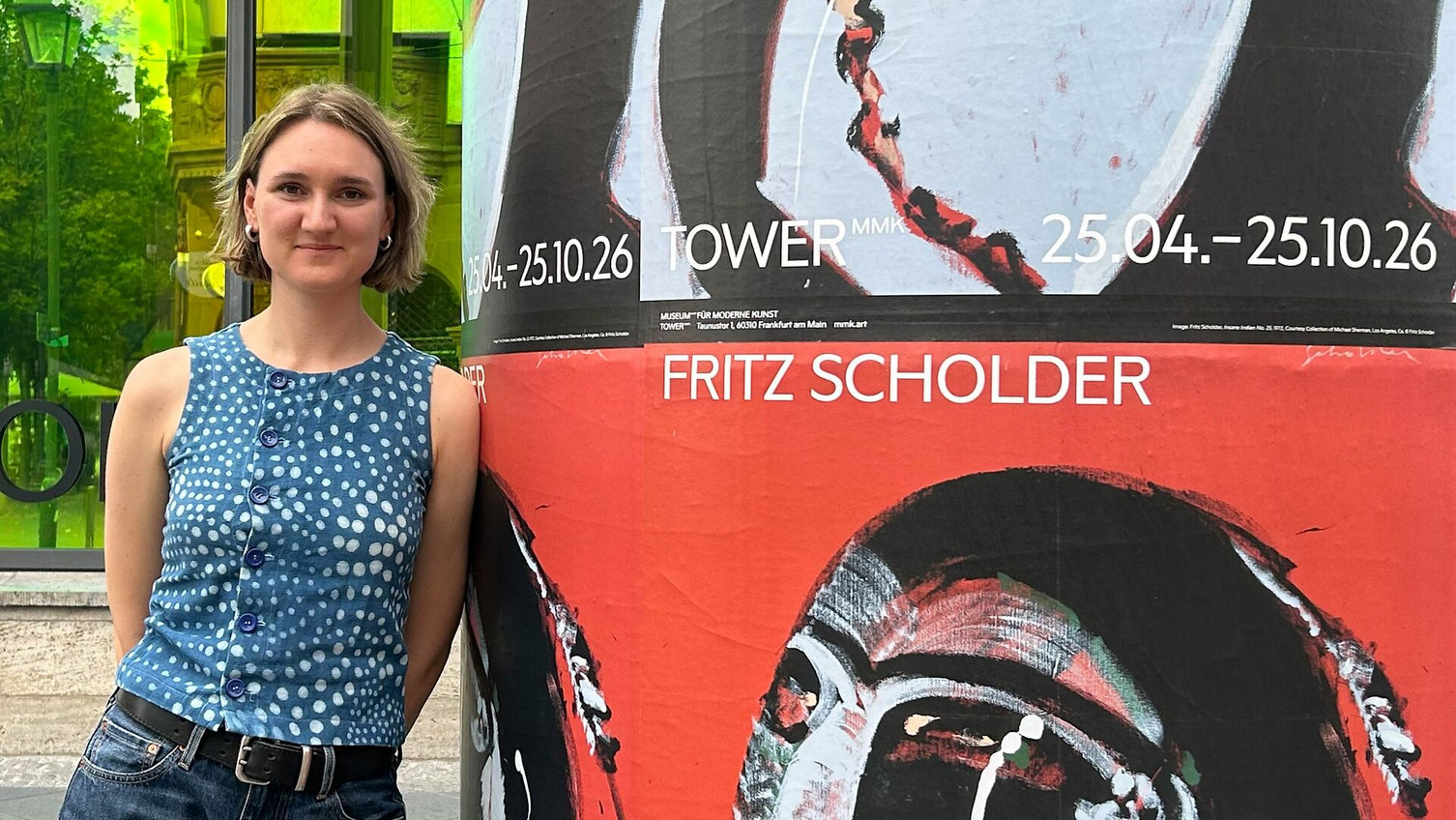
“I felt that at Leuphana, I wasn’t just studying—I was also able to explore what interested me,” says Linn Felgendreher about her time as a student in Lüneburg. One particularly formative experience was her work at the Leuphana Institute for Advanced Studies (LIAS). There, she supported international scholars and artists during their research stays. The fellows come from all over the world. “I helped them settle in and also co-organized lectures and conferences. Through this, I learned how academic work is organized and how much planning goes into international research projects.”
“I’m now benefiting greatly from those experiences,” says Linn Felgendreher. As a research intern at the MMK Frankfurt, she works in the Collections and Exhibitions department. There, her responsibilities include cataloging artworks, organizing international loans, and preparing exhibitions. She finds working directly with the artworks themselves particularly exciting. “You’re not just dealing with the objects, but also with the big questions behind them: How do you document a performance? How do you evaluate a work of art that consists of an idea and not just a physical object?”
After graduating from high school in Erlangen, she moved to Rome, where she studied communication sciences. But despite some courses in cultural studies and film, she still felt she hadn’t found the right path. “I realized that I didn’t want to go into marketing or traditional media careers. I was more interested in philosophical and artistic questions,” she explains, and began searching for a suitable degree program: She was particularly drawn to the interdisciplinary nature of the master’s program “Cultural Studies: Critical Studies” at Leuphana University in Lüneburg. “I wanted to reorient myself academically. At Leuphana, I had the opportunity to combine different perspectives.” With a focus on “Arts, Theory, and History” as central perspectives in cultural studies, the master’s program “Cultural Studies: Critical Studies—Arts, Theory, History” combines the analysis of artistic productions from historical perspectives with a cultural history of knowledge.
Impressed by the program, Linn Felgendreher moved from Italy to northern Germany: “I deliberately chose an apartment in Lüneburg so that I could participate as much as possible in university life .” She was active in the student initiative ArchipelagoLab, worked as a student assistant not only at LIAS but also at the Center for Critical Studies (CCS), and spent countless hours in the university library.
She also gained practical experience in the field of contemporary art early on. Together with her fellow student Sophie McCuen-Koytek, she curated the exhibition *SapphicEntanglements* as part of the peer-to-peer program at Leuphana’s Kunstraum. The exhibition featured works by young artists and explored issues of gender, identity, and relationships.
Through Leuphana’s International Center, she spent a semester abroad at the American University of Beirut in Lebanon. “Beirut has an incredibly vibrant cultural scene. The city made a big impression on me.”
Linn Felgendreher gained further international experience at a summer school in Azerbaijan funded by the German Academic Exchange Service (DAAD), as well as during a three-month internship at the Goethe-Institut in Dakar, Senegal. “I simply tried to take advantage of as many opportunities as possible. Each of these experiences broadened my perspective.”
Her master’s program laid the theoretical foundation: “I found what I was looking for. The theoretical breadth of the program was a huge asset for me. I was able to integrate different approaches: from art history and philosophy to postcolonial and cultural studies perspectives. The experiences I gained during my studies—through study abroad programs, projects, and my work at the university—have opened many doors for me.”