
dies academicus 2026: Prof. Dr.-Ing. Ghada Bouattour receives the Leuphana Early Career Researcher Award
2026-09-04 The Leuphana Early Career Researcher Award recognises the academic achievements of the assistant professor of Measurement Technology and Sensor Technology in Production Engineering, her leadership of research projects, her international network and her contribution to smart and sustainable technologies. Her research makes important contributions to resource-efficient and sustainable production and technology systems.
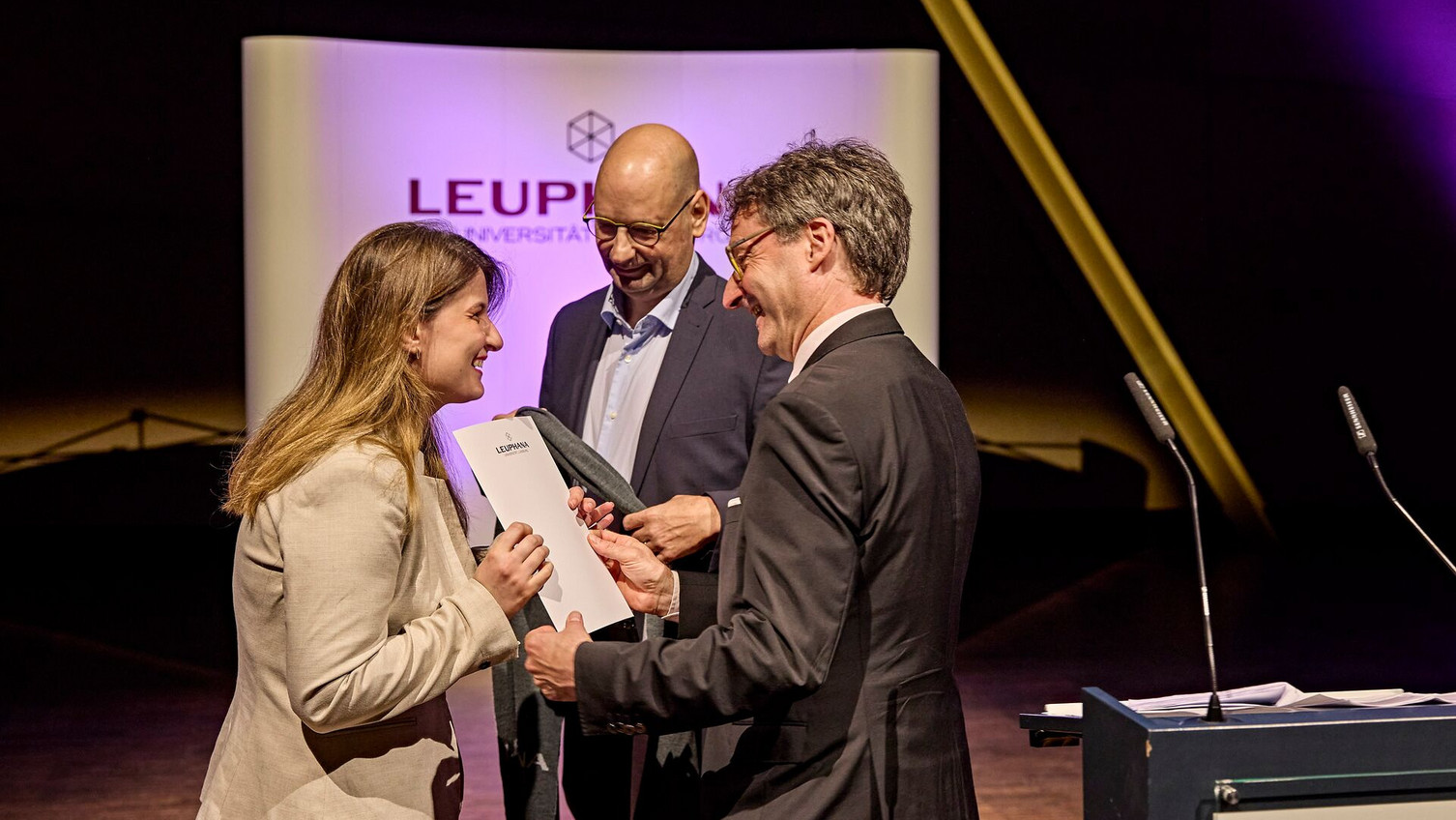 ©Brinkhoff-Moegenburg/Leuphana
Since her appointment at Leuphana in November 2023, Prof. Dr.-Ing. Ghada Bouattour has established an internationally recognised research profile in the fields of measurement and sensor technology, wireless power transmission and intelligent systems. Her research and international collaboration activities have been funded by programmes run by the German Academic Exchange Service (DAAD), the German Research Foundation (DFG), the Federal Ministry for Economic Affairs and Energy, and the European Union.
“The Early Career Researcher Award means a great deal to me, particularly as I have only been working at Leuphana for three years. During this time, I have been able to develop my own research focus whilst learning from colleagues across various disciplines and working closely with partners from industry. For me, research is a continuous process of learning, exchanging ideas and translating them into solutions that can make a meaningful contribution to both industry and society. I am very grateful to my team, my colleagues, the university and, in particular, my family for their support. This award motivates me to continue developing new ideas and breaking new ground.”
Bouattour’s research combines measurement and sensor technology, wireless power transmission, energy efficiency and AI-supported system development. Her work centres on the question of how technical systems can utilise information and energy more efficiently. Sensors provide information about their surroundings, wireless technologies enable flexible energy and data transmission, and artificial intelligence can help systems interpret information and respond to changing conditions.
Three current projects illustrate how these research findings are being put into practice. In the DFG-funded ‘Wi2M’ project, Bouattour is investigating adaptive wireless charging systems with multiple coils that balance energy efficiency, flexibility and computational effort. The ‘Wireless25’ project, funded by the Federal Ministry for Economic Affairs and Energy, is investigating how thermal management can be efficiently optimised when the power output during wireless charging rises to 25 watts. The EU-funded collaborative project ‘REWIRE’ is developing reconfigurable and battery-free sensor solutions for existing production machinery, combining wireless power and data transmission with AI-supported condition monitoring and predictive maintenance. Together, the projects link fundamental engineering questions with applications for more efficient and sustainable production.
Bouattour’s research builds on the solid foundation of her academic career: she studied electrical engineering at the École Nationale d’Ingénieurs de Sfax in Tunisia and completed her master’s degree in embedded systems. In 2021, she obtained her PhD in Electrical Engineering from Chemnitz University of Technology, gaining specialist knowledge in the fields of inductive power transfer, embedded systems and smart metering technologies. At Leuphana, she was able to further expand this expertise in the areas of smart sensor technology, data analysis and production systems.
Artificial intelligence is increasingly complementing this work by helping sensor systems to interpret complex information, recognise patterns and respond to changing conditions. For Bouattour, its value lies in strengthening the link between physical systems, sensor technology and intelligent decision-making.
Collaboration in research is equally important to Bouattour. Through interdisciplinary work and collaboration with international partners and those from industry, she is able to bring together different areas of expertise whilst maintaining the practical relevance of her research to technological challenges. She also describes her project work as a form of integration: developing ideas, building partnerships and working in a new academic environment have helped her to forge academic and personal contacts at Leuphana and to improve her German language skills.