
Leuphana Center for Cooperative Security (LCCS)
At the LCCS, we examine key security risks of the 21st century. These risks pose major challenges to sectors such as the economy, internal affairs, and defense, but they extend far beyond these areas. Today, security arises from a dense network of political, economic, social, technological, and environmental factors.
But how can security be shaped cooperatively – across sectors, levels, and borders? The LCCS sees itself as a space where this question is addressed in an interdisciplinary and interconnected manner. We bring together perspectives from science, politics, business, and civil society in order to think about security not in isolation, but in the interplay of its dimensions – and thus open up ways in which cooperative and sustainable security policies can emerge in Germany, Europe, and globally.
The LCCS is supported by zukunft.niedersachsen, the joint funding program of the Lower Saxony Ministry of Science and Culture and the Volkswagen Foundation.
Cooperative security
The security policy issues of our time affect the economy, domestic affairs, defense, and planetary boundaries equally – and often simultaneously. Security arises where actors and institutional levels think and act in an interconnected manner. The concept of cooperative security takes this reality into account: security measures can have a comprehensive effect if they are developed and implemented in cooperation between institutions, states, and social actors.
Our starting point is therefore that a sustainable security policy for Germany can only be achieved through cooperation – through the interaction of national, European, and global partners, as well as between state and non-state actors within Germany.
The LCCS brings together perspectives from political science, law, and economics and complements them with insights from psychology, as well as sustainability, cultural and organizational studies. This creates a research space in which security is understood as a multi-layered interplay of actors, structures, and dynamics.
As a networking platform, the LCCS connects experts at Leuphana with partners from research, politics, business, and civil society—both nationally and internationally. Together, we examine security issues in all their complexity: from their causes and their social, economic, ecological, and political consequences to possible solutions.
Through dialogue formats, publications, and events, our research aims to bring science and practice together and stimulate discourse. In this way, the LCCS becomes a place where new ideas emerge, and security is conceived and developed as a shared task.
Security topics are to be gradually incorporated into Leuphana’s bachelor’s and master’s degree programs as well as into the complementary studies that are part of both.
The master’s program already offers a multidisciplinary program on the topic of security: The Erasmus Mundus master’s program “International Law of Security, Peace, and Sustainable Development” (successor to the program “International Law of Global Security, Peace & Development”) will be offered under the leadership of Leuphana starting in 2026. The consortium consists of the Universities of Glasgow and Tartu, the Barcelona Institute of International Studies (Universitat Autònoma de Barcelona, Universitat de Barcelona, Universidad Pompeu Fabra), the Université libre de Bruxelles, and the Universidade Nova de Lisboa. Scholarship applications can be submitted until February 1, 2026. Further information is available on the master’s program’s website.
The LCCS promotes the training of future generations of security researchers and qualified leaders through a suitable doctoral program. Like all doctoral candidates at Leuphana, they are prepared for their future fields of activity through a structured doctoral program at the Graduate School. This will be complemented with dedicated events (such as workshops and lectures) with security experts from academia and the field.
Find more information on our PhD and scholarship program on this site.
As part of the Erasmus Mundus Master's program “International Law of Security, Peace and Sustainable Development,” Leuphana University cooperates with the Universities of Glasgow and Tartu, the Barcelona Institute of International Studies (Universitat Autònoma de Barcelona, Universitat de Barcelona, Universidad Pompeu Fabra), the Université libre de Bruxelles, the Universidade Nova de Lisboa, and numerous other associated partners.
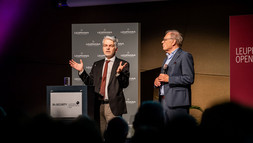

![[Translate to Englisch:] Herder-Schule_Nahost](/fileadmin/_processed_/7/b/csm_Tobias_Herder_Schule_d858068572.jpg)
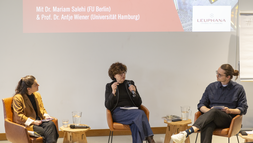

![[Translate to Englisch:] „Die Gefahren eines entgrenzten Krieges“ – Podiumsdiskussion über die Ethik von KI im Militärischen](/fileadmin/_processed_/d/d/csm_Ethik_im_Gespraech-10_42086de33a.jpg)