
Environmental Science: Lea Baumbach – Talking About the Energy Transition
2026-09-07 Expanding the power grids is one of the most important prerequisites for a climate-neutral energy supply. To achieve this, existing grids must be expanded and modernized. Through her work, Leuphana alumna Lea Baumbach helps ensure that residents and decision-makers have a say in the permitting and construction processes. Her interdisciplinary studies at Leuphana continue to shape her approach to this day: “Projects—both large and small—can only succeed when different perspectives come together.”
Before the energy transition, the equation was simple: a few large power plants supplied electricity to many customers. Today, the situation is far more complicated: a young family has a solar power system on their small house; a farmer from the neighboring village operates a biogas plant and leases his land to a project company that is planning to build wind turbines there, in which a local cooperative is then investing. Electricity is being generated all over Germany. And it’s supposed to be fed into the power grid. At the same time, people continue to be supplied with electricity. So the energy has to flow in many directions. The result: The existing power grid is no longer sufficient and must be expanded. Power lines are being built across farmland, sometimes routed through wooded areas, or substations are being expanded. These are changes that often cause concern among residents.
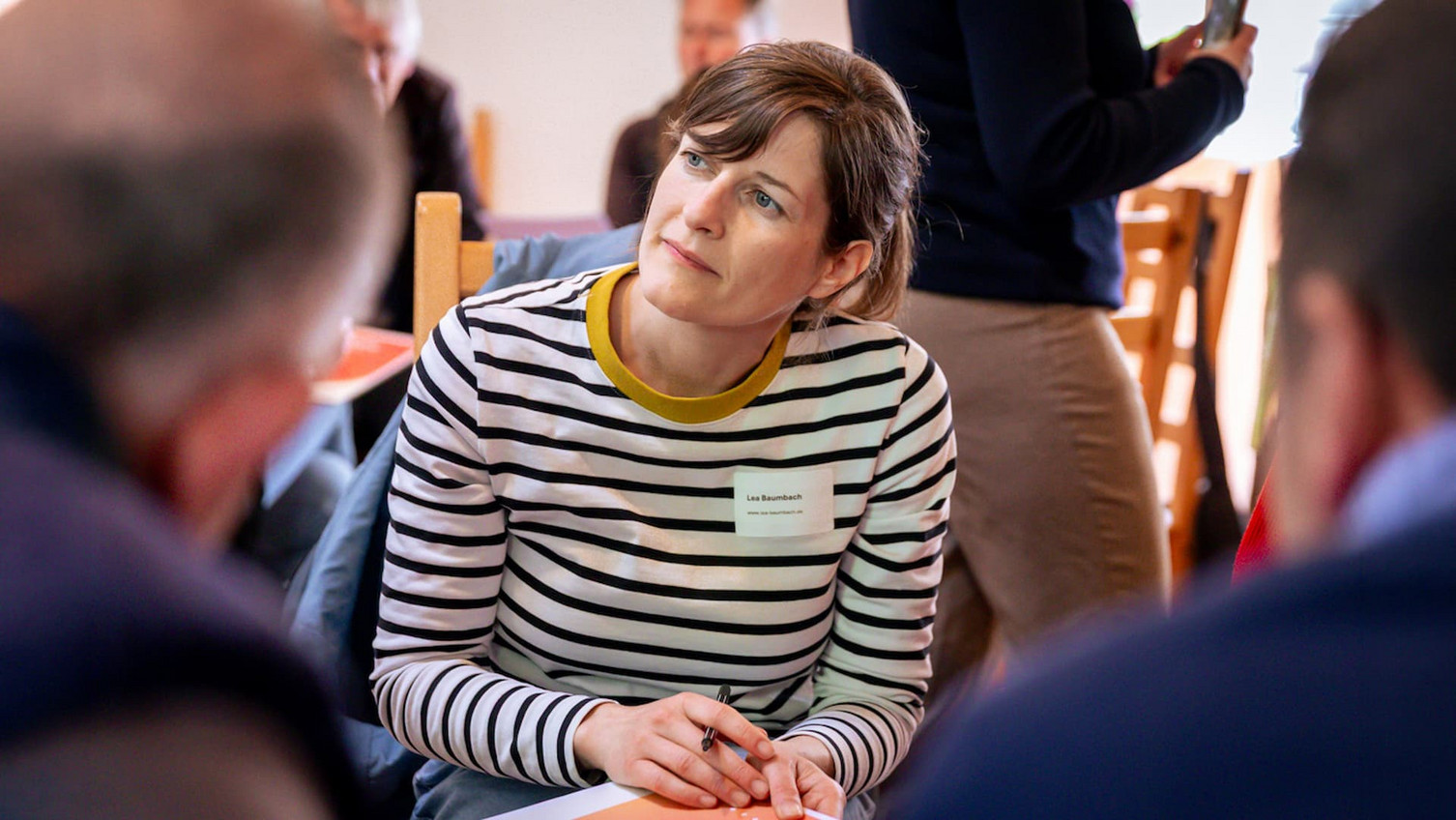
This is exactly where Lea Baumbach comes in: She works at the Nuremberg-based communications agency Kaltwasser, focusing on project communication and public dialogue. “As a communications consultant, I support power grid operators in expanding the energy infrastructure and ensure that conflicts are transformed into constructive discussions whenever possible,” she explains.
What does she need for this, aside from empathy and strong communication skills? Knowledge from the environmental sciences: “I still benefit enormously today from the interdisciplinary content of my studies at Leuphana—ranging from physics and statistics to issues of sustainability in law, economics, politics, and communication. At Leuphana, I learned to understand different technical discourses and to ask the right questions. None of these disciplines can solve the challenges of the energy transition on its own,” she summarizes.
In her daily work, she brings together different perspectives—from mayors and residents to government agencies, environmental organizations, and companies: “When communication works well, it prevents conflicts before they arise. Today, the question is usually no longer whether we need the energy transition, but how we can shape it together.”
For the Nuremberg-based agency, she develops communication strategies for energy transition infrastructure projects. Together with power grid operators, she analyzes stakeholders, prepares informational events, and supports permitting and construction processes.
She fondly recalls her time as a student in Lüneburg. The campus and the close collaboration with her fellow students, in particular, have shaped her to this day: “I made friends back then that I still keep in touch with today. The campus is a wonderful place to meet people.” After earning her bachelor’s degree, she completed the Master’s program in Environmental Science, Policy, and Management (MESPOM) in Budapest, Hungary; Mytilene, Greece; and Lund, Sweden.
In addition to her work at Kaltwasser, the Leuphana graduate works independently as a facilitator and process consultant. She is particularly passionate about projects involving citizen participation and sustainable regional development. Among other things, she facilitates the “Dorfklima.Werkstatt” (Village Climate Workshop) in Mecklenburg-Western Pomerania, where village communities work together to develop ideas for climate protection and a livable future: “I want to build bridges so that the energy transition succeeds.”