
Opening Week 2026: When War Goes Digital
2026-10-12 How is artificial intelligence changing modern conflicts? And how can a democratic society deal with it? Colonel (ret.) Sönke Marahrens, head of department at the Bundeswehr Center for Digitalization, discussed disinformation, military deterrence, and the importance of societal resilience with students.
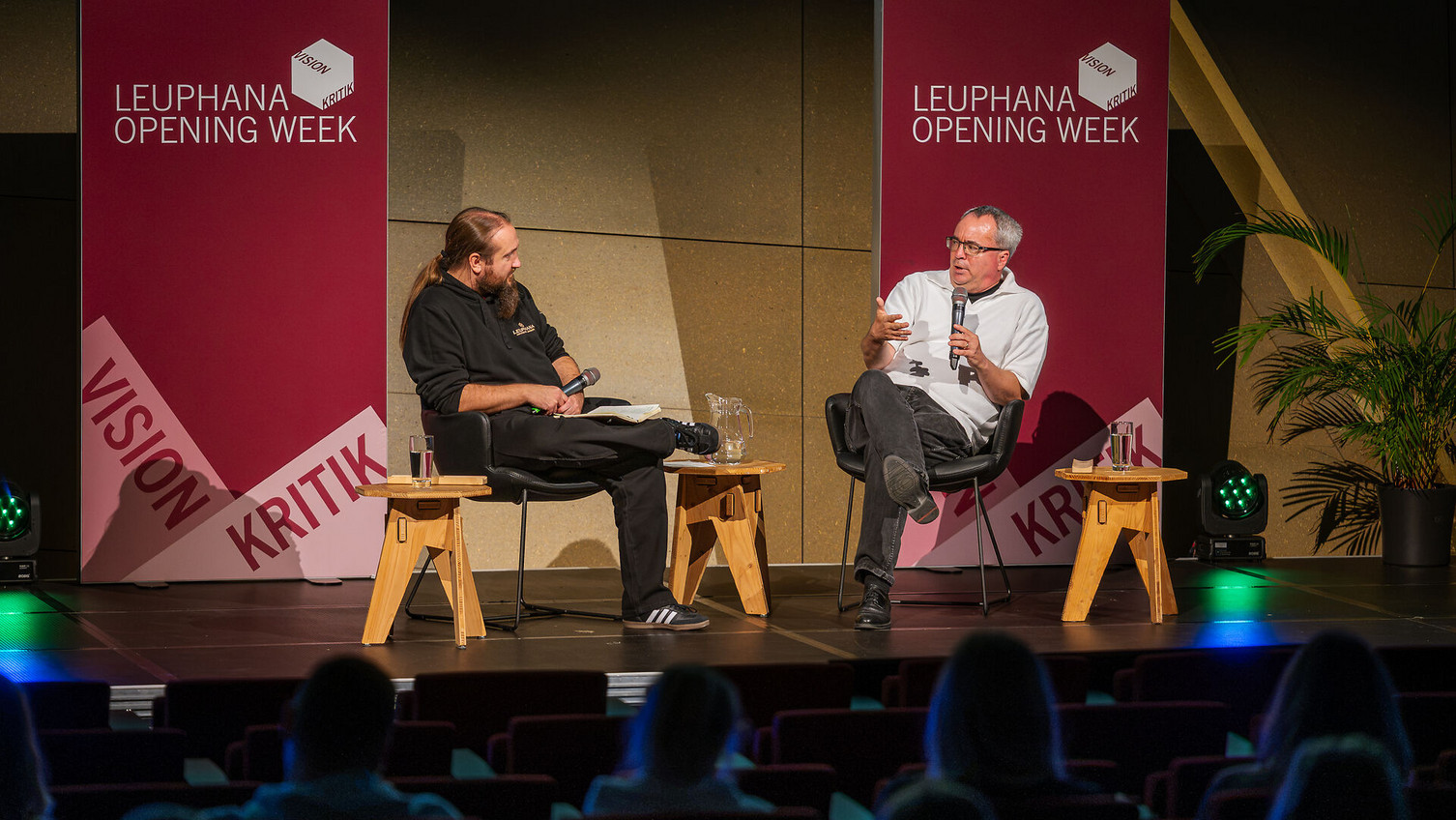
It’s a topic that stirs people; one that requires time and space. The discussion lasts more than an hour longer than planned. About 40 students stayed after the event. They want to keep talking; they have questions—many of them critical. Colonel Sönke Marahrens invites them to sit down with him. He himself crouches on the edge of the stage where, just a few minutes earlier, he had been discussing hybrid warfare with Ricardo Usbeck. The professor of business informatics, specializing in artificial intelligence and explainability, is moderating the afternoon session.
War has long since ceased to take place only on the battlefield. It can play out on social media, on smartphones, and in people’s minds. Marahrens sees precisely this as one of the greatest challenges of modern hybrid warfare. “It’s always about emotions, hate, rage.” Artificial intelligence exacerbates the problem because disinformation can now be produced on a much larger scale. What used to be created by many people in so-called “troll factories” can increasingly be automated with the help of AI. Marahrens therefore calls on the students to be “resilient and critical.”
The security expert sees the central danger not only in false information, but also in the loss of trust: “You have to understand that an adversary doesn’t care whether you’re for something or against something.”
Some students also feel this very loss of trust. Marahrens points to the power of the people in a democracy: “Go vote!” For him, not voting is not a neutral decision: “If you vote, then others won’t be elected.”
The fear of war hangs in the air. “I feel a strong aversion to war,” says a student. “Me too,” Marahrens emphasized. He has personally experienced war zones, having been to Afghanistan and Kosovo. His answer: deterrence and military capabilities. “We must be able to fight so that we don’t have to fight.”
Ricardo Usbeck emphasizes that the current crisis can only be resolved through collective effort. Various academic disciplines could contribute to overcoming the crisis through their research: “That’s why we at Leuphana founded the Leuphana Center for Cooperative Security (LCCS).”
Marahrens takes the time to address the students’ questions and answers them in detail, often drawing on historical references. One student raises the issue of the connection between AI and dehumanization. Marahrens recalls a Christmas Eve during World War I. German soldiers sang “Silent Night, Holy Night” at the front. The French and British joined in: “People only kill each other when they don’t see a human being on the other side.”
“What would we even be fighting for in a war?” a student asks. Marahrens replies that he cannot answer that question for others. For him, however, moments like these—moments of freedom, where different positions can be expressed and controversial issues openly discussed—are worth defending: “We can stay together here; we can have this kind of discussion.”
It’s not an easy topic, but it’s a conversation among equals. “Thank you for being here,” Marahrens says in closing. Warm applause.