
From Cold War Surveillance to Climate Evidence (Lila Lee-Morrison)
2026-05-28 In a Climate Futures Talk at Leuphana on May 26, art historian Lila Lee-Morrison explored how declassified Cold War satellite imagery became a key tool for environmental monitoring. Her talk examined the shifting evidentiary role of satellite images and the politics of disappearance in climate science.
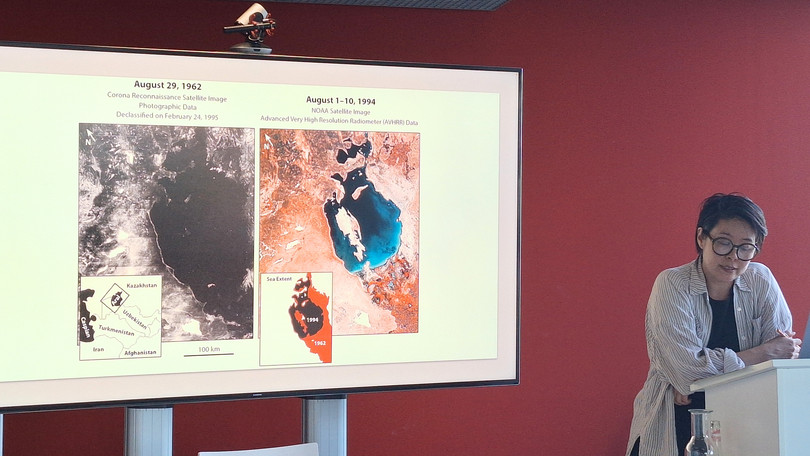
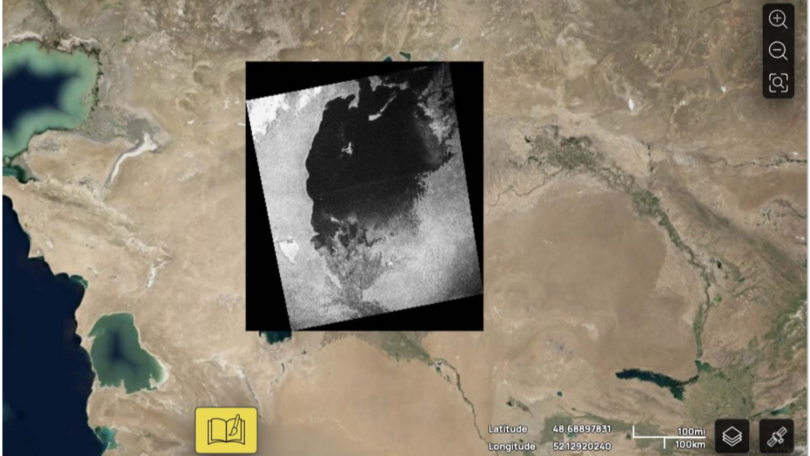
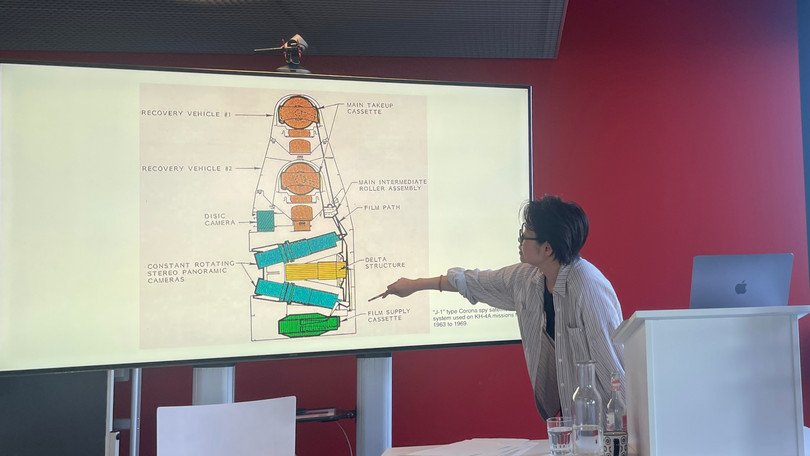
How do formerly classified military images shape our understanding of climate change today? In her lecture “[Dis]Appearance and the Evidentiary Aesthetics of Satellite Imagery”, Lila Lee-Morrison examined the afterlives of Cold War satellite reconnaissance imagery. Drawing on the MEDEA program, which declassified thousands of satellite images in the 1990s, she explored how these visual archives were repurposed for earth sciences and environmental monitoring.
Lee-Morrison argued that the evidentiary value of satellite imagery extends beyond visual sharpness. “Even when pixel reduction diminishes detail and threatens evidentiary quality, satellite images remain operational,” she explained. Instead, their significance emerges through “their geometric and spatial relationship to each other.” Her lecture traced how environmental changes such as ice retreat and erosion become legible through before and after images.
A central focus of the lecture was the transition “from military surveillance to earth observation.” According to Lee-Morrison, this shift reconfigured satellite imagery from a tool for identifying immediate military threats into a medium for tracking “long-term environmental transformations.” Yet, she noted that “the language of surveillance persists,” as environmental phenomena continue to be framed through narratives of threat, loss, and disappearance.
Concluding her talk, Lee-Morrison connected historical forms of censorship surrounding satellite programs to present-day political actions such as the US administration’s current defunding of satellite technologies that produce climate data. “These blackouts on earth observation satellite data mirror the former disappearance that arose around the MEDEA project,” she stated. The lecture highlighted how questions of visibility, evidence, and information control remain deeply entangled with contemporary climate science and geopolitics.
Art historian Lila Lee-Morrison, Associate Professor at the Irwin S. Chanin School of Architecture at The Cooper Union in New York City, visited Leuphana in May and June 2026. As a research fellow of the Centre for Digital Cultures (CDC) and the key subject area Climate Futures in Digital Cultures within Leuphana’s Embracing Transformation program, she engaged in interdisciplinary dialogue and critical reflection on our planetary future from a visual culture perspective.