
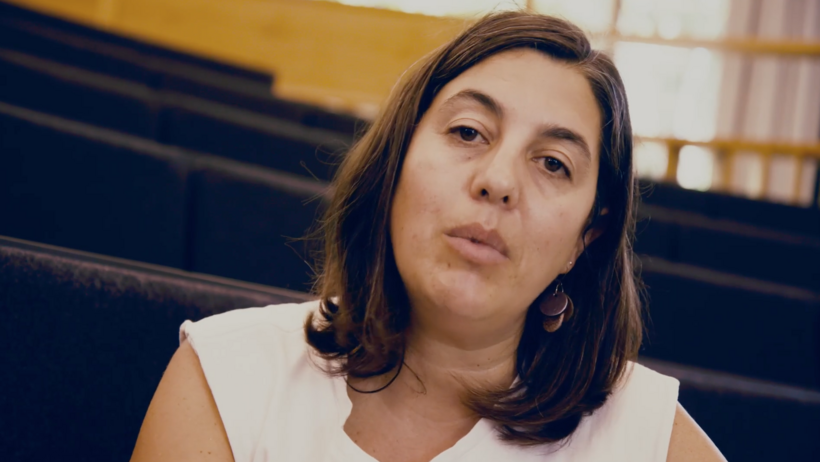
![[Translate to Englisch:] María Laura Mazzoni, LIAS Fellow 2026/2027, Leuphana](/fileadmin/_processed_/b/5/csm__DSC8057_c3c94acfce.jpg)
Fellow 2026/27
María Laura Mazzoni makes a valuable contribution to gender history, legal history, and research on the social dynamics of the South American independence process. The dialectic of control and agency forms a central leitmotif of her work. As an historian, she examines the intertwining of social, legal, and cultural history in Argentina in the late eighteenth and early nineteenth century. Her work is characterized in particular by her analysis of ecclesiastical institutions, their representatives, and their role in the social order. A recurring theme is the function of ecclesiastical law in the context of colonial structures and in the upheavals of the independence movements. In her research, she shows how ecclesiastical legal proceedings served to reproduce social hierarchies – between men and women as well as between social classes – but did not exclude opportunities for action by subaltern actors, especially women from rural or Indigenous contexts.
Furthermore, Mazzoni situates her research in larger transatlantic contexts. She explores how developments in the Río de la Plata region were intertwined with political and social upheavals in other Atlantic regions. Her perspective combines micro-historical reconstructions with macro-historical questions about the formation of legal cultures, gender orders, and social practices in the transition from colonial rule to republic.
Abstract
Women Before the Law: Matrimonial Causes in the Ecclesiastical Court of Dioceses of Cordoba, Río de la Plata, in Times of Reform and Revolution
My project seeks to analyse cases of sevicia (excessive cruelty) against and malostratamientos (mistreatment) of women lodged at the Episcopal Court of the Diocese of Córdoba del Tucumán in Rio de la Plata between the 1770s and the 1850s. It seeks to identify continuities and changes in women’s strategies in ecclesiastical courts to access justice and denounce their husband’s mistreatment. In the Diocese of Córdoba del Tucumán, the oldest in the area that became the Viceroyalty of the Río de la Plata in 1776, ecclesiastical judges heard cases on sevicia and malostratamientos brought by women against their husbands before the Episcopal Court. In most cases, religious justice, canon law, and judicial agents promoted the consolidation and continuation of a patriarchal social system based on the institution of marriage. Thus, most decisions in divorce cases reinforced and perpetuated this framework. My project focusses on female agency and the strategies that women used before the courts in order to escape violence within their homes. Women seemed to turn to these institutions even though they were aware of the limited resonance and empathy that their demands could obtain, and made use of all the limited legal resources at their disposal.
Education
2013 PhD in History, National University of the Center of the State of Buenos Aires (UNICEN), Tandil, Argentina
2010 MA in History, National University of Mar del Plata (UNMDP), Argentina
2008 BA in History, National University of Mar del Plata (UNMDP), Argentina
Most Recent Academic Position
Assistant Professor at the National University of Mar del Plata (UNMdP), Argentina
Most Recent Publications
“Territorialización y dimensión relacional en la visita canónica a la diócesis del Tucumán durante el gobierno de Ángel Mariano Moscoso” (Territorialization and Relational Dimension in the Canonical Visit to the Diocese of Tucumán during the Government of Ángel Mariano Moscoso). In El siglo XIX argentino: un laboratorio de experimentación política. Edited by Alejandro Morea and María Laura Mazzoni. Mar del Plata: Eudem, 2023.
“¿Tienen utilidad las humanidades digitales en el estudio de la dinámica y agentes religiosos?” (Do Digital Humanities Have Usefulness in the Study of Religious Dynamics and Agents?). In Catolicismos de la colonia a la república: nuevas miradas desde el Sur. Edited by Valentina Ayrolo, María Elena Barral, and Guillermo Wilde. Rosario: Prohistoria Ediciones, 2023.
“Causas matrimoniales en la justicia civil de Córdoba en la primera mitad del siglo XIX” (Marriage Cases in the Civil Justice of Córdoba in the First Half of the Nineteenth Century). Revista Electrónica Instituto de Investigaciones Jurídicas y Sociales Ambrosio L. Gioja 34 (2025): 257–79.