
LIAS Workshop "Afterlife of Networks"
29. Jun - 30. Jun
Organised by Nathalia Lavigne (LIAS Fellow 2025/26) with Giselle Beiguelman, Lisa Deml, Daniel Jablonski, Aline Motta and LIAS Faculty Fellow Vera-Simone Schulz
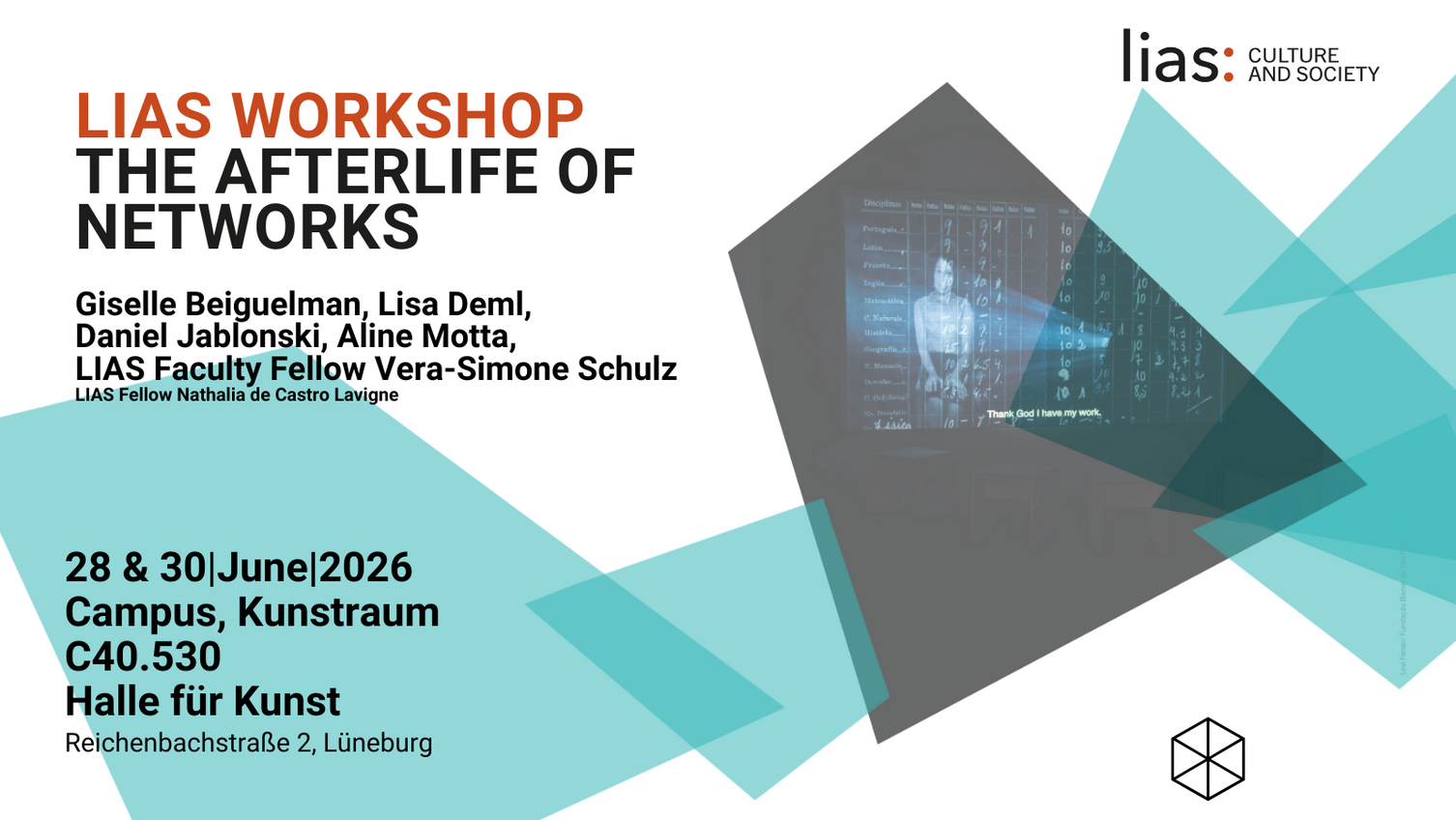
Date: Sunday, 28 and Tuesday, 30 June 2026
Kunstraum-Exhibition until Friday, 3 July 2026
Location: Campus | Kunstraum, Central Building | C40.530
Halle für Kunst, Reichenbachstraße 2, Lüneburg
Metaphors around networks have a long history. From the 19th century, when it shifted from literal nets and fabric to evoke complex systems like railways and telegraphs, networks became a transdisciplinary and traveling concept. This happened especially after a conceptual shift in the mid-20th century, when networks were used to describe other modes of interaction in the social sphere. In the early 2000s, the spread of this term from scientific and cultural studies into colloquial language would be defined as a ‘network fever’. More recently, when networks have been widely associated with social media platforms, how can other understandings of this concept be grasped? Where to find other potential networks beyond the digital sphere and outside the platforms?
This event will present three artistic interventions that expand the understanding about networks to other perspectives. In common, these works reflect the continuity of connections after some unexpected interruption: How can archives persist as networks beyond their original material forms? What happens if we reactivate a conversation that was suddenly stopped? How could water be understood as an element of connection between different times, historical and personal events? The notion of afterlife of networks evokes either artworks that use the digital platforms as a source material or other which reactivate other metaphorical uses of networks and connectivity.
This event is a prelude to the exhibition After Memory (Curators: Nathalia Lavigne, Lisa Deml, Víctor Fancelli Capdevila), which happens from 11 July to 12 October at Kunstraum Kreuzberg/Bethanien, in Berlin. More information about the project here: www.aftermemory.net
Programme
28 JUN 2026
Halle für Kunst Lüneburg | Reichenbachstraße 2 | 21335 Lüneburg
5–5:15 p.m.
Nathalia Lavigne (introduction)
5:15–7:30 p.m.
Lisa Deml: „TRANS/VERSAL: Lasting Resonances & Relational Landscapes“ featuring works by Inas Halabi, Moses März and students from Leuphana University
30 JUN 2026
Campus | Kunstraum & C40.530
12–1:30 p.m.
Daniel Jablonski: “Fwd: Sorry for the Delay” (2017–26)
In conversation with Nathalia Lavigne
(Kunstraum)
3–4 p.m.
Artist Talk with Giselle Beiguelman
Q&A: Nathalia Lavigne (moderation)
(Campus | C40.530)
6:15–7:30 p.m.
Film Screening: Water is a Time Machine
Aline Motta
Q&A: Vera-Simone Schulz (moderation)
(Kunstraum)
Presenters and Art Works:
Lisa Deml (Exhibition TRANS/VERSAL: Lasting Resonances & Relational Landscapes)
Cartography does not merely depict the world, but actively shapes and structures it. As a tool of colonial expansion, it serves to define territories and delineate borders. However, cartographic methods can also be used to reveal power structures and to trace resistance movements. The works brought together in the exhibition map how geopolitical and sociohistorical relations are inscribed in and continue to inform landscapes, infrastructures and discourses, including those of Lüneburg itself.
Aline Motta: Water is a Time Machine
Based on her mother's personal documents, Aline Motta tells a story about her family's life in Rio de Janeiro at the beginning of the 20th century, a time of political unrest immediately following the abolition of slavery. In the form of a novel, a video, and a performance, she traces the fault lines between historical records and intimate memories, weaving them together in a non-linear narrative that extends into the present day.
Aline Motta is a visual artist and writer. Basing her work on speculative studies that combine archival research, field trips and oral history reports, her artistic practice seeks to point out colonial erasures in her family history, and to fill the gaps. Her work consists of videos, photographs, installations and performances. Recent exhibitions include: Sharjah Biennial 15, 2023; Chosen Memories: Contemporary Latin American Art, Museum of Modern Art (MoMA), New York, 2023; 35th São Paulo Biennial, 2023; and Stellenbosch Triennale, 2025. Motta lives and works in São Paulo, Brazil.
Giselle Beiguelman, The Afterlife of Forgotten Networks: Archives, Memory, and Rebellious Traces
Drawing on artistic and research projects that engage with artificial intelligence, memory, and digital archives, this talk investigates archives as networks that persist beyond their original material forms. Through fragmented collections, absent documents, and computationally reconstructed images, it explores how interrupted connections can be reactivated and how the remnants of vanished institutions, objects, and narratives continue to generate meaning. Rather than understanding networks solely as digital platforms, the presentation proposes thinking of them as infrastructures of survival and fabulation, capable of connecting distinct historical moments, individual memories, and collective processes of imagination. In this sense, archives emerge not only as repositories of the past but also as latent spaces where forgotten relationships, suppressed histories, and unrealized futures can be reimagined.
The talk is grounded in the artist’s projects Botannica Tirannica and Poisonous, Harmful, and Suspicious (Venenosas, Nocivas e Suspeitas), which propose a history told through the memories of plants pushed to the margins by processes of colonization. By reactivating neglected botanical knowledge, erased narratives, and forms of resilience that have survived despite historical violence, these works examine how archives can connect human and non-human histories across time.
Giselle Beiguelman is an artist and Full Professor at the Faculty of Architecture, Urbanism and Design of the University of São Paulo (USP). She is the author of Políticas da Imagem: Vigilância e Resistência na Dadosfera (Image Politics: Surveillance and Resistance in the Datasphere, Ubu, 2021), and co-author of Boundary Images (University of Minnesota Press, 2023), and Technologies of Invention (Autêntica, forthcoming), among other publications. Her works are part of the collections of institutions including ZKM, the Jewish Museum Berlin, the Kadist Foundation, MAC-USP, MAR-RJ, and the Pinacoteca de São Paulo. She has received several national and international awards. She is the Principal Investigator of the FAPESP Thematic Project Digital Archives and Research: Art, Architecture, Design and Technology.
Daniel Jablonski, Fwd: Sorry for the Delay (2017-2026)
FWD: Sorry for the Delay (2016) was originally conceived for an exhibition at Instituto Tomie Ohtake in São Paulo which focused on art in the age of telecommunications.
Through an open call, the artist invited the audience to forward their own delayed or unanswered emails: love letters, business deals, junk mail, missed connections, or pending proposals—anything that had not been responded to (or even sent) for various reasons. Over the course of a month, the artist acted as a mediator between the senders and addressees, granting a temporary amnesty for communication that had been interrupted for days, months, or even years. At the end of the project, the messages were briefly exhibited as an installation piece.
Revolving around an idea put forward by Argentinian writer Ricardo Piglia, the project raises questions about communication as a financial transaction — and most specifically debt — while also enabling an interaction that otherwise would not happen again. Re-activated ten years later for the Afterlife of Networks, the piece now raises other questions, such as the relevance of e-mail in an era of instant messaging. Has it become an obsolete medium, or did its place just shift in a wider panorama of worldwide communication?
Daniel Jablonski (Rio de Janeiro, 1985) is a visual artist, teacher and researcher. He lives and works between Brazil and France and is currently doing a Practice-based PhD in the Arts at the École nationale supérieure d'arts de Paris-Cergy & CY Cergy Paris Université (FRA). Combining theory and practice, he applies academic research methods to his own everyday life, to produce artworks that function as true “case studies”. These have been exhibited in solo and group shows in Latin America and abroad, notably at Instituto Tomie Ohtake (São Paulo, BRA), Fundación ArtNexus (Bogotá, COL) and Fondazione Antonio Ratti (Como, ITA). In recent years, he has won several awards at fairs and exhibitions and has been nominated twice to Brazilian art prize PIPA, as well as the Cisneros Fontanals Art Foundation Grants and Commissions Program (Miami, USA). He participated in many international residencies, notably at Lugar a Dudas (Cali, COL), Fonderie Darling (Montreal, CAN), Cité Internationale des Arts (Paris, FRA) and Terra Foundation (Giverny, FRA).