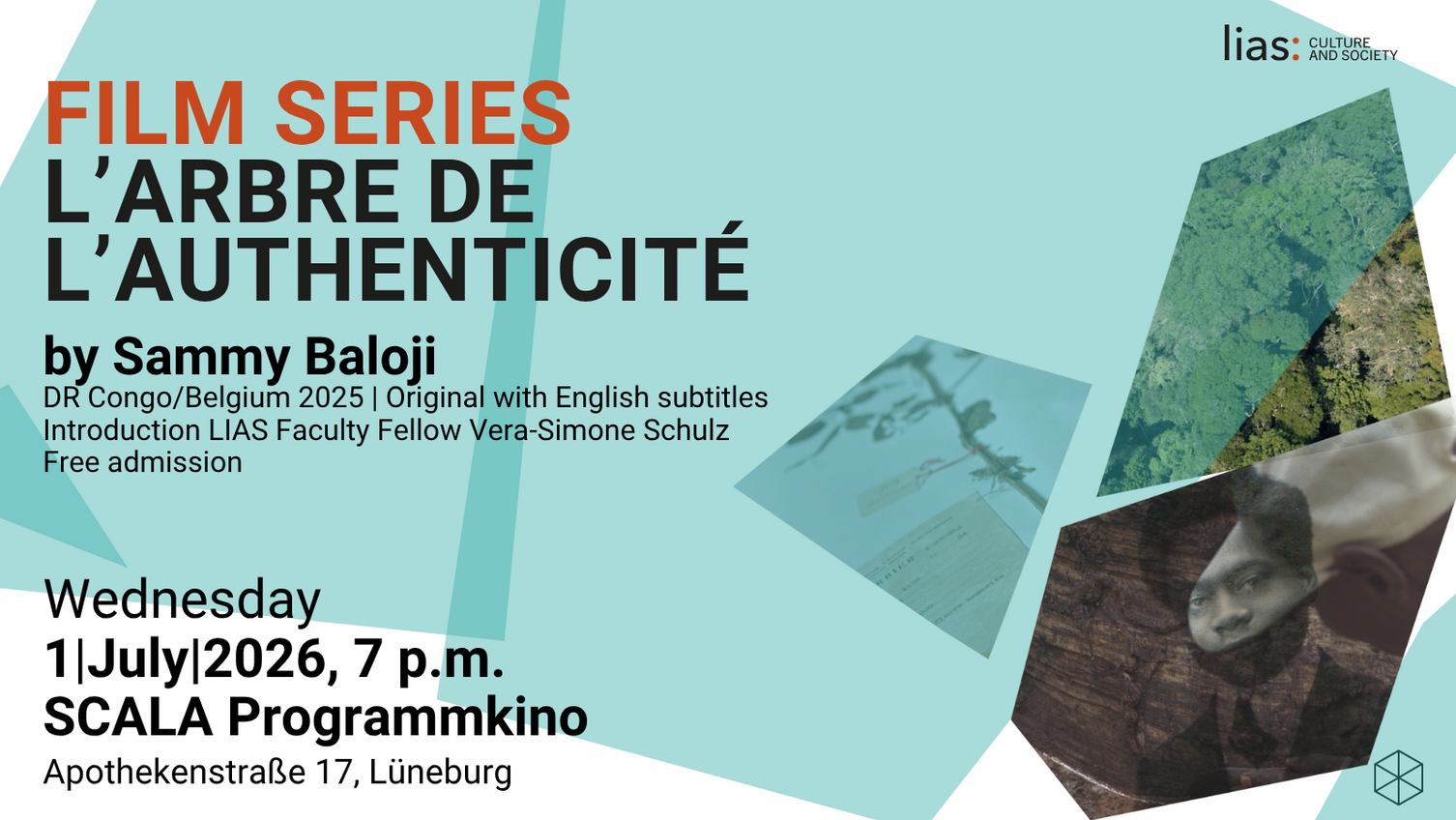
LIAS Film Series: “L’ Arbre de l’Authenticité“
Wednesday, 1 Juli, 7 p.m. | SCALA Arthouse Cinema | Free Entrance
01. Jul
This film is part of the LIAS film series, in collaboration with the SCALA arthouse cinema. Every month, international films exploring cultural and social issues are accompanied by introductions and discussions.
Date: Wednesday, 1 July 2026, 7 p.m.
Place: SCALA Programmkino | Apothekenstr. 17 | 21335 Lüneburg
Director: Sammy Baloji • DR Congo/Belgium 2025 • 89 mins • French original with English subtitles
Free admission
Introduction by LIAS Faculty Fellow Vera-Simone Schulz
As part of the LIAS Film Series, we are screening L’Arbre de l’Authenticité by the Congolese artist and filmmaker Sammy Baloji. The multi-award-winning documentary was honoured with the Special Jury Prize at the International Film Festival Rotterdam and was nominated for the international competition at DOK.fest Munich 2025.
In an essayistic triptych, the film combines historical research, ecological reflection and cinematic imagination. The starting point is the former Belgian research centre in Yangambi in the Congo Basin, which has been collecting meteorological data since the 1930s, data that today provides important insights for climate research. Drawing on the biographies of Paul Panda Farnana (1888–1930), the first Congolese agronomist and intellectual, and the Belgian colonial official Abiron Beinaert (1903–1941), Baloji examines the interconnections between colonial knowledge production, resource exploitation and ecological transformation.
In the film’s concluding section, the approximately 300-year-old tree Lileko appears as a witness to historical and ecological upheavals. Through poetic imagery and a haunting soundscape, the film reflects on the long-term consequences of human intervention in nature and society and highlights the enduring relevance of colonial legacies in the context of global environmental crises.
L’Arbre de l’Authenticité invites us to rethink the relationships between the history of science, colonialism and climate change, and to discuss forms of ecological responsibility in a postcolonial present.