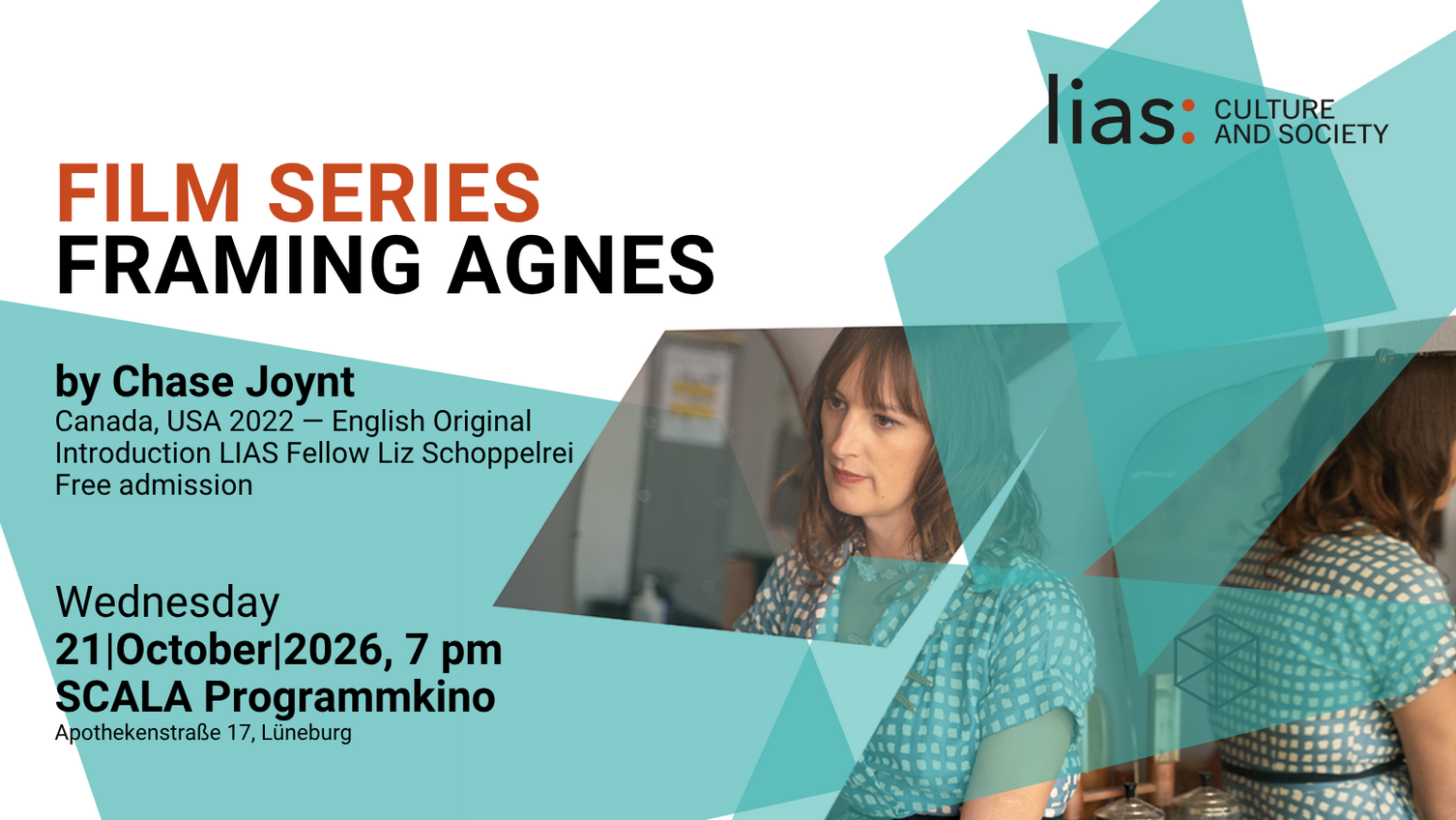
LIAS Filmseries: Framing Agnes
21. Oct
This film is part of the LIAS film series, in collaboration with the SCALA arthouse cinema. Every month, international films exploring cultural and social issues are accompanied by introductions and discussions.
Date: Wednesday, 21 October 2026, 19 p.m.
Place: SCALA Arthouse Cinema, Apothekenstraße 17, Lüneburg
Introduction: LIAS Fellow Liz Schoppelrei
Free Entrance
Canada / USA, 2022 • Director: Chase Joynt • 75 min • English Original
Chase Joynt’s Framing Agnes is an essayistic documentary film about the conditions under which trans history becomes visible. Its point of departure is the research archive of the UCLA Gender Clinic in Los Angeles in particular the 1958 case study of Agnes, a trans woman whose story was long regarded as a singular example within trans history. The rediscovery of further files subsequently broadens the historical horizon, revealing that what had appeared to be an exceptional biography is in fact an ensemble of life stories, social relationships, and strategies for navigating medical and social institutions.
Joynt is less interested in reconstructing a supposedly authentic past than in establishing a relationship with it. He achieves this by bringing archival material, scholarly contextualisation, interviews, and staged encounters together in a form that resists clear generic classification. The framing device is a fictional television programme in which trans actors re-enact historical interviews. At the same time, the performers reflect on their own embodiment of the historical figures. Re-enactment thus becomes a method of historical inquiry rather than a means of retrospectively illustrating an already established history. This approach makes visible the gaps, mediations, and power relations that shape every engagement with the archive.
Joynt’s strategy also challenges two established framings of trans history: its pathologisation through medical discourse and its sensationalisation through forms of media representation. At the same time, the film complicates the narrative of trans history as a history of isolated individuals. The newly uncovered cases point towards social worlds, relationships, and forms of mutual support that have often remained invisible in medical and media archives.
In Framing Agnes, a queer cast and crew are involved not only in the representation of these historical figures but also in the work of constructing the historical narrative itself. The perspective on the archive therefore remains situated and is foregrounded as a collaborative process. Joynt appears on screen as both director and interviewer. The staging makes explicit that historical mediation is always also a question of the present: Who speaks, who is represented, and what forms of knowledge are produced through a particular mode of representation?
Framing Agnes premiered at the 2022 Sundance Film Festival, where Joynt received both the Audience Award and the Innovator Prize in the NEXT programme.