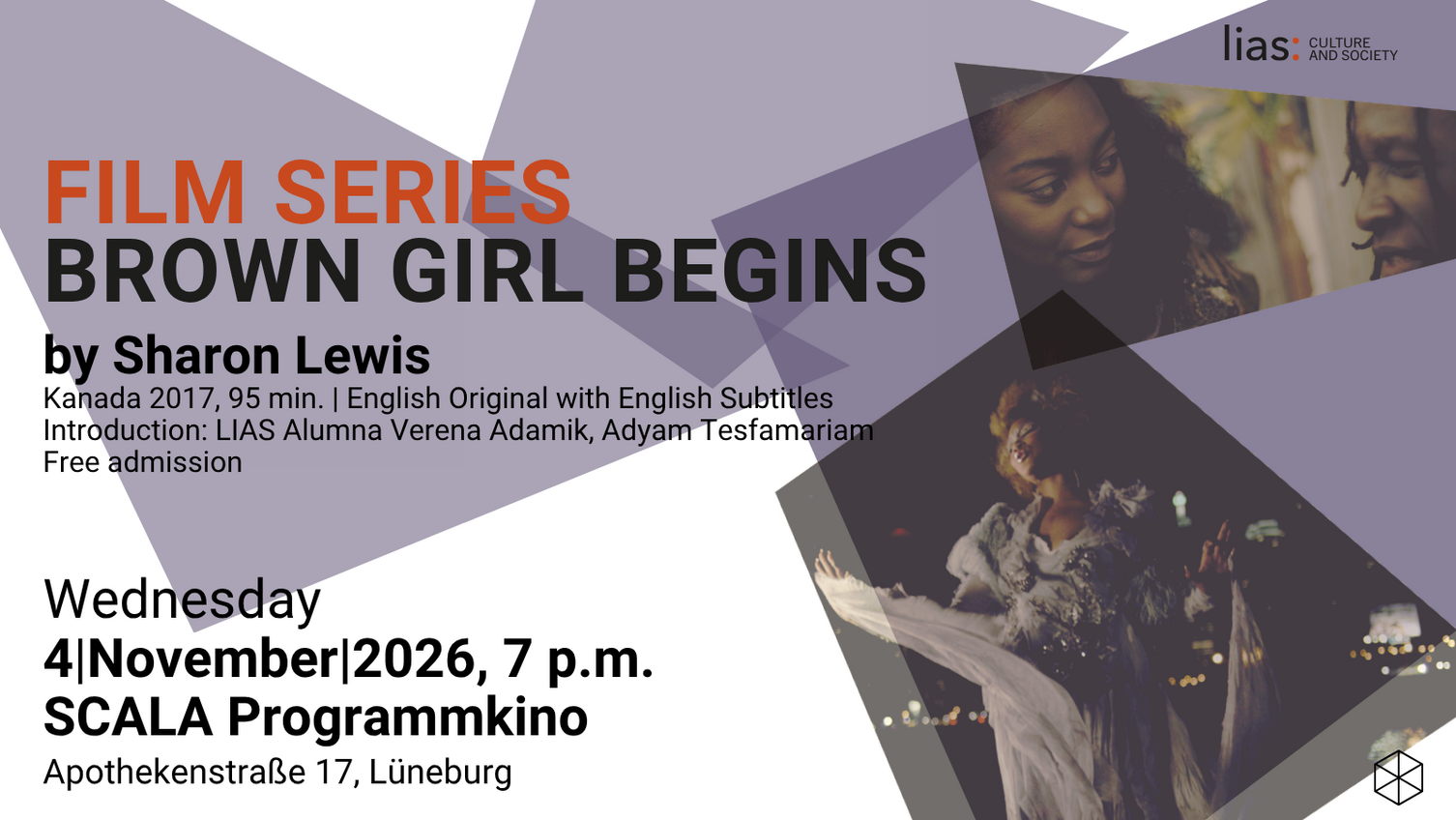
LIAS Film Series: Brown Girl Begins
04. Nov
What might the future look like when it is shaped not by technology, but by memory, spiritual knowledge and cultural traditions? Sharon Lewis’s „Brown Girl Begins“ brings together Afrofuturism, Caribbean folklore and dystopia in an unusual exploration of heritage, self-determination and who gets to shape the future.
Time: Wednesday, 4 November 2026, 7.30 p.m.
Place: SCALA Arthouse Cinema, Apothekenstraße 17, Lüneburg
Introduction: LIAS alumna Verena Adamik, University Potsdam
2049: Toronto has become a city of the rich. The rest of the population, excluded from resources and political participation, lives on a deserted island off the coast. On “The Burn”, a Caribbean-influenced community survives through farming, recycling and barter. Its real resource, however, is another kind of knowledge: knowledge of medicinal plants, rituals and the spirit world.
At the centre of Sharon Lewis’s „Brown Girl Begins“ is 19-year-old Ti-Jeanne, who grows up within this tradition while simultaneously trying to escape it. When her grandmother Mami prepares her to take on the role of priestess, she resists a position inextricably linked to the traumatic death of her mother. Only when violence and exploitation threaten the community must Ti-Jeanne confront both her heritage and her own supernatural abilities.
Released in 2017, the film combines dystopia and coming-of-age narrative with Caribbean folklore and Afrofuturism. Unlike many popular visions of the future, „Brown Girl Begins“, based on Nalo Hopkinson’s novel „Brown Girl Begins“, does not depict a technologically dazzling future, but a world in which cultural traditions, spiritual knowledge and communal practices become means of survival. The future thus appears not as a rupture with the past, but as a space in which suppressed or marginalised forms of knowledge persist and acquire new meaning.
The film therefore uses Afrofuturism as a way of reflecting on who is represented in visions of the future, which forms of knowledge are regarded as relevant to the future, and who has the authority to shape understandings of social development. Lewis connects these questions with a distinctly Caribbean perspective. The spirit figures, language and spiritual practices of the community shape its social order as well as its understandings of identity, memory and responsibility.
Working with limited cinematic resources, Lewis develops a deliberately distinctive aesthetic situated between performance, myth and science fiction. The non-linear narrative mirrors Ti-Jeanne’s confrontation with loss and heritage; at the same time, the film translates an oral and ritual-based tradition into a visual form and reflects on the ways in which cultural knowledge is transmitted and transformed across media, generations and periods of time.
At the heart of the film is a young woman who must not simply inherit a predetermined tradition, but find her own relationship to it. Ti-Jeanne’s journey takes her from a fear of her mother’s legacy towards a vision of the future in which heritage and self-determination are not opposites„Brown Girl Begins“ thus tells of a future in which the question of who we have been remains inseparable from the question of who we can become.