
LIAS-Workshop: Transitional Justice in Illiberal Times
LIAS-Workshop: Transitional Justice
2026-05-26 How can transitional justice be conceived in a present characterized by violence, authoritarian dynamics, and colonial continuities? In the LIAS workshop “Transitional Justice in Illiberal Times”, central concepts of transitional justice were critically evaluated. Central to it were questions about violence as a continuum, the boundaries of categories like “victim” and “perpetrator”, the political function of commemoration and restitution, and possibilities to imagine the future under conditions of ongoing uncertainty. With Alejandro Castillejo-Cuéllar, Ini Dele-Adedeji, Arthur Muliro, Brendan Ciarán Browne, Jelena Subotić

LIAS-Workshop: Transitional Justice in Illiberal Times
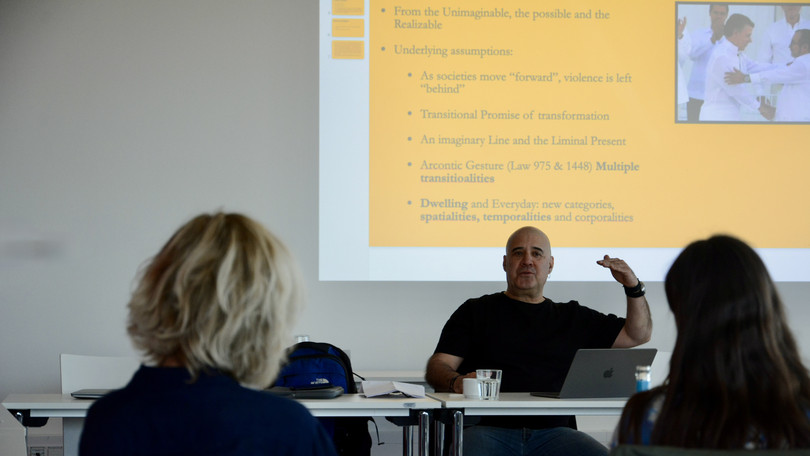
In his talk, “Violence as Continuum: On the Rainforest’s Elusive Testimony”, Alejandro Castillejo-Cuellar occupied himself with the question of how violence is understood in transitional justice. The starting point was a critique of a teleological understanding of transitional justice which assumes that societies have moved linearly from violence and conflict to peace and reconciliation. Based on the Columbian context, he showed that violence, in contrast, persists as a continuum. He emphasized in particular the concept of a “liminal state”: transitional justice moving between past and present, but without reaching a clear endpoint. Peace processes have generated new social spaces for perceiving violence, but remained characterized by uncertainty. Castillejo-Cuellar also emphasized that the existing models of truth, trauma, and reparation are strongly shaped by legal and psychological categories and that violence has often been situated on the body. As a result, other dimensions of violence – for instance, collective, ecological, or epistemic – have frequently been overlooked. He devoted particular attention to the “languages of pain” with which societies describe violence and suffering. Transitional justice thus opens up pluralistic perspectives on the past and future, but reproduces specific normative notions of peace, transformation, and reconciliation. Violence must therefore be conceived more comprehensively – also in its connection to temporality, space, and nonhuman dimensions.
Boko Haram in Nigeria
In his talk, “Neither Victims nor Perpetrators: Transitional Justice and the Collapse of Categories”, Ini Dele-Adedeji analysed the boundaries of traditional categories of transitional justice based on the example of the conflict with Boko Haram in northeastern Nigeria. The starting point was the observation that “victim” and “perpetrator” – as legal and moral categories – collaborate in many conflict situations. People who abducted or controlled by Boko Haram have simultaneously also been victims of violence and involved in forms of cooperation or complicity. Dele-Adedeji described the region as a place of permanent states of emergency, characterized by military controls, internment camps, and limited sovereignty. In such “liminal spaces”, the boundaries between protection, surveillance, and violence blur.
Dele-Adedeji argued that transitional justice was actually developed for contexts with clear perpetrator-victim constellations and is now revealing its limitations. He therefore called for a differentiated understanding of responsibility, suffering, and capacity for action that takes into account the complex forms of coercion and adaptation. Transitional justice must recognize the reality of morally ambivalent life situations and pay greater attention to the role of state violence and military structures.
The Foreclosure of the Future and Questions of Art
In his contribution, “On the Burden of Justice and the Foreclosure of Futures”, Arthur Muliro addressed the long-term effects of violence on social visions of the future. Central to his talk was the thesis that unresolved pasts not only shape memories, but also limit active possibilities for future action. Violence leaves behind traces on social relationships, institutions, infrastructures, and imaginations. Based on examples from Kenya, Muliro described how the burden of past violence is frequently expressed in remaining silent, guardedness, and limited expectations for the future. In an attempt to avoid what might be repeated, people tend to define the future in an increasingly negative way. This then results in an exhausting of a society’s power of imagination.
Muliro criticized the fact that processes of transitional justice frequently focus on measurable results and the stabilizing of institutions, while insufficient attention is given to relational damage and moral injuries. Truth processes alone do not suffice, as memory has a significant influence on how people perceive both the present and the future. Muliro emphasized in particular the importance of art and other cultural forms of expression, which can provide a language for experiences that can barely be articulated institutionally or legally. Visions of the future are created not only by political processes, but also through spaces for listening, recounting, and imagining.
Transitional Justice and Colonialism
In his talk, “Transitional (In-)Justice and Enforcing the ‘Peace’ in Palestine”, Brendan Cierán Browne reflected critically on the role of transitional justice in the context of colonial and ongoing conflicts, particularly in Palestine. Starting from experiences in Northern Ireland, he posed the question of the extent to which transitional justice itself can be part of problematic power structures. Browne argued that processes of “peacebuilding” politics often stabilized colonial structures rather than breaking them down. In such processes, transitional justice appears not only as a legal instrument, but also as a pedagogical practice that produces particular forms of remembering and knowledge. In Palestine, a paradoxical situation appears, in which transitional justice is taught and promoted by institutions in the midst of an ongoing colonial conflict.
He therefore questioned what visions of the future are reproduced by transitional justice in the first place, and whether these models for the future are themselves part of the problem. Transitional justice must be conceived anew from a post-colonial perspective and more intensively ask questions regarding the political prerequisites and interests behind corresponding programmes, conferences, and educational offerings.
Restitution as Symbol Politics?
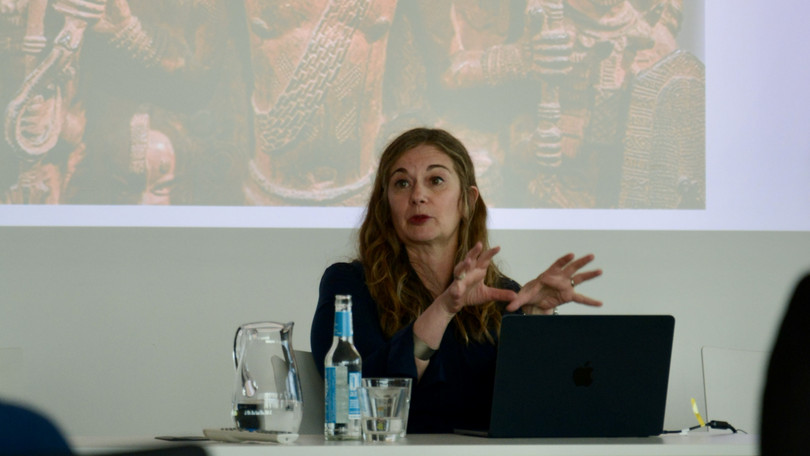
Jelena Subotic’s contribution, “Global Politics of Institutions in Illiberal Times”, was dedicated to the political dimensions of restitution and the processes of returning cultural objects stolen under colonialism, in particular the Benin Bronzes. She traced the history of colonial plundering as well as the restitution initiatives of European states.
She especially criticized the fact that restitution frequently appears to be a symbolic political gesture through which institutions valorise themselves morally, without fundamentally interrogating colonial power structures. While the return of objects might facilitate recognition and decolonialization, they simultaneously obscure structural continuities of colonial order.
The speaker also emphasized that restitution debates are related as well to questions of remembrance, cultural integrity, and self-determination. The return of objects can therefore be a means to renegotiate historical relationships and give agency back to communities. At the same time, she pointed to the political and infrastructural challenges of such processes.
The Limits of Transitional Justice
The workshop made it clear that transitional justice is increasingly showing its conceptional limitations in contemporary global contexts. The talks questioned linear notions of transition, peace, and reconciliation and instead emphasized continuities of violence, instability, and colonial power structures.
Central themes were the persistence of violence after the “end” of conflicts, the unreliability of classic categories like “victim” and “perpetrator”, the role of remembrance and visions of the future, as well as the question of the political function of transitional justice. It again and again became evident that institutional and legal processes alone do not suffice to facilitate social transformations.
Alternative perspectives were seen in relational forms of reparation, cultural and aesthetic practices, and pluralistic notions of time and the importance of art, narratives, and imagination for social designs for the future. The workshop thus showed that debates around transitional justice are today closely linked to questions of coloniality, global inequality, and political imagination.
Complex Experiences of Violence
In the discussions, a question that arose again and again was whether transitional justice must be conceived to a greater extent spatially, rather than solely temporally, and what significance liminal spaces or zones of limited sovereignty have. Another point of discussion was the geopolitical asymmetries of transitional justice: why do some states or regions become the target of international processes of transitional justice, while other contexts remain largely overlooked?
Art was ultimately understood as a central prerequisite for the ability to imagine the future in the first place. Questions regarding language, remembrance, and the communication of pain also played an important role. Finally, the question of trust, social participation, and institutional concepts of reconciliation arose in several panels. What was highlighted in particular was the need to acknowledge complex and contradictory experiences of violence, which cannot be reduced to simple categories.