
LIAS Lecture: Enlightenment as Political Practice
Nick Nesbitt Princeton University
2026-06-03 LIAS Lecture »‘I am Toussaint Louverture’: Who is the Subject of Radical Enlightenment?« von Nick Nesbitt, Princeton University
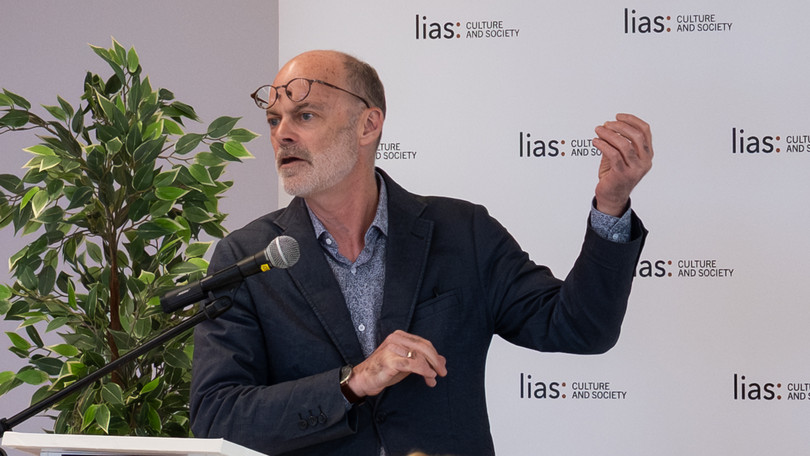


The LIAS Lecture “‘I Am Toussaint Louverture’: Who Is the Subject of Radical Enlightenment?’ by Nick Nesbitt of Princeton University explored the question of who constitutes the subject of the Radical Enlightenment. Taking as his starting point the classical European Enlightenment as articulated by Immanuel Kant (1724–1804) and its foundation in the liberation of the individual from self-imposed immaturity through the courage to use one’s own faculty of reason, Nesbitt highlighted the central idea that what hinders enlightenment is human inertia and complacency.
Nesbitt contrasted this with the Radical Enlightenment described by Jonathan I. Israel, whose philosophical foundation lay in the thought of Baruch de Spinoza (1632–1677). Whilst the moderate enlightenment frequently compromised with existing forms of rule such as monarchy and social inequality, the Radical Enlightenment pursued a more consistent claim to equality and freedom. In doing so, Nesbitt also criticized the logic of rationalization in the colonial economy. Using the example of Saint-Domingue, he showed how wealth was recorded in tables and inventories, whilst the labour of enslaved people remained invisible. Although they constituted the most important source of social wealth, slaves appeared merely as property and not as producers of value. This invisibility points to the analysis of labour, capital, and exploitation by Karl Marx (1818–1883), to whom Nesbitt turned for a theoretical definition of the Radical Enlightenment. Unlike in Hegelian dialectics, it is not about the resolution of contradictions in synthesis, but about social oppositions and confrontations. In the French edition of Das Kapital as revised by Marx, the concept of contradiction is deliberately replaced by that of antithesis. This brings social struggles more firmly into focus as a historical driving force. Nesbitt’s interpretation follows on from those of Marx scholar Michael Heinrich.
Nesbitt saw an important alternative to European notions of human rights in the Manden Charter from medieval Mali in the early thirteenth century, which is attributed to the reign of Soundiata Keïta (also known as Sogolon Djata, ca. 1190–1255). This early declaration of fundamental rights emphasizes the value of every human life and fundamentally rejects distinctions based on origin, gender, or social status. The statement that every life is a life (“toute vie est une vie”) articulates a universal claim to recognition and freedom. At the same time, it points to a social order that is not based on a transcendent or sovereign power.
This perspective is linked to Spinoza’s philosophy, according to which freedom arises not in the individual but in social relations. Knowledge and rational action are always the result of shared, intersubjective processes. An ethical life is therefore necessarily a social life. Nesbitt also illustrated similar oppositional modes of thought using the example of Maximilien Robespierre (1758–1794), who advocated for the abolition of the death penalty, yet at the same time regarded the execution of the king as a necessary prerequisite for a new political order.
Nesbitt devoted particular attention to the Haitian Revolution and the figure of Toussaint Louverture (ca. 1743–1803). He understood Louverture’s public declaration “Je suis Toussaint Louverture” not as an expression of individual identity, but as the political self-designation of a collective subject. Louverture spoke on behalf of a community that no longer merely demanded freedom and equality, but sought to realize them in practice. The Haitian Revolution gave concrete meaning to the concepts of “liberté” and “égalité” and made them principles of social transformation. Following the defeat of Napoleon Bonaparte (1769–1821), Henri Christophe (1767–1820) introduced the Code Henry as a new attempt at social order, an order which, however, remained shaped by capitalist relations of exchange and property.
In this sense, Nesbitt argues, the Radical Enlightenment does not appear as a philosophical project, but as an urgent political practice emerging from real struggles against oppression and realizing universal freedom only through collective action. The Haitian Revolution can thus be understood as a historical attempt to enforce concrete notions of freedom and equality vis-à-vis existing power structures – a perspective that was later also taken up by Aimé Césaire (1913–2008) in his reflections on decolonization and social equality.