Artistic worlds beyond colonial, national and patriarchal boundaries
2026-06-05 The event “World-Making Experiments with Art and Literature” brought together writers, artists and academics to reflect on how art, literature, and performance can open up new ways of thinking, remembering, and living together.
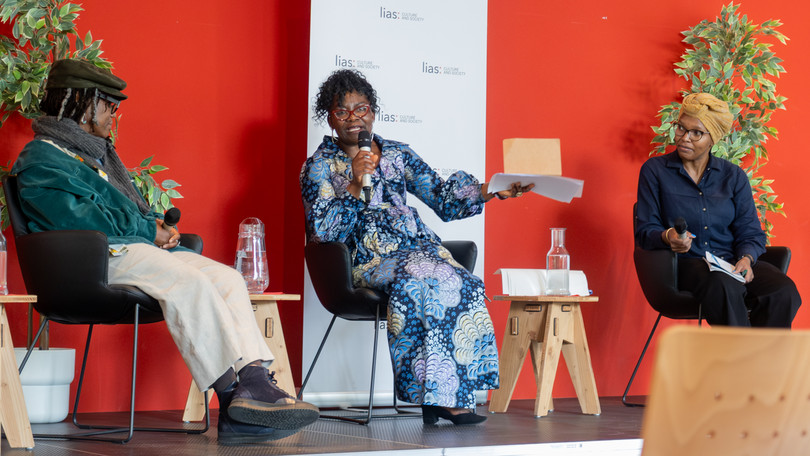
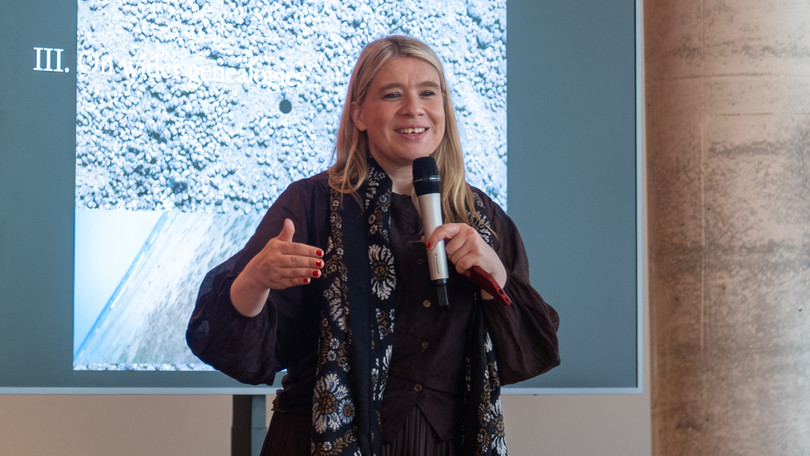
The focus was on how stories, images and artistic practices create alternative “worlds” – beyond colonial, national, and patriarchal boundaries. Yvonne Adhiambo Owuor spoke about her novel The Dragonfly Sea, a coming-of-age story of a girl on a journey through the Swahili Seas. Particular emphasis was placed on the role of women in maritime narratives, as well as the conception of the sea as a space of movement, connection, and the crossing of national borders. Owuor challenges colonial narratives linking African mobility exclusively to enslavement, instead emphasizing agency, travel, and exchange. In her lecture “Entangled Cartographies”, she developed the idea of intertwined cartographies: maps, myths, and stories shape our conception of who “we” are. Confronted with global crises, she asked what new stories and forms of coexistence might become possible.
Tsitsi Dangarembga reflected on multimedia as a survival strategy in “metacolonial capitalism”. The shift between film, theatre, and literature has been particularly necessary for African women artists. In autobiographical essays, she critically engages with Zimbabwe, nation-building, and her own relationship with the government. She sees art as a means of imagining alternative futures: “We must start the world anew.”
Maaza Mengiste spoke about the connection between literature and photography in The Shadow King. She demonstrated how colonial photography dehumanizes African people and legitimizes violence. Her literary work seeks to restore dignity and complexity to these images. Mengiste collects historical photographs, treats the people depicted as real individuals with stories, and develops collaborative projects such as “Project 3531”, which examines the Italian colonization of Ethiopia. Her current book project is dedicated to Black life stories in Berlin in the 1930s and connects the past and present of racism and migration.
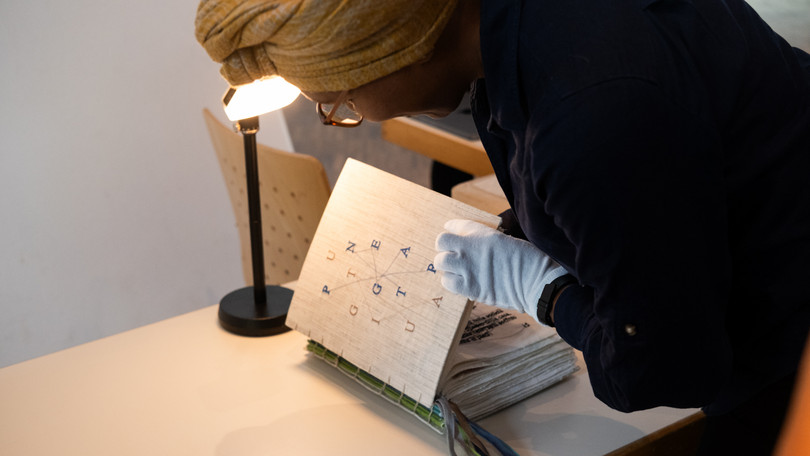
Muna Mussie’s film Cinema Impero engages with colonial archives, Eritrea, and artificial intelligence in a fragmentary way. The discussion highlighted how the film destabilizes colonial visual orders and devises alternative forms of remembrance. In her project “Punteggiatur”, which she subsequently presented, Mussie collaborated with migrant women in Italy. Through embroidery, conversations, and collective writing, what emerged was a “textile book” exploring language, migration, and ambiguity. The project understood schools not merely as a place of education, but as a space for encounter and mutual learning.
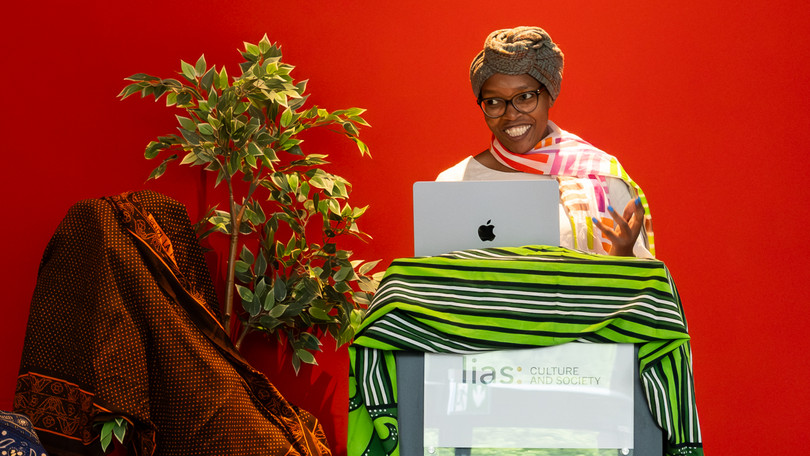
Mshaï Mwangola combined performance, storytelling, and textiles. Leso fabric was understood as a form of cartography: patterns, names, and the movement of the fabric told stories of trade, colonialism, and cultural interconnections in the Swahili Seas region. Mwangola emphasized the importance of “orature”, a cross-border aesthetic and intellectual tradition of oral storytelling. Art appeared here as a collective dialogue that encouraged people to critically reflect on their present.
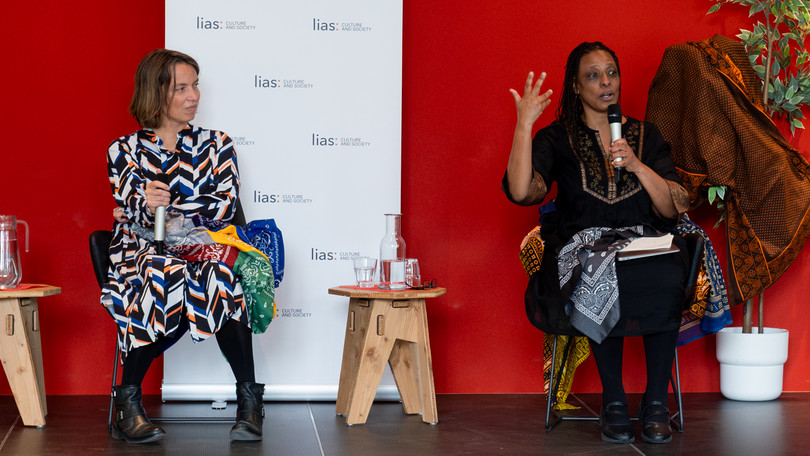
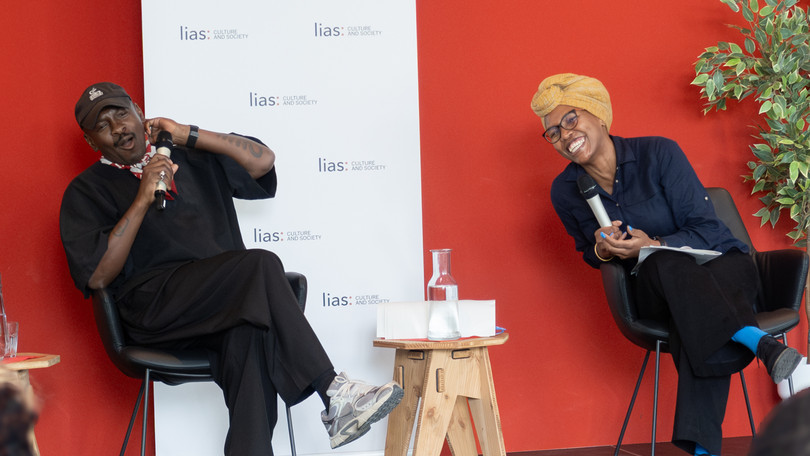
Grace A. Musila spoke with filmmaker, poet, and visual artist Lemohang Jeremiah Mosese. Her first question was how he had come to film. He described his path to cinema as a poetic one, not so much in the sense of writing poetry, but because he had thought in poetic images from an early age, before writing and later cinema became his forms of expression. As film was omnipresent during his childhood, this medium seemed to him like a natural language. When asked about his self-taught background in contrast to institutional education, such as at a film school, Mosese described an ambivalent perspective. Whilst a film school might shorten the learning process and impart technical skills, it was precisely his lack of knowledge of cinematic rules that gave him the freedom to develop his own visual language. For him, art arises not solely from technique, but from inspiration, intuition, and the “cracks” through which unpredictability a work; a reference to a reference to the Japanese art of kintsugi.
The inspiration for his films often stems from architecture, landscapes, and mythologies. At the heart of his work lie questions of violence, memory, and belonging. The red fabric in his film Ancestral Visions of the Future, which had been screened the day before, symbolizes for him a violent superimposition of landscape and history. Recurring motifs in a number of his films are strong female and maternal figures, shaped by his own life story. He initially writes female characters as male figures so as to avoid stereotypical notions. He then changes the characters’ names to female ones, which was a surprising revelation for Grace A Musila as well as for the event’s guests.
The event as a whole understood “worldmaking” as an open, collaborative process. Various media – literature, film, photography, performance, textiles, and archival work – were used to challenge dominant historiographies and devise new relationships, memories, and visions of the future. In the concluding discussion, the participants described the workshop as a tapestry of encounters and ideas that fostered hope for long-term connections and shared ways of thinking and creating.