
Artistic Practices Challenge Historical Narratives
Panel War Memory
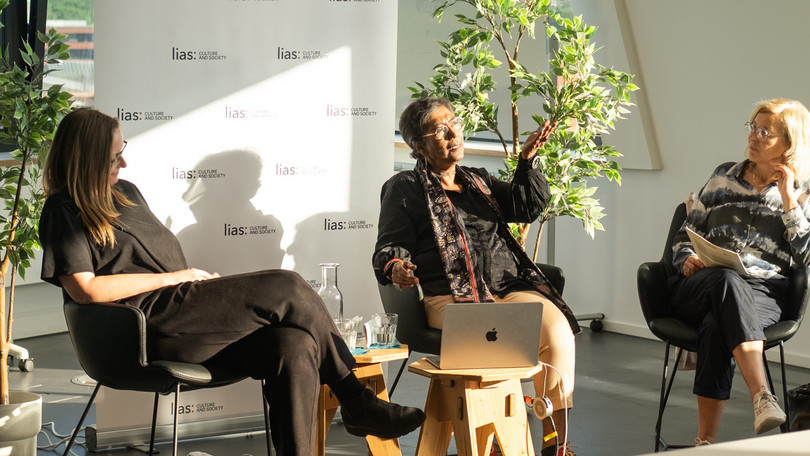
2026-06-17 The panel discussion “War, Memory, and Infrastructure: Where is Art?” with LIAS Public Fellow Madhusree Dutta (Mumbai), filmmaker & artist Clarissa Thieme (Berlin/Vienna) und LIAS Co-Direktorin Susanne Leeb explored how art, archives, images, and storytelling operate within contexts of war, political violence, and historical memory. The speakers examined how artistic practices can challenge dominant historical narratives and create alternative forms of testimony and collective remembrance.
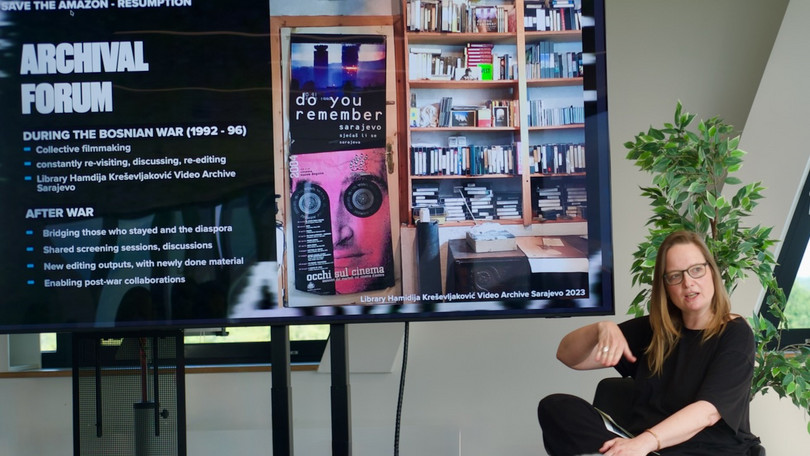
The first presentation "Save the Amazon – Resumption" by Clarissa Thieme focused on an archival project in Sarajevo that emerged during the Bosnian War. A group of teenagers began documenting everyday life under siege, creating a collective archive that continued after the war. Through collaborative filming, editing, and discussion, the archive became a space where people who had remained in Bosnia and members of the diaspora could reconnect and reflect on traumatic experiences. Artistic works produced from this archive moved between documentary and fiction, questioning conventional forms of evidence and representation. The presentation emphasized how art can function as a political space that fosters dialogue, preserves memory, and imagines futures beyond conflict.
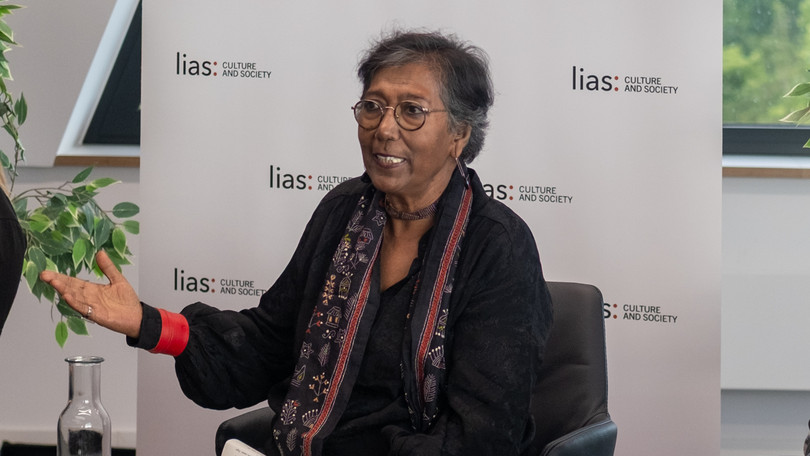
The second presentation “Post-youth Female Body and War”by LIAS Public Fellow Madhusree Duttaexamined the relationship between memory, the body, and political resistance, drawing on experiences from Kashmir and Manipur. It questioned the assumption that bodies transparently carry or reveal memories and highlighted how photographs often acquire meaning through captions and narratives rather than through the image itself. The speaker discussed ongoing conflicts within India that are often framed as internal “conflicts” rather than wars, thereby receiving limited international attention. Particular focus was placed on women’s movements in Manipur, where elderly women became highly visible political actors through protests against state violence and human rights abuses. Their bodies became sites of resistance, challenging both state power and conventional representations of femininity. Artistic and cinematic practices were presented as forms of cultural resistance that helped create new political communities and collective identities.
The discussion that followed centered on the relationship between images, narratives, and historical knowledge. Participants reflected on how the meaning of images constantly shifts depending on context, interpretation, and political conditions. Rather than viewing archives and documents as fixed records of truth, they described them as dialogical and unstable. Fiction was presented not as the opposite of truth but as a means of communicating experiences that conventional historical or legal frameworks often fail to capture.
A recurring theme was the tension between testimony and political action. While archives and witness accounts can provide crucial evidence and have even been used in international legal proceedings, participants noted that testimony alone does not necessarily lead to political change. They also highlighted the ethical difficulties of collecting testimonies, since survivors may be required to repeatedly relive experiences of violence. Art was therefore described as a space that can complement legal and historical processes by creating forms of engagement that foreground human experience and dialogue.
Questions from the audience further addressed the status of documents, evidence, and reality in an era saturated with images and videos. The speakers argued that documents should not be understood as neutral carriers of information but as traces that invite interpretation and conversation. They also reflected on contemporary indifference toward images of suffering and the challenges of producing memory and political awareness through visual media.
Overall, the panel presented art as a critical practice that resists dominant histories, questions established forms of evidence, and creates spaces for collective memory, dialogue, and political imagination.