Artistic Research and the Afterlives of Digital Networks
Afterlifes of Networks
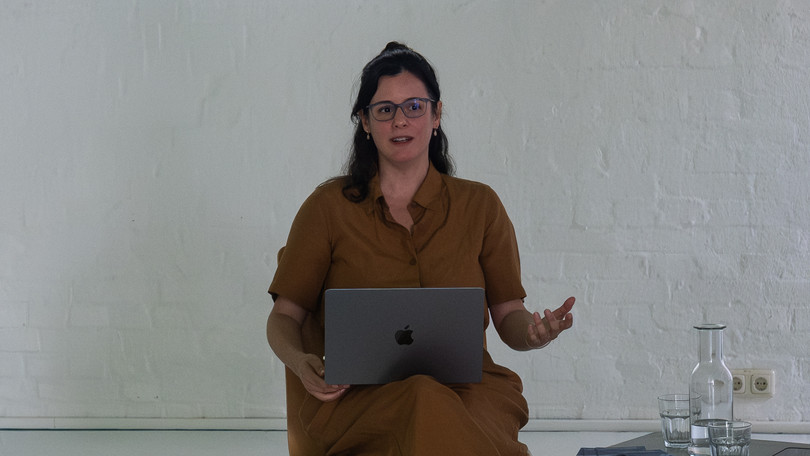
2026-07-07 In the two-day workshop “The Afterlifes of Networks”, LIAS Fellow Nathalia Lavigne introduced the artistic practice of Brazilian artist and researcher Daniel Jablinski (*1985), which emerged from his transition from scientist to artist. While scientific knowledge is inherently open to scrutiny, Jablonski argued that art enables personal experience to serve as a point of departure while simultaneously rendering it meaningful and accessible to others.
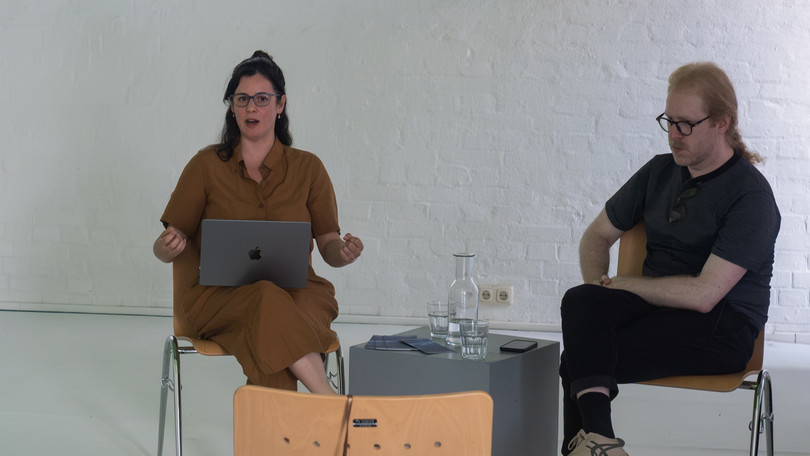
In the two-day workshop “The Afterlifes of Networks”, LIAS Fellow Nathalia Lavigne introduced the artistic practice of Brazilian artist and researcher Daniel Jablinski (*1985), which emerged from his transition from scientist to artist. While scientific knowledge is inherently open to scrutiny, Jablonski argued that art enables personal experience to serve as a point of departure while simultaneously rendering it meaningful and accessible to others.
Jablonski investigates everyday experiences in order to reveal collective patterns extending beyond the individual. His work deliberately blurs the distinction between subject and object: personal experience becomes material for artistic research, inviting audiences to identify with and critically reflect on the work. At the centre of his practice lies the question of which experiences people share and how alternative forms of living together and communicating might be imagined. The choice of medium is determined by the respective research question and intended audience.
Jablonski then presented his project FWD: Sorry for the Delay (2017). The project originated from his habit of beginning messages with an apology for being late in replying. He asked whether this behaviour was symptomatic of digital communication, which is characterized by a continuous cycle of messages, replies, and increasing communicative pressure.
To illustrate this point, he referred to Argentine writer Ricardo Piglia (1941–2017), who described digital communication as an endless cycle of mutual obligations. As an artistic intervention, Jablonski invited participants to forward interrupted or abandoned chat conversations to him. Over the course of a month, he analysed these exchanges and composed a reply on behalf of the person who had last failed to respond. To do so, he frequently reconstructed the context of the conversation by contacting those involved. Some of his messages successfully revived communication, while others remained unanswered, revealing the limitations of the project. Jablonski noted that digital communication has changed considerably since 2017. Given the growing importance of messaging services and the dramatic increase in digital communication, he no longer considers the project suitable for repetition in its original form.
Finally, he introduced his current project, All the Rest Is Literature, which explores book dedications. Drawing on historical examples, including those of Xavier de Maistre (1763–1852) and Jorge Luis Borges (1899–1986), he demonstrated how dedications reflect literary conventions while making relationships between authors and readers visible. Jablonski understands both printed and handwritten dedications as expressions of social networks, suggesting that literature extends beyond textual structures to become a space of real social interaction.
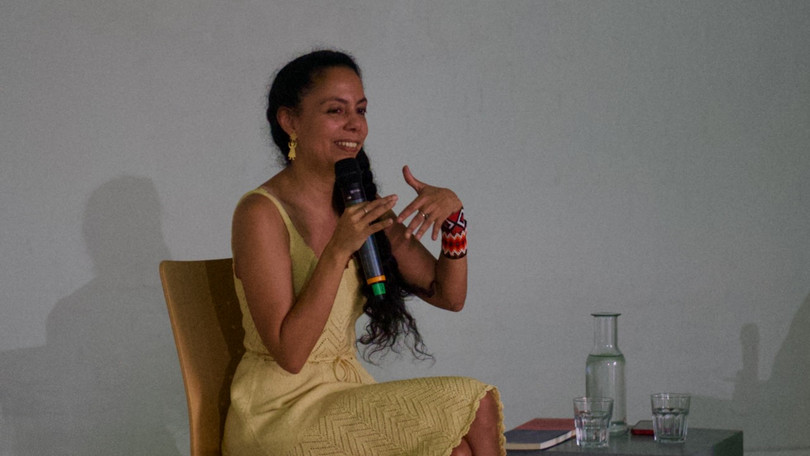
The talk by Brazilian artist Giselle Beiguelman (*1962) focussed on the preservation of net art, the transformation of the internet, and the impact of artificial intelligence on artistic practice and digital culture. Rather than restoring obsolete websites, Beiguelman advocated developing new strategies for preserving net art that document both what has survived and what has been lost. Her project The Book After the Book exemplifies this approach. Instead of reconstructing the original website, it foregrounds absence, transformation, and loss as fundamental components of digital memory. Rather than leading users back to the original version, the redesigned platform deliberately directs them towards an “interval” or void, thereby making the instability of digital memory tangible.
According to Beiguelman, a central principle of digital preservation is that historical traces should not be erased. The website incorporates snapshots of the original source code alongside contextual information explaining the historical significance of each page. At the same time, broken links remain intentionally untouched. Rather than representing technical failure, these broken links document the evolution of the web and the disappearance of digital communities. The project thus becomes both a map of what has been preserved and a record of what no longer exists.
Beiguelman further argued that preserving websites extends far beyond reconstructing their visual appearance. Changes in cybersecurity, software, and technical infrastructures fundamentally alter how websites function and can be understood. Even technically accurate reconstructions cannot fully recover the original cultural and technological conditions under which net art was created. Digital preservation therefore becomes a process of documenting irreversible transformation rather than of restoring an allegedly authentic original state.
The subsequent discussion addressed the transformation of the early web from a space of community, experimentation, and openness into a highly commercialized, platform-dominated environment. Beiguelman argued that today’s internet is increasingly shaped by machine-generated content, opaque algorithms, and AI systems that primarily communicate with other machines. As a result, digital infrastructures have become progressively less comprehensible to human users, limiting their ability to critically understand the technologies that structure everyday life.
At the same time, Beiguelman described AI as the defining code of the present, as it is fundamentally reshaping language, perception, and knowledge production. Despite its entanglement with corporate power and political interests, she also sees AI as offering new possibilities for critical artistic practice and collaboration between human and nonhuman actors. For Beiguelman, the challenge for contemporary art lies in imagining new aesthetic and social possibilities within evolving technological networks.
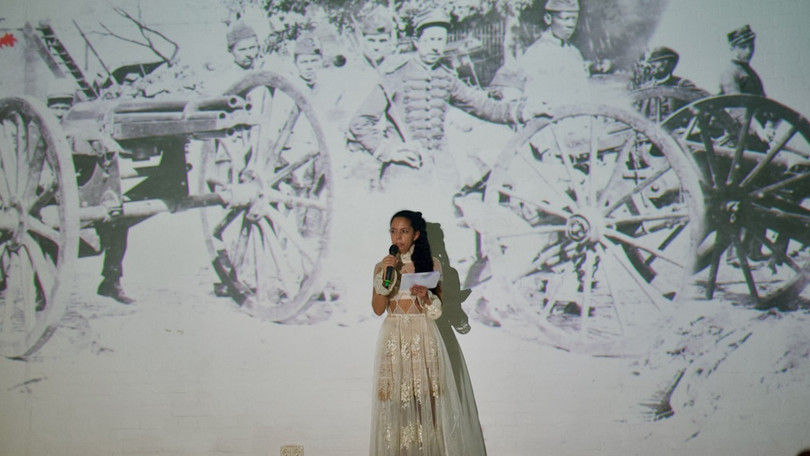
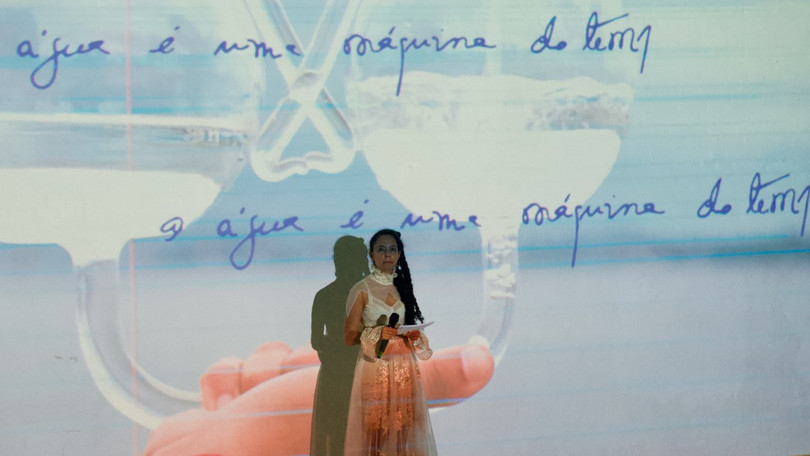
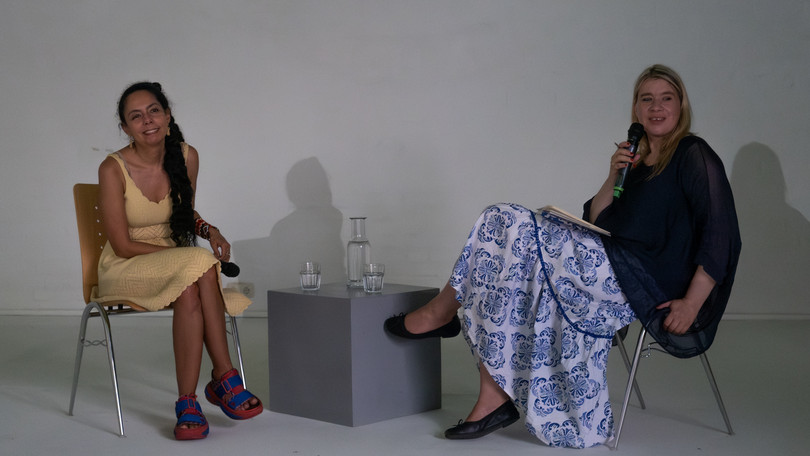
The evening concluded with a presentation of Aline Motta’s project “Water is a Time Machine”, in which the Brazilian artist reconstructs her family’s history in early twentieth-century Rio de Janeiro through the personal documents of her mother. In the subsequent conversation, moderated by Vera-Simone Schulz, Motta discussed how she combines archival research, oral histories, and speculative storytelling to reveal colonial erasures within her family history and to connect personal memory with broader historical processes.