
Award for Exceptional Civil Courage: Lifesavers Honored
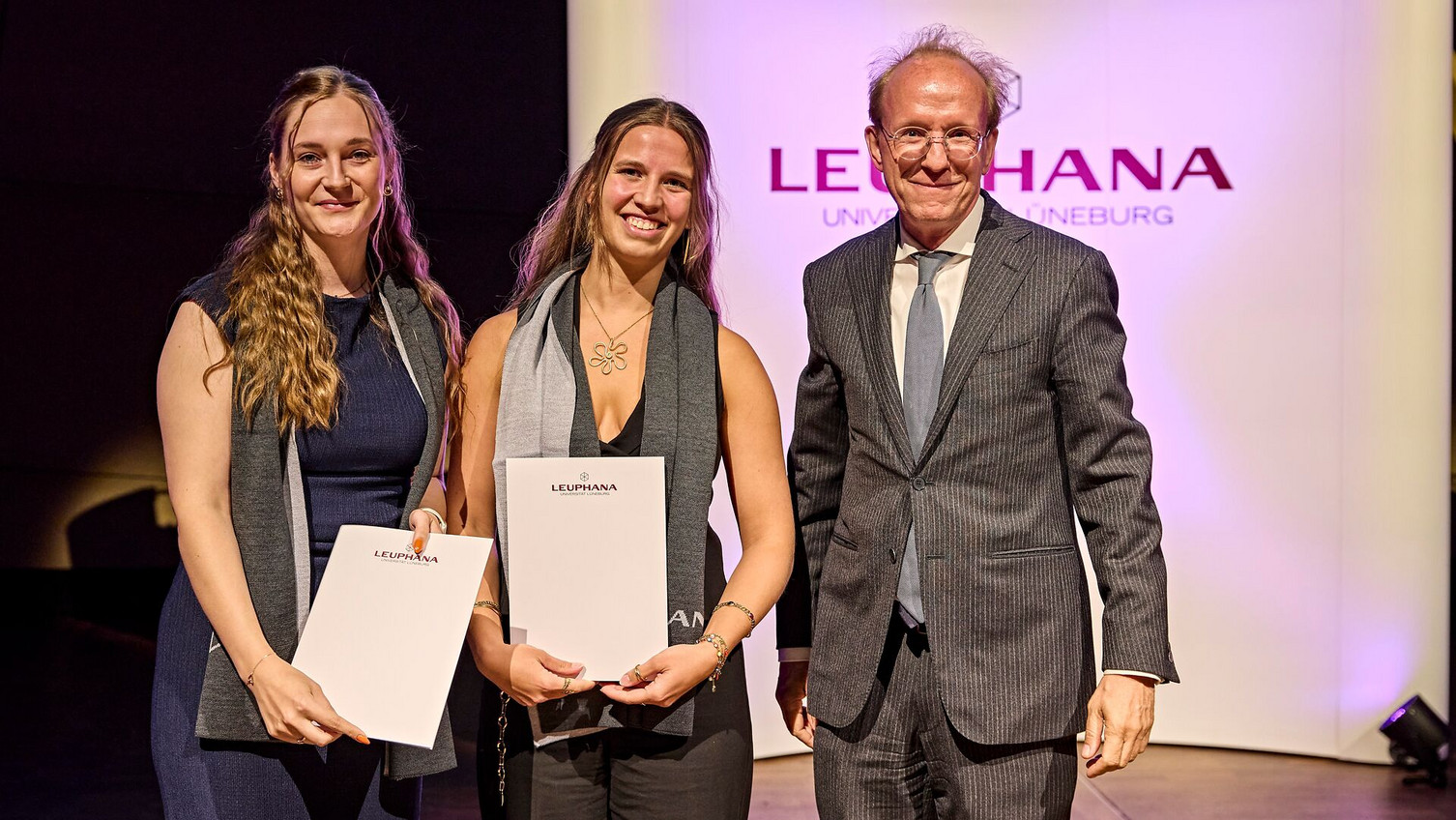
2026-08-03 The Award for Exceptional Civil Courage was presented for the first time at this year’s Leuphana dies academicus. The award went to students Madelaine Stenger and Sarah Boenert, who saved a lecturer’s life through their quick action. For both of them, the award serves as a call not to look the other way.
The semester had just begun. Suddenly, the door opened: “There’s a medical emergency. Who can help?” Sarah Boenert volunteered immediately. A few seconds later, the student teacher was kneeling next to a motionless professor. He had collapsed just moments earlier. She called the emergency services, instructed other students to fetch the first-aid kit and defibrillator, and immediately began treating the patient. “I just went into action,” she recalls. Her professional response in that moment was no coincidence: Sarah Boenert has been active in the Salzhausen Volunteer Fire Department for many years, rides along on calls, and led the youth fire brigade. In addition, she completed an apprenticeship as a medical assistant before starting her studies.
Just a few moments later, Madelaine Stenger arrived at the scene of the emergency. Students had run into several rooms to get help: “They did exactly the right thing,” says the 24-year-old. She comes from Schafflund, a village near the Danish border on the Baltic Sea: “I’m a DLRG lifeguard, boat captain, and trained paramedic. That’s why I regularly participate in first-aid training,” she explains.
The two students had not known each other before this incident. Nevertheless, they immediately worked hand in hand: While Sarah Boenert initially performed chest compressions, Madelaine Stenger administered rescue breaths to the patient: “We just trusted each other. We were lucky to have each other.” The emergency physician later confirmed: The two students saved the young father’s life with their quick response.
Both were honored at the dies academicus for this extraordinary commitment. President Sascha Spoun praised their efforts in his keynote address: “Within the limits of their capabilities, they did what they could, and it was enough to save a human life. They didn’t let a sense of helplessness paralyze them; instead, they acted decisively.”
Despite the honor, the students remain humble. “It went without saying that we would help. We would have done it even without thanks,” they both say. Many people go out of their way to help others every day without receiving any recognition.
Even more important to them than the award itself is the message behind it: “We want to call on everyone to take action in an emergency. It’s always better to respond than to do nothing.” Both want to encourage others to take first-aid courses and learn more about providing first aid on the scene.
Volunteer work and social engagement remain an integral part of both their lives. Sarah Boenert has just completed her bachelor’s degree: “I’m looking forward to my master’s program and my teaching internship.” First aid will also be on the curriculum: “Children want to help; I’ll show them how to respond to emergencies without fear.”
Madelaine Stenger is preparing for her research internship in Costa Rica. She is majoring in Environmental and Sustainability Science and has been actively involved since the start of her studies, including with the umbrella organization for student initiatives (DSi); she supports the Academic Events team in various roles, such as in the awareness teams and, most recently, primarily in the central student planning team. She also served as student dean at the Faculty of Sustainability.
For both of them, social cohesion begins when people take responsibility for one another. They hope that, in the event of another emergency, people will once again come together to show moral courage, and they urge: “We must take good care of one another.”