
Research & Projects
PriOrity Effect Mechanisms (POEM): interactive effects of assembly history and weather conditions on the creation and persistence of priority effects in dry acidic grasslands
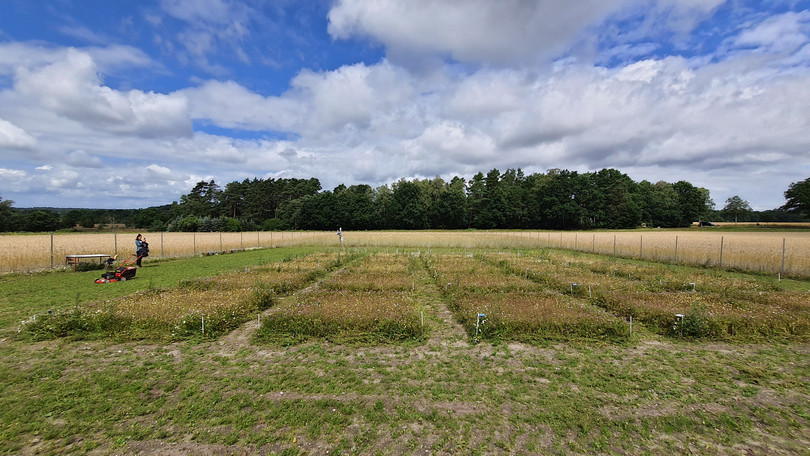
Started in 2020, POEM is a German Science Foundation (DFG)-funded project that investigates how the order in which plant species establish in a community influences the further assembly and stability of dry acidic grasslands. When order of arrival influence either the community outcome or ecosystem functioning, we call this a priority effect. More specifically in this second phase of the POEM project we are examining how assembly history interacts with weather conditions, such as drought or temperature variability, to shape plant community structure and ecosystem functioning over time. By combining field experiments and ecological analysis, POEM aims to understand the mechanisms that drive the creation and persistence of priority effects, to support more effective conservation and restoration strategies for species-rich grassland ecosystems.
To gain knowledge on how the weather conditions during the year of initiation of priority effects influence their outcome, we have set up three sub-experiments with the same experimental design in different years. This is what makes POEM a unique and novel experiment. The experimental set-up currently consists of three independent sub-experiments located at the same site (Niederhaverbeck, Lower Saxony, Germany) established in a different year. In each sub-experiment, the order of arrival of three plant functional groups (legumes, forbs and grasses) is manipulated by sowing one functional group 6 weeks earlier than the others. The third sub-experiment has transitioned to a one-year sowing interval. The same priority effect treatments are tested in all sub-experiments: synchronous sowing, grasses sown first, forbs sown first, and legumes sown first. So far we have found that the sowing legumes or forbs earlier than the other plant functional groups led to deeper rooting then in other treatments (Alonso-Crespo et al. 2025 J Vegetation Science), and we are currently tracking whether the deeper rooting has persisted. In contrast, sowing legumes or forbs first did not cause strong priority effects in aboveground biomass or species diversity and composition (as was found in more nutrient-rich soils in previous field experiment; Weidlich et al. 2017).
Rwanda
The Rwanda Restoration Project: A social-ecological systems approach to inform ecosystem restoration in rural Africa
This is a German Science Foundation (DFG) research unit that focuses on understanding and improving ecosystem restoration in rural Rwanda by applying a social-ecological systems (SES) approach. It examines how ecological processes and human activities interact within landscapes that support local livelihoods, within an agroforestry Forest Landscape Restoration context. Overall, the consortium is assessing already restored sites in the Western region of Rwanda (in four districts) from a social-ecological perspective as well as doing live restoration with local communities in co-creation within a living lab setting. Within the ecosystem functioning and services lab, we are working on two main aspects: 1) the biodiversity impacts of the tree-focused restoration, such as effects on tree diversity, butterfly and bird diversity (Verene Nyiramvuyekure, together with Professor Jörn Fischer at Leuphana). 2) setting up round tables in two communities in the Rutsiro district in Western Rwanda with whom we are co-designing tree restoration plantings that include the overall goal of improving soil health, increasing native tree diversity and trophic diversity (birds, insects) as well as livelihoods within the Agroforestry context.
GrünlandVielfalt Project
The project (2022-2028) aims to restore and enhance species-rich grasslands in the Ise floodplain in Lower Saxony, Germany. The project seeks to increase biodiversity on grassland areas in the Gifhorn region of Lower Saxony by promoting a more extensive and ecologically sustainable management of the land. To achieve this, the project combines ecological restoration measures (e.g. reseeding with native plant species, testing the potential of applying priority effects research in the real world of grasslands, rewetting degrades grasslands) with socio-economic approaches developed together with local farmers. These actions are designed to improve plant diversity and support insects and birds, while also strengthening ecosystem services such as pollination, carbon storage, and water retention.
Through collaboration between scientists, conservation organizations, and agricultural stakeholders, the project establishes living labs to test innovative management strategies that balance biodiversity conservation with viable agricultural practices.
The Grassworks project ran from 2021 to 2025 and was funded by the German Ministry of Education and Research (BMBF) within the FEdA programme (https://www.feda.bio/en/ ) and investigated what makes grassland restoration successful in Germany by applying a social-ecological systems approach. This was a large-scale endeavour that assessed the outcomes of grassland restoration across three regions in Germany (North, Centre and South) and combined assessing already restored sites with doing live restoration with local actors in co-creation in living labs (like in the Rwanda Restoration project above). This project is one of a kind in Germany, in terms of its integrated assessment across multiple sites: we compared restored sites with both positive and negative restoration sites (see Temperton et al. 2025 Restoration Ecology for details).
The project combined ecological studies with analyses of social, economic, and governance factors that influence restoration outcomes. Working across several model regions and in collaboration with local actors, it aimed to identify effective restoration strategies and develop practical tools and policy recommendations to support the recovery and sustainable management of species-rich grasslands.