
Anna-Marie Rönsch
Vita
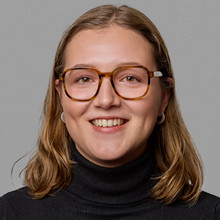
Anna-Marie Rönsch has been a research assistant and doctoral candidate at the Institute for Culture and Aesthetics of Digital Media (ICAM) at Leuphana University since September 2025. She earned her bachelor’s degree in literature, art, and media studies at the University of Konstanz, focusing on media studies and collaborating with Prof. Dr. Beate Ochsner’s research group. She then completed a Research Master’s degree at Erasmus University Rotterdam (NL) in the field of Sociology of Culture, Media, and Arts, where she worked as a research assistant at the university’s Innovation Hub, collaborated on research projects, and worked to make teaching more inclusive. During her master’s program, she spent a semester studying at the University of Antwerp (BE).
As part of her role as a research assistant, she coordinates and teaches in the Bachelor’s program in the Major Digital Media (MDM), which is offered in cooperation with the Hamburg Media School.
Her current research focuses on the intersection of media studies and disability studies, disability media studies, with an emphasis on algorithmic media and the co-constitution of disability.
Teaching
Media Theory, History of Artificial Intelligence, Disability Media Studies
Research Interests
Media Studies, Disability Media Studies, Critical Data/ AI Studies, Media History, Science and Technology Studies
Projects
-
The algorithmic co-constitution of dis/ability
Anna-Marie Rönsch (Project manager, academic)
Project: Dissertation project
Publications
Journal contributions
- University Students’ Perspectives and (Re-)Imaginations of Inclusive Classroom Practices: An Inclusive and Collaborative Approach to Inclusive Education
David Ongenaert (Author) , Natalia Koenig (Author) , Anna-Marie Rönsch (Author) , 25.03.2026 , in: International Journal of Inclusive Education , 19 p.Research output: Journal contributions › Journal articles › Research › peer-review
- Provozierte Unruhe: Von Störungen und Entstörungen in Among Us
Irena Brehm (Author) , Beate Ochsner (Author) , Henrika Röhr (Author) , Ramona Schön (Author) , Markus Spöhrer (Author) , Harald Waldrich (Author) , Anna-Marie Rönsch (Author) , 01.01.2023 , in: Spiel| Formen-Zeitschrift für Play Game Studies, 2, 1 , p. 62-84 , 22 p.Research output: Journal contributions › Journal articles › Research › peer-review
Activities
-
Regulating Access, Co-Producing Algorithms. The Paradox of AI-Overlays in Web Accessibility
Anna-Marie Rönsch (Speaker)
Activity: Conference Presentations › Research
-
Solide Zwischenräume: Disability Media Studies unter (noch) nicht tragfähigen Bedingungen
Anna-Marie Rönsch (Speaker) , Jan Müggenburg (Speaker) , Beate Ochsner (Speaker) , Robert Stock (Speaker) , Judith Willkomm (Speaker) , Daniel Wessolek (Speaker)
Activity: Presentations (poster etc.) › Research
-
The first medical chatbot? A media archaeological study of the expert system MYCIN
Anna-Marie Rönsch (Speaker)
Activity: Presentations (poster etc.) › Research
-
The algorithmic co-constitution of dis/ability. A research outline.
Anna-Marie Rönsch (Speaker)
Activity: Conference Presentations › Research
Courses
Saturday January 23th: 10-14h
In this colloquium, we focus on forming an exciting and answerable
research question for a BA thesis. We look at the relationship between
formulating a hypothesis and subsequently identifying methods to guide
the inquiry. The colloquium is a process of discovery best conducted
with peers.
The study of Digital Culture increasingly calls for interdisciplinary
methods – you have a considerable amount of latitude in terms of your
topic and methods. This disciplinary latitude means that choosing a
topic narrow enough to answer in a BA thesis is critical. For this
reason, much of the feedback given in the initial stages amounts to “be
more specific.” Accordingly, you will get the most out of this
colloquium if you arrive with a clearly defined topic. You have to know
the boundaries (e.g., a time frame, geographic area, demographics).
In this introductory course we look at current approaches to research on Digital Media. In addition to the cultural and media studies approaches that are essential for our study programme, you will get to know positions from related fields such as the history of technology, disability studies, science and technology studies or game studies. Each session combines the term “digital cultures” with a verb that refers to a certain aspect of how digital media structure our current situation. At the same time, they can be understood as an opportunity for acting on and shaping digital cultures.
In this introductory course we look at current approaches to research on Digital Media. In addition to the cultural and media studies approaches that are essential for our study programme, you will get to know positions from related fields such as the history of technology, disability studies, science and technology studies or game studies. Each session combines the term “digital cultures” with a verb that refers to a certain aspect of how digital media structure our current situation. At the same time, they can be understood as an opportunity for acting on and shaping digital cultures.