
Dr. Daniel Irrgang
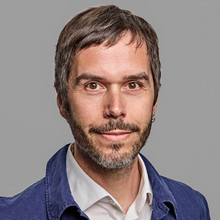
Vita
Daniel Irrgang is a scholar in media, art, and culture with a focus on the enactment of knowledge, e.g., in exhibitions, diagrammatic depictions, or algorithmic practices in art and design. His current focus in research and teaching is on environmental humanities, particularly on artistic or aesthetic approaches towards climate science representation, as well as on technological and ideological structures of digital inequalities.
Since October 2025 he is a postdoctoral researcher within the ‘Climate Futures in Digital Cultures’ research section of the wider program ‘Embracing Transformation’ at Leuphana University of Lüneburg, where he is affiliated with the Center for Digital Cultures and the Institute of Culture and Aesthetics of Digital Media (ICAM). Daniel is also an associated researcher with the ‘Design, Diversity und New Commons’ section at the Weizenbaum Institute for the Networked Society in Berlin.
For the 2024/25 winter term he was visiting professor at the Institute of Culture and Aesthetics of Digital Media (ICAM), Leuphana University of Lüneburg, where he represented the chair for Media Aesthetics and Media Technology.
Previously, he was a Marie Skłodowska-Curie fellow and postdoctoral researcher at the University of Copenhagen’s Centre Art as Forum, where he conducted research on Bruno Latour’s and Peter Weibel’s concept of ‘Thought Exhibition’ (EU Horizon 2020, grant agreement no. 101028379).
At the Weizenbaum Institute he was, until August 2022, senior researcher and deputy head of the Berlin University of the Artsresearch group ‘Inequality and Digital Sovereignty’ (now: ‘Design, Diversity, and New Commons‘).
Daniel Irrgang completed his doctorate at the University of the Arts Berlin at the Chair of Media Theory/Archaeology of Media on diagrammatics and expanded mind theories. His research topics include visual representations of information from a media theory, art studies, and cognitive science perspective; historiographies and archaeologies of art and media; critical investigations into the premises of human-computer interaction and its roots in Californian Ideology; investigative practices in the field of art and technology; aesthetics of computer-generated imagery; exhibition and curatorial concepts; and epistemological problems in connection with corporeality and media technology.
From January 2018 to November 2019, Daniel coordinated the research seminar “Critical Zones” with Bruno Latour at the Karlsruhe University of Arts and Design and ZKM | Center for Art and Media, Karlsruhe. He has contributed to the exhibition catalogue (MIT Press) and edited the research section of the ZKM exhibition website.
From May 2016 to July 2019 he was research associate in the Media Philosophy and Art Studies section and between May 2016 and March 2018 assistant to the rector at the Karlsruhe University of Arts and Design. From 2013 to 2016 he was a research associate at the Chair of Media Theory (Siegfried Zielinski) at the Institute for Time-Based Media and supervisor at the Vilém Flusser Archive, Berlin University of the Arts.
Daniel Irrgang is the author and editor of numerous books and paperson the history and theory of media, communication and the arts. Together with Florian Hadler and Alice Soiné, he is also editor of the journal Interface Critique and, together with Siegfried Zielinski and Marcel René Marburger, of the book series International Flusser Lectures. Additionally, he has organised various conferences and other events as well as (co-)curated exhibitions at venues such as the ZKM Karlsruhe, the Einstein Center Digital Future, and the Berlin Academy of Arts.
From 2008 to 2016, Daniel was a founding member of the communication agency AFKM in Berlin.
Projects
-
Representation and aesthetics of digital data in critical zone research
Daniel Irrgang (Project manager, academic)
Project: Research
-
Embracing Transformation: Climate Futures in Digital Cultures
Armin Beverungen (Project manager, academic) , Jan Müggenburg (Project manager, academic) , Daniel Irrgang (Coordination) , Jana Hitziger (Project staff)
→Project: Research
-
Thought Exhibition: The significance of Bruno Latour's art exhibition concept for his work and as a model for art institutions
Daniel Irrgang (Project manager, academic)
→Project: Research
-
Embodied means of thinking: A study on diagrammatics from an expanded hermeneutics and expanded cogni-tion perspective
Daniel Irrgang (Project manager, academic)
→Project: Dissertation project
Publications
Books and anthologies
- Interface Critique 5: Conversing the Book
Florian Hadler (Editor) , Daniel Irrgang (Editor) , Alice Soiné (Editor) , Lindsey Drury (Editor) , Nina Tolksdorf (Editor) , 2025 Berlin , 339 p.Research output: Books and anthologies › Special Journal issue › Research
- Artnodes. Journal on Art, Science and Technology 34 (2024): Special Issue: Materiology and Variantology: invitation to dialogue
Daniel Irrgang (Editor) , Siegfried Zielinski (Editor) , 2024 , 246 p.Research output: Books and anthologies › Special Journal issue › Research
- 媒介思维的谱系 – Zur Genealogie des MedienDenkens
Daniel Irrgang (Editor) , Siegfried Zielinski (Editor) , Florian Hadler (Editor) , 2023 , 650 p.Research output: Books and anthologies › Collected editions and anthologies › Research
- Weizenbaum Journal of the Digital Society 3/1 (2023): Special issue on the Weizenbaum Conference 2022: Practicing Sovereignty – Interventions for Open Digital Futures
Daniel Irrgang (Editor) , Bianca Herlo (Editor) , Martin Krzywdzinski (Editor) , 2023 BerlinResearch output: Books and anthologies › Special Journal issue › Research
- Interface Critique 4 (2023): Diagrammatic Operations
Daniel Irrgang (Editor) , Christoph Ernst (Editor) , Florian Hadler (Editor) , Alice Soiné (Editor) , 2023 , 177 p.Research output: Books and anthologies › Special Journal issue › Research
Journal contributions
- A Cartogram of Vilém Flusser’s Nomadism
Daniel Irrgang (Author) , Clemens Jahn (Illustrator) , 01.11.2025 , in: Flusser Studies, 2025, 40 , p. 1-3 , 3 p.Research output: Journal contributions › Journal articles › Research
- Critical Zones and Thought Exhibitions
Daniel Irrgang (Author) , 19.07.2025 , in: Spool, 12, 2 , p. 7-18 , 12 p.Research output: Journal contributions › Journal articles › Research › peer-review
- NODE “MATERIOLOGY AND VARIANTOLOGY: INVITATION TO DIALOGUE”
Siegfried Zielinski (Author) , Daniel Irrgang (Author) , 01.07.2024 , in: Artnodes, 2024, 34 , p. 1-3 , 3 p.Research output: Journal contributions › Journal articles › Research › peer-review
- Projective Imagination: Vilém Flusser’s Concept of the Technical Image
Daniel Irrgang (Author) , 01.12.2023 , in: Theory, Culture and Society, 40, 7-8 , p. 73-90 , 18 p.Research output: Journal contributions › Journal articles › Research › peer-review
- Editorial: Practicing Sovereignty Interventions for Open Digital Futures
Daniel Irrgang (Author) , Bianca Herlo (Author) , 20.11.2023 2 ed. , in: Weizenbaum Journal of the Digital Society, 3, 2 , 4 p.Research output: Journal contributions › Other (editorial matter etc.) › Research
Contributions to collected editions/anthologies
- Institut Scientifique de Recherche Paranaturaliste, 1972, Louis Bec
Daniel Irrgang (Author) , Anita Jóri (Author) , 01.01.2025 , p. 61 , 1 p.Research output: Contributions to collected editions/anthologies › Contribution of Exihibition catalogues › Research
- Jeffrey Shaw and Dirk Groeneveld (The Legible City)
Daniel Irrgang (Author) , Siegfried Zielinski (Author) , 01.01.2025 , p. 197 , 1 p.Research output: Contributions to collected editions/anthologies › Contribution of Exihibition catalogues › Research
- Apple I, 1976, Steve Wozniak
Daniel Irrgang (Author) , 01.01.2025 , p. 243 , 1 p.Research output: Contributions to collected editions/anthologies › Contribution of Exihibition catalogues › Research
- Telehor, 1919, Dénes von Mihály
Daniel Irrgang (Author) , 01.01.2025 , p. 153 , 1 p.Research output: Contributions to collected editions/anthologies › Contribution of Exihibition catalogues › Research
- Project of Music for Magnetic Tape: Imaginary Landscape No. 5, 1952/53, John Cage
Daniel Irrgang (Author) , 01.01.2025 , p. 53 , 1 p.Research output: Contributions to collected editions/anthologies › Contribution of Exihibition catalogues › Research
Activities
-
Aesthetics of More-than-human Climate Observation in Critical Zone Research
Daniel Irrgang (Speaker)
Activity: Conference Presentations › Research
-
On critical approaches to GenAI in art and aesthetics
Daniel Irrgang (Speaker)
Activity: Guest lectures › Education
-
On critical approaches to GenAI in art and aesthetics
Daniel Irrgang (Speaker) , Mick With Berland (Speaker) , Tanya Ravn Ag (Coauthor)
Activity: Conference Presentations › Research
-
Sensitive Tree Infrastructures: Artistic Representations of Critical Zone Science
Daniel Irrgang (Speaker)
Activity: Conference Presentations › Research
-
Critical Zones and Thought Exhibitions
Daniel Irrgang (Speaker)
Activity: Conference Presentations › Research
Press / Media
-
“Vilém Flusser – Die Gefahren digitaler Kommunikation,” radio feature
1 Media contributionPress/Media: Press/Media
Prizes
-
Postdoctoral Fellowships – Marie Skłodowska-Curie Actions
(Recipient) ,Prize: external Prizes, scholarships, distinctions, appointments › Research
Courses
In our course, we want to identify possibilities for critical artistic practices with, through, and on GenAI. In the first part, we establish a theoretical framework of self-reflexive, situated criticality for research and artistic practice. Here we will highlight three operative principles of GenAI that complicate established traditions of critical practice: black-boxing, access, and relationality. In the second part, we present and discuss examples of artistic investigative practices that work with, through, and on GenAI to expose the technology’s extractivist dynamics. Here, “extraction” refers to the operating principle of tech- and platform-capitalist value creation—characterized particularly by massive energy and data consumption—with disruptive consequences for multispecies ecosystems and human social bonds. These extractivist practices, and their ecological and social ramifications, are often removed from or shielded within consumer lifeworlds, hidden beneath engaging interfaces and narratives of collaboration, co-creation, or positivist innovation. The course treats investigative artistic practice as aesthetic strategies to reveal and make perceptible principles that are, by design, opaque and often imperceptible.
The aim of this seminar is to map these challenges and to analyze conceptual, artistic, and design approaches towards making these tensions graspable. We want to identify ways in which artists, designers, and “the public” – from exhibition visitors to popular science journal readers to climate activists – can critically engage with the complexities of the anthropogenic forcings and their effects on human and more-than-human communities. As Bruno Latour (2020, 19) has put it while describing his exhibition “Critical Zones – Observatories for Earthly Politics” at the ZKM Centre for Art and Media in Karlsruhe (Germany): “Changes in cosmology cannot be registered without changes in representation – in all tenors of the word.” The seminar themes and approaches are based on the course teacher’s collaboration with Bruno Latour at the ZKM and the University of Arts and Design Karlsruhe, where they conducted a two-year research seminar with postgraduates, artists, designers, and curators to conceptually prepare the exhibition “Critical Zones”.
Given the interdisciplinary nature of this course, participants are invited to integrate their individual PhD or related topics, if they align (in the widest sense) with the themes described above. As for the concrete course outcome or exam, participants can choose between two alternative formats, (1) a curatorial concept or (2) a glossary entry. Option (1) entails the development of an own (conceptionally and operatively sound) concept for a fictional exhibition (in art, science, or design) around themes touched up on in our course and, ideally, connected to the individual PhD project. For those participants who seek to expand their publication portfolio, option (2) provides the possibility to contribute an entry to the glossary “Environmental Humanities – Emergent Key Terms.” This ongoing online publication project at the University of Copenhagen’s Faculty of Humanities is edited by the course teacher in cooperation with Ulrik Ekman: https://artsandculturalstudies.ku.dk/research/art-and-earth/environmental-humanities-glossary/. Participants choosing this option can select a glossary term – aligning with the themes of the course and their individual PhD topic – to develop as a glossary entry. An editorial review process will support text editing and eventually decide if entries are accepted for publication.
PhD students submission deadline for the written assignment: March 21, 2027
The aim of this seminar is to map these challenges and to analyze conceptual, artistic, and design approaches towards making these tensions graspable. We want to identify ways in which artists, designers, and “the public” – from exhibition visitors to popular science journal readers to climate activists – can critically engage with the complexities of the anthropogenic forcings and their effects on human and more-than-human communities. As Bruno Latour (2020, 19) has put it while describing his exhibition “Critical Zones – Observatories for Earthly Politics” at the ZKM Centre for Art and Media in Karlsruhe (Germany): “Changes in cosmology cannot be registered without changes in representation – in all tenors of the word.” The seminar themes and approaches are based on the course teacher’s collaboration with Bruno Latour at the ZKM and the University of Arts and Design Karlsruhe, where they conducted a two-year research seminar with postgraduates, artists, designers, and curators to conceptually prepare the exhibition “Critical Zones”.
Given the interdisciplinary nature of this course, participants are invited (although not mandatory) to integrate their individual PhD or MA thesis topics, if they align (in the widest sense) with the themes described above. As for the concrete course outcome or exam, participants can choose between two alternative formats, (1) a curatorial concept or (2) a glossary entry. Option (1) entails the development of an own (conceptionally and operatively sound) concept for a fictional exhibition (in art, science, or design) around themes touched up on in our course. For those participants who seek to publish their work, option (2) provides the possibility to contribute an entry to the glossary “Environmental Humanities – Emergent Key Terms.” This ongoing online publication project at the University of Copenhagen’s Faculty of Humanities is edited by the course teacher in cooperation with Ulrik Ekman: https://artsandculturalstudies.ku.dk/research/art-and-earth/environmental-humanities-glossary/. Participants choosing this option can select a glossary term – aligning with the themes of the course – to develop as a glossary entry. An editorial review process will support text editing and eventually decide if entries are accepted for publication.