
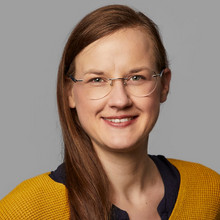
Prof. Dr. Laura Venz
Werdegang
2023: Gastwissenschaftlerin (1 Monat), DeGroote Business School, McMaster University, Kanada
seit 01/2022: Professorin für Arbeits- und Organisationspsychologie, Institut für Management & Organisation, Leuphana Universität Lüneburg; gefördert von der ias AG
2019-2021: Juniorprofessorin für Arbeits- und Organisationspsychologie, Institut für Management & Organisation, Leuphana Universität Lüneburg; gestiftet von der ias AG
2019: Gastwissenschaftlerin (3 Monate), DeGroote Business School, McMaster University, Kanada
2016-2019: Postdoktorandin, Arbeits- und Organisationspsychologie, Universität Mannheim
2015: Gastwissenschaftlerin (5 Monate), Warrington College of Business Administration, University of Florida, USA
05/2015 Dr. rer. soc., Universität Mannheim
2010-2015: Wissenschaftliche Mitarbeiterin & Doktorandin, Arbeits- und Organisationspsychologie, Universität Mannheim
2012/13: Gastwissenschaftlerin (3 Monate), School of Psychology, University of Queensland, Australien
2009-2010: Wissenschaftliche Mitarbeiterin, Arbeits- und Organisationspsychologie, Universität Konstanz
07/2009 Diplom-Psychologin, TU Dresden
Lehrgebiete
Arbeits- und Organisationspsychologie
Organizational Behavior
Differentielle Psychologie
Methoden der Arbeits- und Organisationspsychologie
(Berufliche) Gesundheitspsychologie
Forschungsgebiete
Soziale Beziehungen am Arbeitsplatz
- Kollegenbeziehungen und interpersonelles Arbeitsverhalten
- Vorgesetzte-Mitarbeiter*innen-Beziehungen
Berufliches Wohlbefinden
- Selbstregulation am Arbeitsplatz
- Erholung von Arbeitsstress
- Führung und Wohlbefinden
Demographischer Wandel und Alternde Belegschaften
- Erfolgreiches Älterwerden im Arbeitskontext
- Führung alternder Belegschaften
Publikationen
Beiträge in Zeitschriften
- Maladaptive working time strategies and exhaustion: A Daily Diary Study on Violating Breaks, Working Faster, and Working Overtime
Laura Venz (Autor*in) , Anne Marit Wöhrmann (Autor*in) , 06.06.2025 , in: Sozialpolitik.ch, 2025, 1 , 27 S.Publikation: Beiträge in Zeitschriften › Zeitschriftenaufsätze › Forschung › begutachtet
- Is the joke on you? The impact of sexist humour and gender dynamics on interpersonal work outcomes
Yara Bouckaert (Autor*in) , Louisa Vofrei (Autor*in) , Nina Jonczyk (Autor*in) , Annika Mertens (Autor*in) , Meikel Neumann (Autor*in) , Laura Venz (Autor*in) , David D. Loschelder (Autor*in) , 01.01.2025 , in: European Journal of Work and Organizational Psychology, 34, 1 , S. 144-159 , 16 S.Publikation: Beiträge in Zeitschriften › Zeitschriftenaufsätze › Forschung › begutachtet
- Leader support for recovery: A multi-level approach to employee psychological detachment from work
Sabine Sonnentag (Autor*in) , Ronit Kark (Autor*in) , Laura Venz (Autor*in) , 01.12.2024 , in: Journal of Occupational and Organizational Psychology, 97, 4 , S. 1762–1788 , 27 S.Publikation: Beiträge in Zeitschriften › Zeitschriftenaufsätze › Forschung › begutachtet
- The social dynamics of knowledge hiding: a diary study on the roles of incivility, entitlement, and self-control
Laura Venz (Autor*in) , Monique Mohr (Autor*in) , 01.01.2023 , in: European Journal of Work and Organizational Psychology, 32, 1 , S. 47-59 , 13 S.Publikation: Beiträge in Zeitschriften › Zeitschriftenaufsätze › Forschung › begutachtet
- Leading in times of crisis: How perceived COVID-19-related work intensification links to daily e-mail demands and leader outcomes
Laura Venz (Autor*in) , Katrin Boettcher (Autor*in) , 01.07.2022 , in: Applied Psychology, 71, 3 , S. 912-934 , 23 S.Publikation: Beiträge in Zeitschriften › Zeitschriftenaufsätze › Forschung › begutachtet
- Be smart, play dumb? A transactional perspective on day-specific knowledge hiding, interpersonal conflict, and psychological strain
Laura Venz (Autor*in) , Hadar Nesher Shoshan (Autor*in) , 01.01.2022 , in: Human Relations, 75, 1 , S. 113 – 138 , 26 S.Publikation: Beiträge in Zeitschriften › Zeitschriftenaufsätze › Forschung › begutachtet
- Daily deep acting toward coworkers: An examination of day-specific antecedents and consequences
Hadar Nesher Shoshan (Autor*in) , Laura Venz (Autor*in) , 01.01.2022 , in: Journal of Organizational Behavior, 43, 1 , S. 112-124 , 13 S.Publikation: Beiträge in Zeitschriften › Zeitschriftenaufsätze › Forschung › begutachtet
Beiträge in Sammelwerken
- Recovery from work stress
Laura Venz (Autor*in) , Anne Marit Wöhrmann (Autor*in) , Laura Vieten (Autor*in) , Alexandra Michel (Autor*in) , 25.01.2024 2. Aufl. Hoboken , S. 321-344 , 24 S.Publikation: Beiträge in Sammelwerken › Kapitel › Forschung › begutachtet
Aktivitäten
-
Die Vier-Tage-Woche: Eine systematische Literaturübersicht zu den Nachhaltigkeitsfolgen komprimierter und reduzierter Arbeitszeitmodelle
Islena Ferreira de Araujo (Ko-Autor*in) , Laura Venz (Sprecher*in)
Aktivität: Vorträge in anderen Veranstaltungen › Forschung
-
Work Life Balance: Stipendiat*innen / Gen Z im Gespräch mit Laura Venz und David Gutensohn
Laura Venz (Sprecher*in) , David Gutensohn (Sprecher*in)
Aktivität: Vorträge in anderen Veranstaltungen › Transfer
-
Working from home and recovery
Laura Venz (Sprecher*in) , Anne Marit Wöhrmann (Ko-Autor*in) , Dana Unger (Ko-Autor*in)
Aktivität: Vorträge in anderen Veranstaltungen › Forschung
-
Ausbildung in Zeiten von New Work
Laura Venz (Sprecher*in)
Aktivität: Gastvorträge und -vorlesungen › Transfer
-
Proactively against the crisis: An explorative diary study on discretionary employee green behavior
Laura Venz (Sprecher*in)
Aktivität: Konferenzvorträge › Forschung
-
Wo geht es hin mit der Erholungsforschung?
Laura Venz (Keynote Sprecher*in)
Aktivität: Vorträge in anderen Veranstaltungen › Forschung
-
Work well, rest well, be well: How experience-sampling methods help us understand the new world of work
Laura Venz (Sprecher*in)
Aktivität: Gastvorträge und -vorlesungen › Forschung
-
Arbeiten wo und wann man möchte: Grenzenlose Freiheit oder grenzwertige Praxis?
Laura Venz (Sprecher*in)
Aktivität: Gastvorträge und -vorlesungen › Transfer
-
Heute hier, morgen dort: Erkenntnisse zur Arbeit im Wechsel zwischen Homeoffice und Büro
Laura Venz (Sprecher*in)
Aktivität: Gastvorträge und -vorlesungen › Forschung
-
New Work: Was ist das und was macht das mit uns?
Laura Venz (Sprecher*in)
Aktivität: Gastvorträge und -vorlesungen › Transfer
Auszeichnungen
-
EAWOP impact incubator research dissemination award
Meikel Neumann (Empfänger/-in) Laura Venz (Empfänger/-in) David D. Loschelder (Empfänger/-in) ,Auszeichnung: Externe Preise, Stipendien, Auszeichnungen, Ernennungen › Transfer
-
Human Relations Paper of the Year Award 2022
Laura Venz (Empfänger/-in) ,Auszeichnung: Externe Preise, Stipendien, Auszeichnungen, Ernennungen › Forschung
-
Outstanding Reviewer in the 2021 Emerald Literati Awards, selected by the editorial team of Journal of Managerial Psychology
Laura Venz (Empfänger/-in) ,Auszeichnung: Externe Preise, Stipendien, Auszeichnungen, Ernennungen › Forschung
Lehrveranstaltungen
Quantitative Fragebogenstudie zu Arbeitszeit- und Arbeitsortflexibilität, Arbeitsstress und Erholung
Individuelle Abschlussarbeit unter Einbindung in eine Projektgruppe
Abschlussarbeit kann auf Deutsch oder Englisch verfasst werden (je nach Prüfungsordnung)
---
Quantitative survey study on working time and work location flexibility, work stress, and recovery
Individual thesis with integration into a project group.
Course:
This course consists of the following 10 parts: (1) discussing relevant literature of work psychology and organizational behavior research, (2) identifying a research question, (3) deriving hypotheses, (4) getting to know research designs in applied work psychology, (5) applying a quantitative survey study design, (6) implementing and conducting an empirical research project using a survey design, (7) collecting field data, (8) analysing the data using SPSS or R, (9) evaluating the results, and (10) presenting the findings.
Overall, this seminar engages students to actively reflect on and apply future skills within their specific fields and engage in interdisciplinary perspectives. Future skills encompass the essential competencies required to thrive in dynamic work environments.
By considering their future work domains, students will engage in various reflections to understand the relevance of future skills, how they can be applied to their personal learning and development processes, to discuss the chances and limits of artificial intelligence (AI) and its ethical aspects. Students will explore how these skills intersect with emerging trends, technological advancements, and societal changes, enabling them to navigate and contribute meaningfully to their respective fields.
The accompanying reflective format will provide students with opportunities to assess their skill sets, strengths, and areas for improvement. They will also be encouraged to consider their future professional aspirations and how future skills can be transferred and integrated into their learning and development processes.
Die Vorlesung vermittelt Theorien und Methoden zum Verständnis von Verhalten und Prozessen im Arbeits-und Organisationskontext. Die Vorlesung beleuchtet die verschiedenen Analyseeinheiten Individuen, Teams/Gruppen und Organisationen und behandelt dabei folgende Themen:
Einführung in die Arbeits- und Organisationspsychologie - geschichtlicher Abriss
Arbeitsanalyse und Arbeitsgestaltung
Teamarbeit und deren Gestaltung
Führung
Gestaltung von Organisationen und Organisationsentwicklung
Wirkung von Arbeit: Stress und Gesundheit
Arbeitseinstellungen: Arbeitszufriedenheit und Commitment
Arbeitsmotivation und Arbeitsengagement
Arbeitsleistung (Aufgabenleistung, kontextuelle Leistung, kontraproduktives Verhalten)
Leistungsmessung und Leistungsbeurteilung
Personalauswahl
Karrieren in Organisationen: Personalentwicklung und Training
Die Vorlesung vermittelt Theorien und Methoden zum Verständnis von Verhalten und Prozessen im Arbeits-und Organisationskontext. Die Vorlesung beleuchtet die verschiedenen Analyseeinheiten Individuen, Teams/Gruppen und Organisationen und behandelt dabei folgende Themen:
Einführung in die Arbeits- und Organisationspsychologie - geschichtlicher Abriss
Arbeitsanalyse und Arbeitsgestaltung
Teamarbeit und deren Gestaltung
Führung
Gestaltung von Organisationen und Organisationsentwicklung
Wirkung von Arbeit: Stress und Gesundheit
Arbeitseinstellungen: Arbeitszufriedenheit und Commitment
Arbeitsmotivation und Arbeitsengagement
Arbeitsleistung (Aufgabenleistung, kontextuelle Leistung, kontraproduktives Verhalten)
Leistungsmessung und Leistungsbeurteilung
Personalauswahl
Karrieren in Organisationen: Personalentwicklung und Training
We will have:
* a research group kick-off session (Tue, 27.10.2026, 16:15, C 6.317 / hybrid)
* about biweekly research forum meetings (Tue, starting 10.11.2026, 16:15, C 6.317 / hybrid)
* the doctoral research conference day (organized at the School of Management and Technology, Fri, 29.01.2027)
In the (biweekly) research forum meetings, you can present research that is at a preliminary stage. The purpose of these presentations is to help you improve your research project. Therefore, please prepare a presentation of a maximum of 10 minutes and conclude by asking questions and raising issues that help you advance your project. Consider the other participants as a resource to improve your work.
During the Doctoral Conference Day at the end of the semester, you can present research that is at a more advanced stage. Typically, you give a presentation of a maximum of 15 minutes, including all parts of a paper. The Doctoral Conference Day will take place in person on campus.