
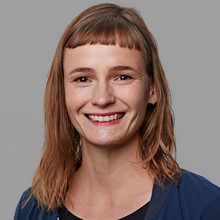
Vita

Laura Lambert is a postdoctoral researcher in the ERC project "Doing Digital Identities" (DigID) with a focus on Sierra Leone. In her dissertation, Laura examined the EU's externalization of refugee protection in Niger on the basis of a comprehensive ethnography. Among her main research interests are the remaking of European migration control and asylum policies in the cooperating African third states, asylum and migration bureaucracies, migrant struggles, future-making, infrastructures, and international organizations.

Academic CV

10/2023- Postdoctoral researcher, ERC project Doing Digital Identities

07/2022-09/2023 Deputy head of the research cluster "Flight and Migration", Arnold-Bergstraesser-Institute, Freiburg

12/2022: PhD in Social Anthropology, dissertation topic: "Everyday Externalization. The Transformations of Individual Asylum in Niger", Martin Luther University Halle-Wittenberg

11/2017-01/2022 PhD student, Department of Law and Anthropology, Max Planck Institute for Social Anthropology, Halle (Saale), Germany

08/2017 M.A. Social Sciences, Humboldt University Berlin

Projects

  1. Doing Digital Identities
    Stephan Scheel (Project manager, academic) , Salah El-Kahil (Project staff) , Oisin O'Brien (Project staff) , Laura Lambert (Project staff) , Sindhunata Hargyono (Project staff)

    Project: Research

  2. Everyday Externalization. The Transformations of Individual Asylum in Niger
    Laura Lambert (Project manager, academic)

    Project: Dissertation project

Publications

Journal contributions

  1. Zwischen unliebsamen Anderen und digitalen Nicht-Orten: Anthropologische Perspektiven auf das Grenzregime in Zeiten des Rechtsrucks. Kommentar zu Bernd Kasparek
    Laura Lambert (Author) , 01.01.2026 , in: Berliner Blätter, 92 , p. 157-162

    Research output: Journal contributionsComments / Debate / ReportsResearch

  2. Undoing data. The ‘migration crisis’ statistics by the International organization for migration and its discontents in Niger
    Laura Lambert (Author) , Alizée Dauchy (Author) , 01.01.2026 , in: Mobilities

    Research output: Journal contributionsJournal articlesResearchpeer-review

  3. Resettlement as a temporal border: infrastructural promises and future-making among migrants and officials in Niger
    Laura Lambert (Author) , 01.12.2025 , in: Comparative Migration Studies, 13, 1 , 17 p.

    Research output: Journal contributionsJournal articlesResearchpeer-review

  4. Between morality and the law: negotiating protection for queer asylum seekers in Niger’s asylum administration
    Laura Lambert (Author) , 01.01.2025 , in: Journal of Ethnic and Migration Studies, 51, 10 , p. 2529-2546 , 18 p.

    Research output: Journal contributionsJournal articlesResearchpeer-review

  5. Brokers of Citizenship. Justices of the Peace as Intermediaries in Sierra Leone’s Digital Identification Project
    Laura Lambert (Author) , 01.01.2025 , in: Citizenship Studies, 29, 6 , p. 555-570 , 16 p.

    Research output: Journal contributionsJournal articlesResearchpeer-review

Contributions to collected editions/anthologies

  1. Westafrika
    Laura Lambert (Author) , Franzisca Zanker (Author) , 01.01.2023 Baden-Baden , p. 701-706 , 6 p.

    Research output: Contributions to collected editions/anthologiesContributions to collected editions/anthologiesResearch

  2. Externalisierung
    Laura Lambert (Author) , 01.01.2023 Baden-Baden , p. 513-520 , 8 p.

    Research output: Contributions to collected editions/anthologiesContributions to collected editions/anthologiesResearch

  3. Externalisierungspolitik als "travelling model": lokale Aneignungen und Widerstände beim Ausbau des Asylverfahrens im Niger
    Laura Lambert (Author) , 01.01.2022 Berlin; Hamburg , p. 220-237 , 18 p.

    Research output: Contributions to collected editions/anthologiesContributions to collected editions/anthologiesResearch

  4. Studium gestattet?: Die symbolische Ordnung des Asyl- und Aufenthaltsrechts beim Hochschulzugang von Geflüchteten
    Laura Lambert (Author) , 05.02.2019 Wiesbaden , p. 347-365 , 19 p.

    Research output: Contributions to collected editions/anthologiesContributions to collected editions/anthologiesResearch

  5. Asyl im Niger. Politische Rolle und lokale Adaptionen des Flüchtlingsschutzes
    Laura Lambert (Author) , 01.01.2019 Bielefeld , p. 191-206 , 16 p.

    Research output: Contributions to collected editions/anthologiesContributions to collected editions/anthologiesResearch

Prizes

  1. Klaus J. Bade Award for Junior Migration Researchers
    (Recipient) ,

    Prize: external Prizes, scholarships, distinctions, appointmentsResearch

  2. Humboldt Research Track Scholarship
    (Recipient) ,

    Prize: external Prizes, scholarships, distinctions, appointmentsResearch

  3. Menschen mit Hintergrund
    (Recipient) ,

    Prize: external Prizes, scholarships, distinctions, appointmentsEducation

  4. Study Stipendium
    (Recipient) ,

    Prize: external Prizes, scholarships, distinctions, appointmentsResearch

  5. Study Stipendium
    (Recipient) ,

    Prize: external Prizes, scholarships, distinctions, appointmentsResearch

Courses

Digital technologies have become central features of our lives. The question of how they are transforming what it means to be human currently figures high in public debates around artificial intelligence and age limits for social media. This question is the primary concern of anthropology as a discipline. In the past two decades, anthropology has approached digital technologies and produced important innovations in their study. This seminar addresses some of the central concepts and methodologies to approach the digital as that which can be reduced to the binary code of 0 and 1. It discusses recent case studies on the increasing digital entanglements of everyday lives in some of the central fields, including social media, artificial intelligence, algorithmic governance, big data, biometric identification, digital economies and inequalities such as race, gender and dis-/ability. Methodologically, a central tenet of anthropological research has been the “being there” in physical spaces. The seminar explores new research methodologies and reflexivities that go beyond that, including digital ethnography and multimodal anthropology, and offers space to students to test these methods in exploratory case studies.
Next appointment:
Tuesday, 2026-10-13 at 16:15