
Prof. Dr. Serhat Karakayali
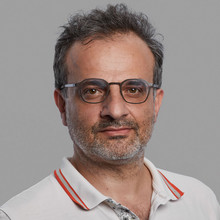
Vita
Serhat Karakayalı received his PhD from Johann-Wolfgang-Goethe University in Frankfurt am Main and wrote his dissertation on the genealogy of illegal migration in Germany. At the same time, he co-designed and implemented the TRANSIT Migration project at the Institute for European Ethnology (Frankfurt). In this interdisciplinary research group, the concept of migration regime was linked back to empirical research, resulting in methods such as "ethnographic regime analysis", mediation tools and also a new network for critical migration research. In the meantime, he was, among other things, head of a project on anti-Semitism in the immigration society in Berlin and curator of an exhibition on modern architecture in the colonial context of North Africa.
From 2009, he worked as a post-doctoral researcher in the Department of General Sociology at Martin Luther University Halle-Wittenberg. From 2014, he was involved as a post-doc in the establishment of the newly founded Berlin Institute for Empirical Integration and Migration Research. His research focused on voluntary engagement with refugees, cosmopolitan concepts of solidarity, and civil society as a site of political socialization in the migration society.
In 2016, he led the first representative survey to determine the proportion of members with a migration background in a large civil society organization – the metalworker’s union IG Metall, with over 2 million members. Following the findings of this project, he conducted a study on the motives and trajectories of migrant involvement in workplace co-determination, which was funded by the Hans Böckler Foundation. In the BMBF-funded collaborative project entitled "ZoMiDi," he worked with colleagues from Ludwig Maximilian University in Munich and the Max Planck Institute in Göttingen to examine how various civil society organizations deal with migration-related diversity in their structures. At BIM, he also led the Einstein Research Group on "Migration and Diaspora" and established the MERGE network.
From 2020, he was head of the "Migration" department at the German Center for Integration and Migration Research, a research institution funded by the German government, where he conducted research on migration in and from the Middle East as well as a series of public events, including on the crisis of refugee protection in Europe. The DeZIM Institute is also home to the Racism Monitor, commissioned by the German government, where Prof. Karakayali continues to be responsible for networking with international research and theoretical foundations. Since July 2021, he has been Professor of Migration and Mobility Studies at the School of Cultural Studies at Leuphana University.
Publications
Books and anthologies
- Organisationaler Wandel durch Migration?: Zur Diversität in der Zivilgesellschaft
Hella von Unger (Editor) , Helen Baykara-Krumme (Editor) , Serhat Karakayali (Editor) , Karen Schönwälder (Editor) , 2022 Bielefeld , 268 p.Research output: Books and anthologies › Collected editions and anthologies › Research
Journal contributions
- The Flüchtlingskrise in Germany: Crisis of the Refugees, by the Refugees, for the Refugees
Serhat Karakayali (Author) , 01.06.2018 , in: Sociology, 52, 3 , p. 606-611 , 6 p.Research output: Journal contributions › Scientific review articles › Research
- Volunteers: From solidarity to integration
Serhat Karakayali (Author) , 01.04.2018 , in: South Atlantic Quarterly, 117, 2 , p. 313-331 , 19 p.Research output: Journal contributions › Journal articles › Research › peer-review
- Borders
Serhat Karakayali (Author) , 01.01.2018 , in: Krisis, 2/2018 , p. 23-25 , 3 p.Research output: Journal contributions › Other (editorial matter etc.) › Research
Contributions to collected editions/anthologies
- Solidarität in postmigrantischen Allianzen:: Die Suche nach dem Common Ground jenseits individueller Erfahrungskontexte
Katarina Stepjandic (Author) , Serhat Karakayali (Author) , 01.01.2019 Frankfurt am Main , p. 237-252 , 16 p.Research output: Contributions to collected editions/anthologies › Contributions to collected editions/anthologies › Research
- Emergent infrastructures: Solidarity, spontaneity and encounter at Istanbul's Gezi Park uprising
Özge Yaka (Author) , Serhat Karakayali (Author) , 29.03.2017 , p. 53-69 , 17 p.Research output: Contributions to collected editions/anthologies › Contributions to collected editions/anthologies › Research › peer-review
Activities
-
Rassismus oder Rassismen
Serhat Karakayali (Speaker) , Manuela Bojadzijev (Speaker)
Activity: Guest lectures › Research
-
Institutional dynamics of affecting and being affected: The emotionalization of injustice and the threat of withdrawing the organizational identification
Serhat Karakayali (Speaker) , Yvonne Albrecht (Speaker)
Activity: Conference Presentations › Research
-
Rassismuskritik nach Hanau
Serhat Karakayali (Speaker) , Vanessa Thompson (Speaker)
Activity: talk or presentation in privat or public events › Research
-
Affekte der Migration - Habitus als verkörperlichte Urteilskraft
Serhat Karakayali (Speaker)
Activity: Guest lectures › Research
Courses
The seminar combines close reading of key texts in cultural and social theory with a small-scale ethnographic research project developed over the course of the semester. Students will identify an accessible field of study early on and return to it repeatedly. Each new theoretical perspective will serve as a lens through which the field is observed, described and reconsidered. Rather than applying theory to an already defined object, the seminar asks how theoretical concepts change what becomes visible, questionable or sociologically significant in empirical material.
The purpose of reading classical and contemporary texts in cultural theory is therefore to treat them as analytical instruments rather than as a canon to be mastered for its own sake.
Die Studierenden lernen zentrale Verfahren qualitativer Forschung kennen und wenden diese exemplarisch an.