
dies academicus 2026: “Let Us Preserve Our Ability to Recognize Room for Maneuver”
2026-07-13 The 2026 academic year concludes with dies academicus, the university’s annual celebration. During the ceremony in the Libeskind Auditorium, the Faculty of Political Science awarded an honorary doctorate to Prof. Dr. Wolfgang Hoffmann-Riem, a former judge of the Federal Constitutional Court. Various groups of friends and supporters from the Hanseatic City of Lüneburg and the surrounding region attended the ceremony. Students’ exceptional commitment was recognized, and university members were honored for outstanding research achievements and innovative approaches to knowledge transfer.
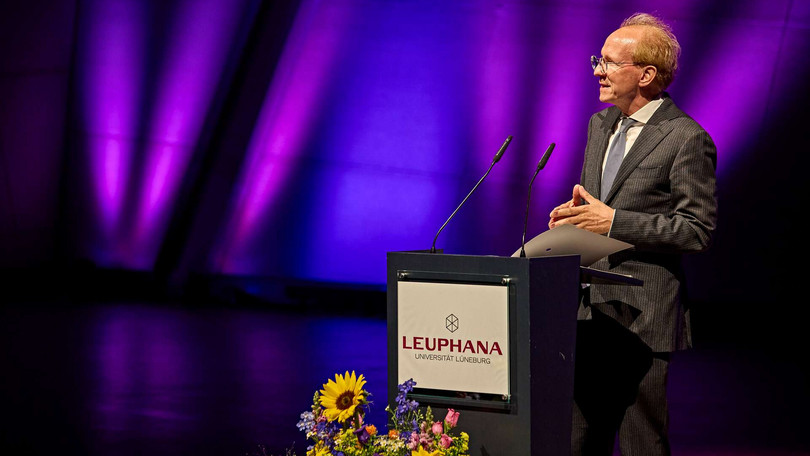
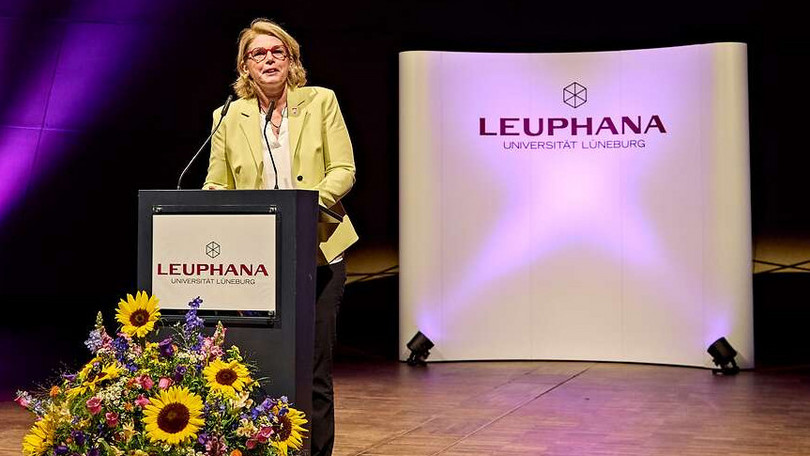
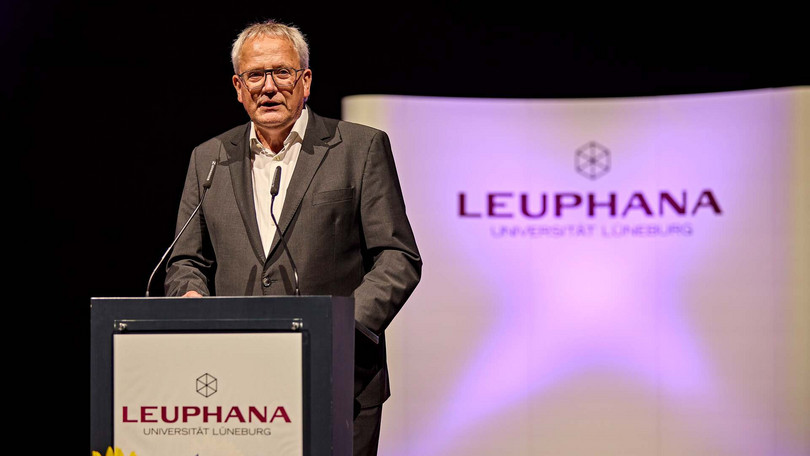
“Let us preserve our ability to recognize room for maneuver”—with this appeal, President Sascha Spoun concluded his keynote address at this year’s dies academicus in the Central Building. Earlier, he had warned of a “hidden institutional depression” at universities and urged everyone not to lose the courage to act despite bureaucracy, scarce resources, and social tensions. This forward-looking sentiment shaped the evening, which showcased just how vibrant, diverse, and committed Leuphana’s university community is. Numerous achievements were recognized and awards were presented.
Lüneburg’s Mayor Claudia Kalisch described the dies academicus as an integral part of public life in the Hanseatic city. “It is the evening of scholarship in our city,” she summarized. She emphasized the close connection between the city and the university: “Cooperation is the foundation of a functioning society,” she explained.
As chairman of the Lüneburg University Foundation for Research and Business, Michael Zeinert, IHK, highlighted Leuphana’s role as a driver of innovation for the city and region. He paid tribute to the recently deceased Klaus-Peter Langlotz, whose dedication had a decisive influence on the foundation as it stands today. “Leuphana is at the heart of our city and a creative driving force. It brings fresh ideas, young perspectives, and bright minds to Lüneburg,” said Zeinert. To support these efforts, the foundation contributes to Germany Scholarships, outstanding master’s theses, and doctoral dissertations
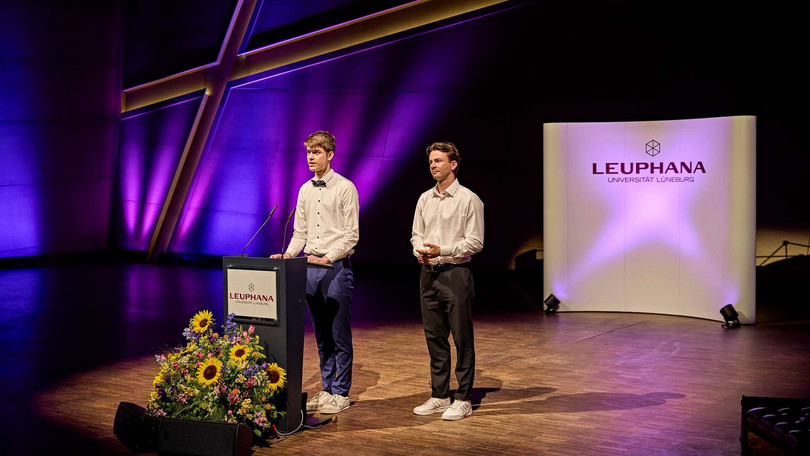
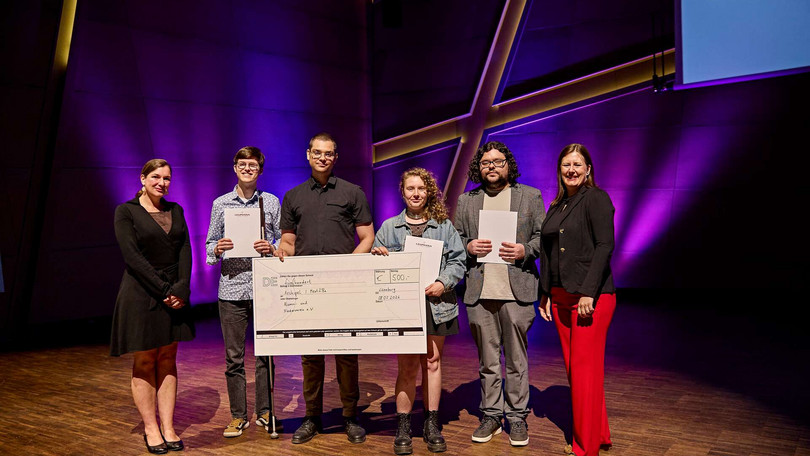
The two Asta spokespeople, Philipp Näser and Marc Schreiber, emphasized in their speech—delivered in English—the important role universities play in strengthening democracy: “Universities should play a central role within democracy and take a stand for democratic values.” The two students highlighted the value of personal commitment: “Change does not just happen. Change is made.”
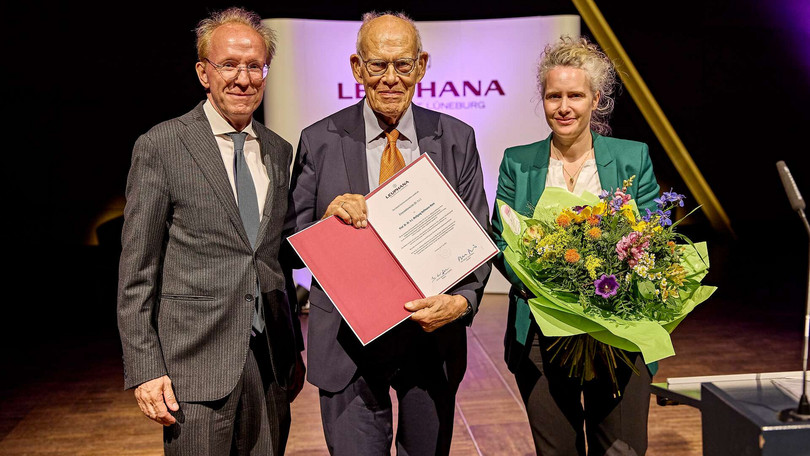
The Faculty of Political Science honored former Federal Constitutional Court Justice Wolfgang Hoffmann-Riem: “Through today’s honors, I have been included in a circle of scholars whose values and qualities are exemplary. I, too, value the pursuit of knowledge, justice, social engagement, and curiosity,” he summarized.
As a judge on the First Senate of the Federal Constitutional Court (1999–2008), Hoffmann-Riem played a key role in shaping landmark decisions, particularly regarding fundamental rights in a digital society. In addition, he championed the principles of the rule of law and the further development of democratic standards in various roles, including as Senator for Justice of the Free and Hanseatic City of Hamburg, as Director of the Hans Bredow Institute for Media Research, and as a member of the Venice Commission of the Council of Europe. He is also regarded as a driving force behind the further development of the law program at Leuphana.
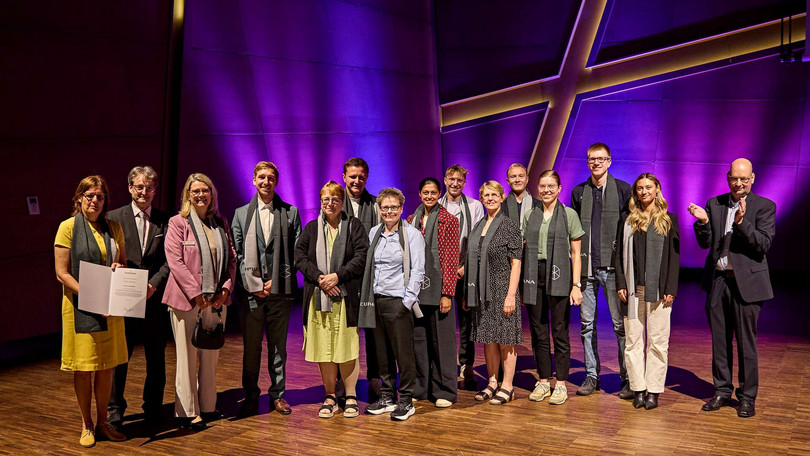
The Award for Outstanding Student Volunteerism honors the following students who volunteer with the autonomous AStA department “Archipel” (Autonomous Department for Chronic Illnesses, Inclusion, Mental Health, Empowerment, and Learning Disabilities) and who are involved in the “ment2be” project: Ina-Marie Ernst, Ezra (Kevin) Hecht, Jonte Levi Ferber, Jarmila Binia, Justus Hein, and Marcel Seibt. The Leuphana University Alumni and Friends Association is once again supporting the award this year with prize money, thereby recognizing the students’ exceptional volunteer commitment to the university community.
The members of the “Archipel” department and the “ment2be” project actively advocate for the interests and concerns of students with disabilities, neurodivergence, chronic and/or mental health conditions, or learning disabilities, and—through specific event formats, networking, support, and counseling—facilitate these students’ transition into and progress through their studies at Leuphana University.
These dedicated students address fundamental and highly personal support needs with innovative approaches and services, and foster the ongoing social discourse on appropriate academic conditions regardless of individual disabilities. Through professional peer-based support and strong self-empowerment fostered by sharing their own experiences, the students create accessible services and reduce barriers to access and engagement with the issues and needs of students with disabilities, neurodivergence, chronic and/or mental health conditions, or learning disabilities.
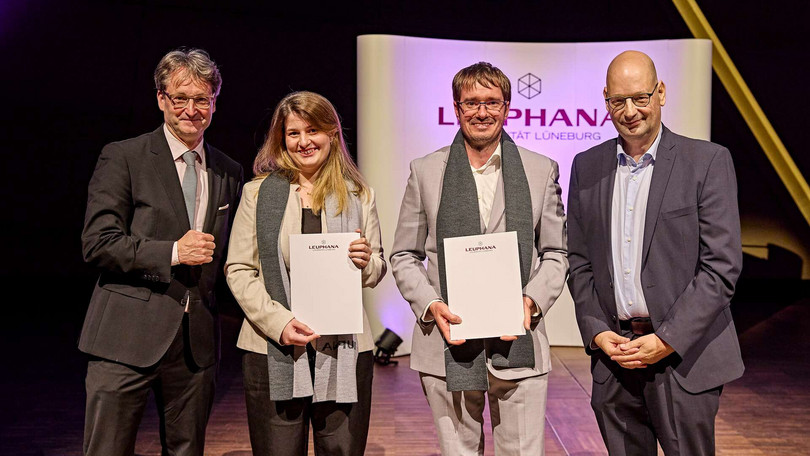
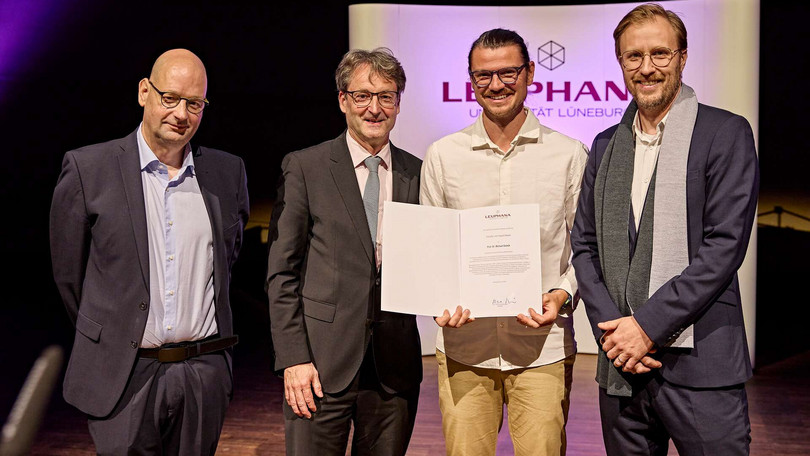
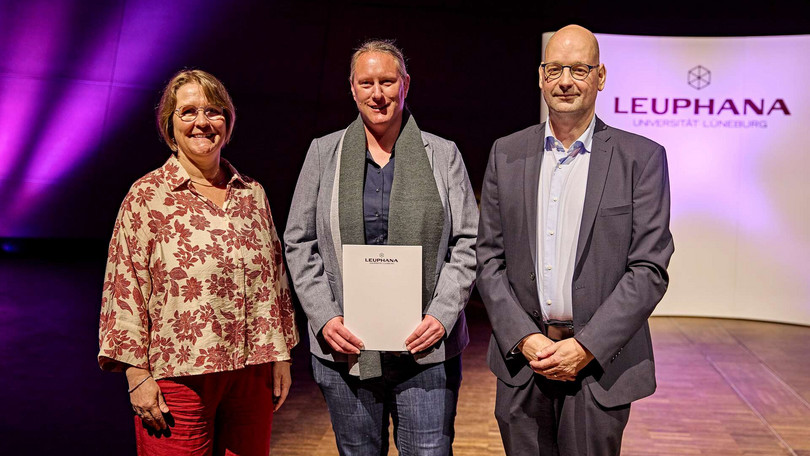
A particularly moving moment of the evening was the tribute to the two students Sarah Boenert (major in Teaching and Learning) and Madelaine Stenger (major in Environmental and Sustainability Science), who were honored for their moral courage. Through their quick and decisive actions during a medical emergency, they saved a lecturer’s life.
That evening also featured a presentation of the Joachim Herz Doctoral College and its special significance for early-career researchers: “The Graduate School views the doctoral degree not merely as a personal academic qualification, but supports the process of scientifically addressing pressing, socially relevant issues so that the results can then be effectively applied for and in collaboration with practitioners,” explained Vice President Prof. Dr. Simone Abels.
“The strong response to this year’s call for nominations for the Transfer & Impact Award has impressively demonstrated how diverse, high-quality, and impactful knowledge transfer is at Leuphana,” summarized Prof. Dr. Markus Reihlen, Vice President for Entrepreneurship, Knowledge Transfer, and Internationalization. Awards were presented to Prof. Dr. Michael Gielnik and his team for the STEP project—Student Training for Entrepreneurial Promotion, which very successfully trains entrepreneurs in the Global South—as well as to Prof. Dr. Jessica Süßenbach for the collaborative project “Sport Connects All-Day Elementary Schools,” which combines scientific findings with the promotion of physical activity and educational equity.
Prof. Dr. Roman Trötschel, Vice President for Research, honored three high-achieving researchers. The first recipients of research awards for early-career researchers were: Prof. Dr. Ghada Bouattour for her excellent work on wireless sensor systems. Her research lies at the intersection of measurement and sensor technology, energy efficiency, and AI-supported system development. In doing so, she combines fundamental engineering research with a clear focus on concrete societal and technological challenges. The second award went to the animal ecologist Prof. Dr. Michael Staabfor his outstanding research on the role of insects in ecosystems. He investigates how global environmental changes influence biodiversity, species communities, and ecological interactions, combining animal ecology, biodiversity research, and the analysis of trophic networks with fundamental questions about the stability and functioning of ecosystems. Both scientists have secured substantial funding from renowned institutions, published their findings in leading journals, and are active members of international networks within their respective scientific communities.
Prof. Dr. Vera Uppenkamp was the third recipient, honored for her outstanding achievements in gender and diversity research. In her research, she combines conceptual and empirical perspectives and works at the intersections of inclusive religious education, gender and queer theology, and intersectionality research. Through her work addressing poverty sensitivity, gender-sensitive education, queer theology, and diversity in teaching and learning processes, she has provided important impetus for education research that is sensitive to discrimination. Particularly noteworthy is her combination of academic excellence and social relevance.
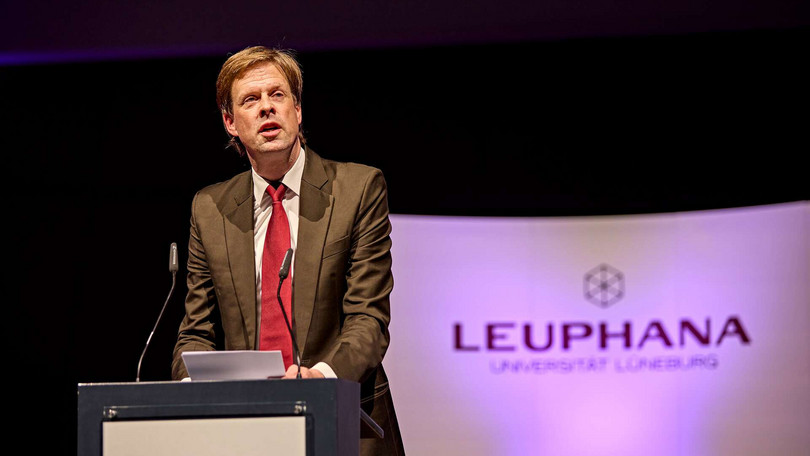
Leuphana’s full-time Vice President, Christian Brei, spoke about the role of bureaucracy, which, while often perceived as paralyzing, also creates a reliable legal framework. “You can criticize bureaucracy all you want. But it guarantees at least three things: legal certainty, planning certainty, and justice—that is, adequate equal treatment of all those involved,” he summarized, adding pointedly: “The exception so often sought is—when things go wrong—an injustice.”
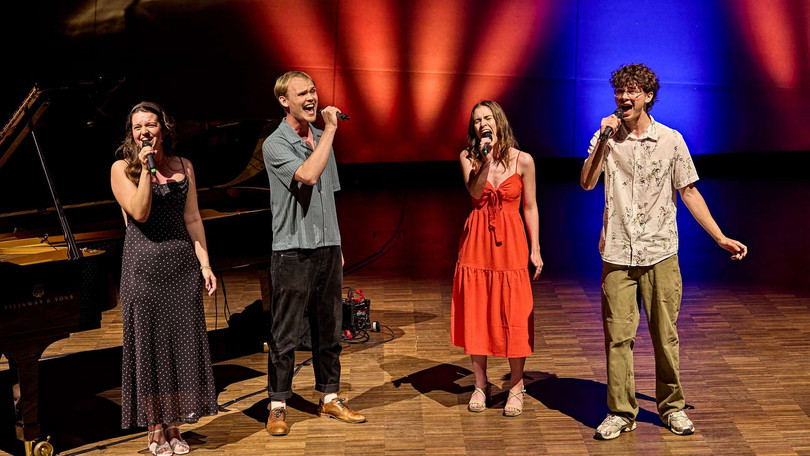
The evening’s musical program was provided by the University Music Center: Students presented excerpts from the musical “Dear Evan Hansen.” The stage production will premiere on October 21 in the Central Building.
The surprise guest, the Leuphana Dance Company, received thunderous applause for its contemporary dance performance. The company is part of the university’s sports program, which was selected in November 2025 as the “University Sports Program of the Year 2026” for all of Germany.