
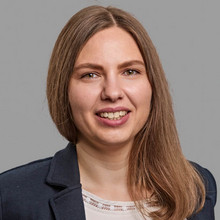
Dr. Monika Tschense
Werdegang
Monika Tschense ist Postdoktorandin in der Arbeitsgruppe für Forschungsmethoden am Institut für Nachhaltigkeitspsychologie. Ihre Forschung umfasst die Schnittstelle von Psychologie und Linguistik und befasst sich unter anderem mit den Themen Lesekompetenz und Verarbeitung geschlechtergerechter Sprache. Zur Untersuchung dieser Fragestellungen setzt sie verschiedene empirische Forschungsmethoden ein, darunter Eyetracking, EEG, Aktigraphie, Reaktionszeitmessungen und Umfragen. Ein methodischer Schwerpunkt liegt in der Anwendung nichtlinearer Zeitreihenanalysen, insbesondere der Rekurrenz- und Fraktalanalyse.
Seit Juli 2025 ist Monika Tschense zudem als Referentin für Kompetenzentwicklung an der Graduate School tätig. In dieser Funktion gestaltet und koordiniert sie Veranstaltungen zu Karriereperspektiven und Kompetenzen für Promovierende sowie zu den Themen mentale Gesundheit und soziale Herkunft.
Beruflicher Werdegang
Seit 07/2025: Referentin für Kompetenzentwicklung
Graduate School, Leuphana Universität Lüneburg
Seit 01/2021: Wissenschaftliche Mitarbeiterin
Arbeitsgruppe für Forschungsmethoden, Institut für Nachhaltigkeitspsychologie, Leuphana Universität Lüneburg
01/2021 – 12/2021: Gastwissenschaftlerin
Forschungsgruppe für Neurokognition von Musik und Sprache, Max-Planck-Institut für empirische Ästhetik, Frankfurt am Main
11/2018 – 12/2020: Wissenschaftliche Mitarbeiterin
Abteilung für Sprache und Literatur, Max-Planck-Institut für empirische Ästhetik, Frankfurt am Main
05/2017 – 07/2018: Wissenschaftliche Mitarbeiterin
Arbeitsgruppe für Klinische Linguistik, Institut für Germanistische Linguistik, Philipps-Universität Marburg
06/2016 – 05/2017: Wissenschaftliche Hilfskraft
Abteilung für Sprache und Literatur, Max-Planck-Institut für empirische Ästhetik, Frankfurt am Main
10/2013 – 08/2014: Tutorin
Institut für Linguistik, Goethe-Universität Frankfurt am Main
04/2013 –08/2014: Studentische Hilfskraft
Arbeitsgruppe für Deutsch als Zweitsprache, Institut für Psycholinguistik, Goethe-Universität Frankfurt am Main
Studium
11/2018 – 02/2024: Promotion (Dr.phil.) in Psychologie
Leuphana Universität Lüneburg & Max-Planck-Institut für empirische Ästhetik, Frankfurt am Main
10/2015 – 04/2019: Master of Arts in Linguistik: Kognition und Kommunikation
Philipps-Universität Marburg
10/2014 – 03/2017: Master of Arts in Klinische Linguistik
Philipps-Universität Marburg
10/2011 – 09/2014: Bachelor of Arts in Linguistik
Goethe-Universität Frankfurt am Main
Publikationen
Beiträge in Zeitschriften
- A Multivariate Method for Dynamic System Analysis: Multivariate Detrended Fluctuation Analysis Using Generalized Variance
Sebastian Wallot (Autor*in) , Julien Patrick Irmer (Autor*in) , Monika Tschense (Autor*in) , Nikita Kuznetsov (Autor*in) , Andreas Højlund (Autor*in) , Martin Dietz (Autor*in) , 01.07.2026 , in: Topics in Cognitive Science, 18, 3 , 18 S.Publikation: Beiträge in Zeitschriften › Zeitschriftenaufsätze › Forschung › begutachtet
- Measuring the semantic priming effect across many languages
Erin M. Buchanan (Autor*in) , Kelly Cuccolo (Autor*in) , Tom Heyman (Autor*in) , Niels van Berkel (Autor*in) , Nicholas A. Coles (Autor*in) , Aishwarya Iyer (Autor*in) , Kim Peters (Autor*in) , A. E. van ’t Veer (Autor*in) , Maria Montefinese (Autor*in) , Nicholas P. Maxwell (Autor*in) , Jack E. Taylor (Autor*in) , Kathrene D. Valentine (Autor*in) , Patrícia Arriaga (Autor*in) , Krystian Barzykowski (Autor*in) , Leanne Boucher (Autor*in) , W. Matthew Collins (Autor*in) , David C. Vaidis (Autor*in) , Balazs Aczel (Autor*in) , Ali H. Al-Hoorie (Autor*in) , Ettore Ambrosini (Autor*in) , Théo Besson (Autor*in) , Debora I. Burin (Autor*in) , Muhammad Mussaffa Butt (Autor*in) , A. J.Benjamin Clarke (Autor*in) , Yalda Daryani (Autor*in) , Dina Abdel Salam El-Dakhs (Autor*in) , Mahmoud M. Elsherif (Autor*in) , Maria Fernández-López (Autor*in) , Paulo Roberto dos Santos Ferreira (Autor*in) , Raquel Meister Ko Freitag (Autor*in) , Carolina A. Gattei (Autor*in) , Hendrik Godbersen (Autor*in) , Philip A. Grim (Autor*in) , Peter Halama (Autor*in) , Patrik Havan (Autor*in) , Natalia C. Irrazabal (Autor*in) , Chris Isloi (Autor*in) , Rebecca Kvisler Iversen (Autor*in) , Yoann Julliard (Autor*in) , Aslan Karaaslan (Autor*in) , Michal Kohút (Autor*in) , Veronika Kohútová (Autor*in) , Julija Kos (Autor*in) , Alexandra I. Kosachenko (Autor*in) , Tiago Jessé Souza de Lima (Autor*in) , Matthew H.C. Mak (Autor*in) , Christina Manouilidou (Autor*in) , A. Timur Sevincer (Autor*in) , Monika Tschense (Autor*in) , Sebastian Wallot (Autor*in) , 01.01.2026 , in: Nature Human Behaviour, 10, 1 , S. 182-201 , 20 S.Publikation: Beiträge in Zeitschriften › Zeitschriftenaufsätze › Forschung › begutachtet
- Global temporal typing patterns in foreign language writing: exploring language proficiency through recurrence quantification analysis (RQA)
Lisa Haake (Autor*in) , Sebastian Wallot (Autor*in) , Monika Tschense (Autor*in) , Joachim Grabowski (Autor*in) , 01.02.2024 , in: Reading and Writing, 37, 2 , S. 385-417 , 33 S.Publikation: Beiträge in Zeitschriften › Zeitschriftenaufsätze › Forschung › begutachtet
- Modeling items for text comprehension assessment using confirmatory factor analysis
Monika Tschense (Autor*in) , Sebastian Wallot (Autor*in) , 20.10.2022 , in: Frontiers in Psychology, 13 , 10 S.Publikation: Beiträge in Zeitschriften › Zeitschriftenaufsätze › Forschung › begutachtet
- Using measures of reading time regularity (RTR) to quantify eye movement dynamics, and how they are shaped by linguistic information
Monika Tschense (Autor*in) , Sebastian Wallot (Autor*in) , 01.05.2022 , in: Journal of Vision, 22, 6 , 21 S.Publikation: Beiträge in Zeitschriften › Zeitschriftenaufsätze › Forschung › begutachtet
Lehrveranstaltungen
Keine Veranstaltungen gefunden.