
How Learning Games Conquered Leuphana
2026-02-25
How Learning Games Conquered Leuphana – A Behind the Scenes Look at the Game Didactics Project
What happens when you invite people at a university to play more—deliberately and with purpose? In the Game Didactics Project, we set out to explore exactly that. And we witnessed the energy that emerges when teaching meets creativity, curiosity, and game mechanics.
Why We Started a Game‑Focused Project
Although learning games are proven motivation boosters and help deepen learning processes, they are surprisingly rare in higher education. A survey among instructors at Leuphana quickly revealed why: many lacked inspiring examples, found the search for suitable games too time‑consuming, or felt unsure about using interactive methods in their teaching.
This is exactly where we wanted to begin.
With an action‑research approach, we embarked in 2024 on a two‑year adventure: Could we lower these barriers—and show how powerful teaching becomes when games are systematically integrated?
What Happened in Two Years
From April 2024 to March 2026, a lot happened—often behind the scenes, sometimes right in the seminar room, and frequently in direct exchange with instructors and students.
Six Beacons That Lit Up the Campus
Across six major course projects, we supported instructors in embedding learning games in a structured, meaningful, and sustainable way. The results were impressive—such as courses where games like Lego4Scrum were fully integrated into the learning design, allowing students to experience project management “with their hands.”
200 Learning Games: Sorted, Tested, Recommended
Our team reviewed more than 200 analog and digital learning games across disciplines—from ethics and sustainability to software development. Many instructors used our consultations to find games tailored to their own courses.
A Growing Community
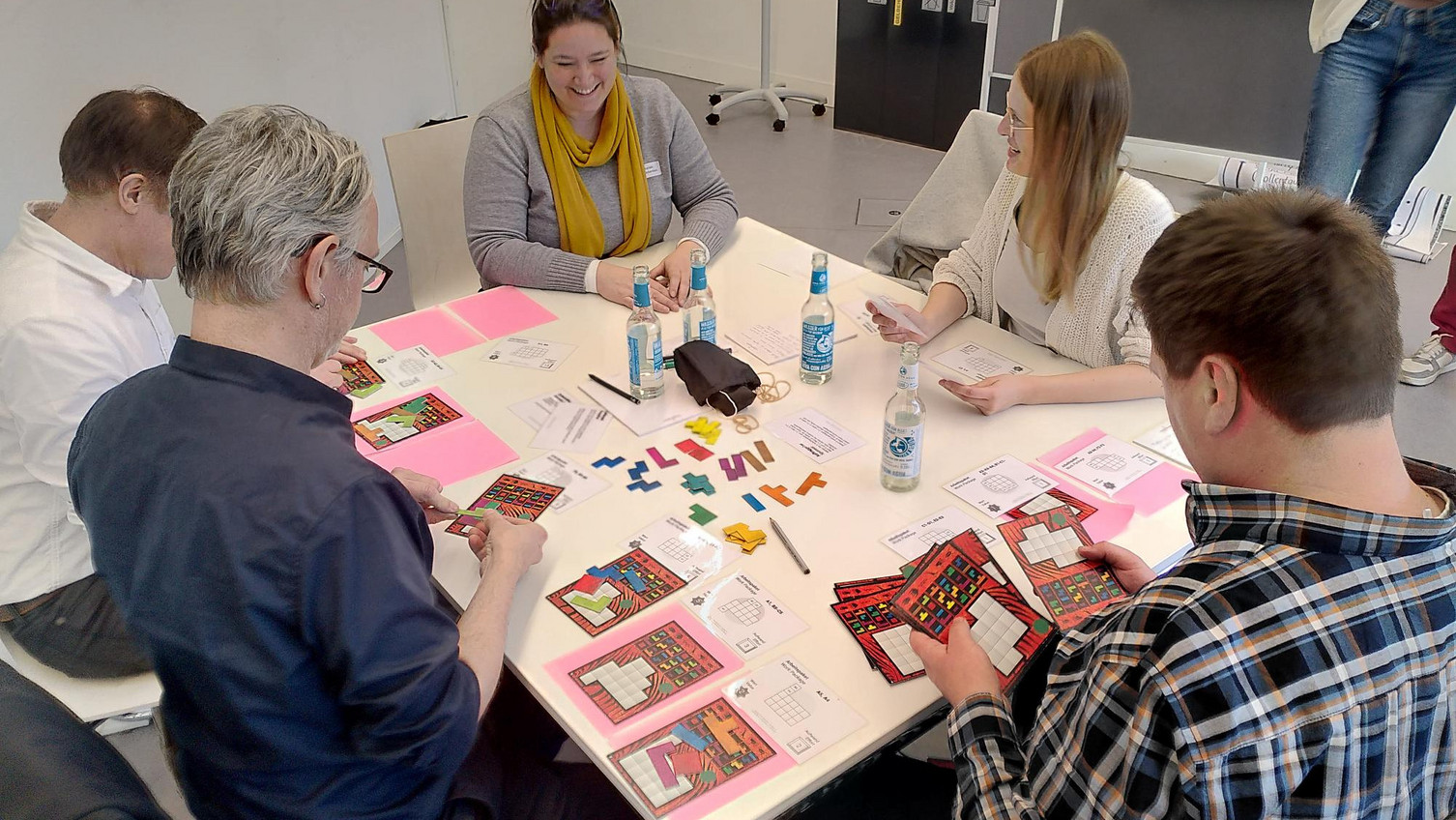
We met more than 50 instructors in workshops, game sessions, and community events. What makes us especially happy: many now use playful methods regularly—some even developed their own concepts during our trainings.
What Remains—And What Comes Next
A project may end, but its impact stays visible.
An Expanding Game Collection
Nearly 70 high‑quality learning games—from the fast‑paced card game Earth Effect to the culture‑reflective simulation BaFá BaFá—are being transferred to the university library. Through the Game Didactics website, you can now browse by topic, learning outcomes, or teaching scenario.
A Book With Impact Beyond Leuphana
Our open‑access edited volume Games for Higher Education will be published soon, presenting over 100 learning games with detailed descriptions and didactic insights. Individual chapters will also appear in the Serious Games Information Center—freely accessible to educators worldwide.
Trainings That Stick
Our highly interactive trainings were so well received that many participants now confidently use frame games, icebreakers, and complex serious games. The feedback is clear: those who play themselves go on to teach differently.
A Spark That Will Continue to Spread
In the end, more than 100 people subscribed to our newsletter—a strong sign of the growing interest in game‑based teaching. This community has the potential to shape teaching at Leuphana for years to come. Dozens of colleagues already use learning games in their courses. We hope they will continue to set a good example and share their knowledge.
Why All of This Matters
The Game-Didaktikcs Project shows this: when we create spaces for play—literally and figuratively—we foster excitement, connection, and genuine joy in learning.
Serious games are not just a nice add‑on. They are tools for a university system that aims not only to inform students but also to activate them.
Anyone who has ever used a power drill knows how much more efficiently and effortlessly it works compared to a screwdriver. The same is true for good learning games: the best of them convey core insights within minutes—insights learners may remember decades later.
With our project, we carried the torch of game‑based teaching through Leuphana and gathered many enthusiastic allies. And perhaps this is the beginning of a new teaching culture at our university.
The Game Didactics Team consisted of Saskia Sterzl, Nilufar Ernazarova, Timon Freyer, Hannes Hamester, Lucian Jueterbock, Ivy Karaatanasova, Maya Kim, Marit Klinge, Jonathan Sierks, Leon Sumfleth, Dustin Thulke and Johanna Willich. It was led by Dr Johannes Katsarov. We would like to thank the Foundation for Innovation in Higher Education for its support, as well as Prof. Hannah Trittin-Ulbrich, Prof. Paul Drews and Annette Schimming for their tremendous assistance. Finally, we would also like to express our sincere gratitude to all our colleagues with whom we have had the opportunity to collaborate over the past few years – it has been an honour and a great pleasure to work with you!