
Helmut Schmidt Future Festival: “Embracing Hope”
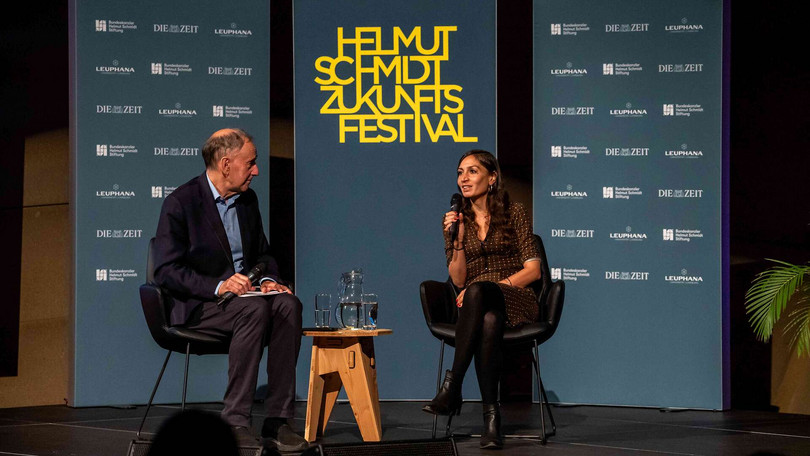
2026-06-17 In collaboration with the weekly newspaper DIE ZEIT and the Federal Chancellor Helmut Schmidt Foundation, Leuphana University Lüneburg hosted an event at Leuphana to foster dialogue. Young people from Germany, Austria and Switzerland came together to discuss concrete ideas for social change. ZEIT journalist Uwe Heuser spoke with doctor and political scientist Gilda Sahebi at the opening.
Luisa von Festenberg-Pakisch is postponing her lunch break: “I’ve still got a question for Gilda Sahebi,” explains the psychology student and founder from Rosenheim. The Young Forum in Munich had encouraged her to apply to the Helmut Schmidt Festival and become one of around 100 future thinkers. “The Helmut Schmidt Festival brings together committed young people from a wide variety of backgrounds. I’ve already made lots of exciting connections.” Luisa von Festenberg-Pakisch is a positive psychology coach and is a strong advocate for inclusion and mentoring, amongst other things. “Gilda Sahebi has encouraged me to let go of inner barriers and work on my own issues. With greater self-confidence, I can bring positive psychology to the world more effectively,” she explains.
Under the title ‘WILDE ZUKUNFT’ (WILD FUTURE), the festival explores the question of what kind of future we actually want and what potential arises when familiar boundaries between ideas are crossed. In this context, the Federal Chancellor Helmut Schmidt Foundation expressly does not see itself as the guardian of a political legacy, but rather as a catalyst for current debates, such as at the festival, which brings together particularly committed young people. Meik Woyke of the Federal Chancellor Helmut Schmidt Foundation on the festival’s namesake: “I am convinced that he asked the right questions for the 21st century. But it would have been asking too much of him to already know all the answers.”
Gilda Sahebi opened the festival this year. The doctor and journalist spoke about the situation in her home country, Iran, and quoted a friend: “You know, when I leave the house every morning, I have to put on hope, just as I put on my shoes and jacket. Otherwise, I won’t make it through the day.”
Gilda Sahebi fled Iran at the age of three. Her father was politically persecuted. Drawing on this personal history, she reflected on life in Germany. She warned against explaining social problems in terms of cultural or ethnic divisions, referring in particular to the growing polarisation of Western societies. “We live in a society where people believe you can feed the shadows and the light will grow brighter. That won’t happen,” she said. Instead, she argued, we must focus more strongly on shared interests.
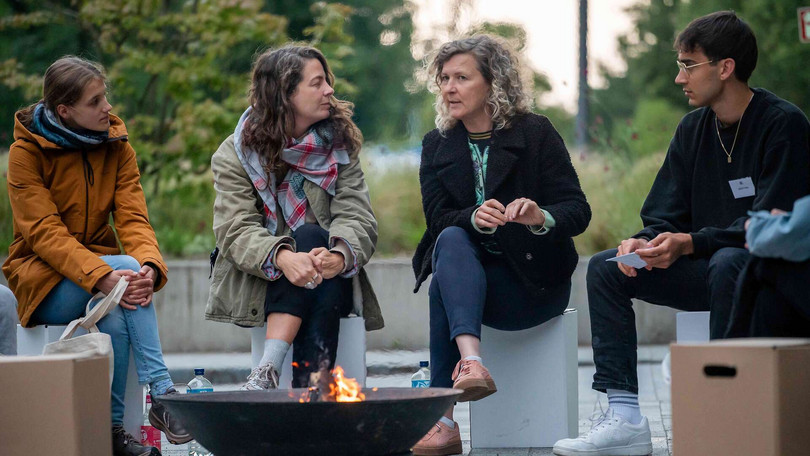
During a fishbowl discussion, Gilda Sahebi engaged in conversation with the participants. Leuphana student Jarmila Binia spoke about the student art project “Boxing Match for Sustainability”, which was developed as part of the complementary degree programme. Carrying a large cardboard heart, the project team sought to engage with people in Lüneburg city centre – deliberately including those with different political views. “We wanted to bring different perspectives together and facilitate an open exchange,” explained the environmental science student. Sahebi praised this approach and emphasised the importance of personal encounters. At the same time, she warned against confusing openness with indifference. Democracy, she said, requires commitment and emotion.
“Anyone who isn’t angry right now hasn’t been paying attention,” she said, to applause from the audience. In the face of growing inequality and democratic challenges, she argued, social participation and political pressure are essential.
Over the course of three days, the participants discussed and developed ideas in dialogue with social entrepreneur Lisa Jaspers, Greenpeace spokesperson Baro Gabbert, news influencer Fabian Grischkat, *Die Zeit* writer Yasmine M’Barek, entrepreneur Fried Graf von Bernstorff, physicist Marco Wehr and illustrator Sarah Heuzeroth. Leuphana President Sascha Spoun also took the time to engage in conversation with the participants.
A highlight of the festival is the presentation of the Helmut Schmidt Future Prize at Hamburg’s Thalia Theatre. This year’s award goes to Florence Gaub. The head of the research department at the NATO Defence College in Rome will be discussing the social and geopolitical challenges of the coming decades with festival participants beforehand. The ideas of these young visionaries will form part of the evening’s programme.