
Forschung & Projekte
MULTI-TROPHIC INTERACTIONS IN A FOREST BIODIVERSITY EXPERIMENT IN CHINA (MULTITROPH)
Funding: Research Group FOR 5281 funded by the Deutsche Forschungsgemeinschaft (DFG, German Research Foundation)
Duration: 2022-2026
Institute staff involved: Joshua Spitz (PhD student), Michael Staab (PI)
Website: https://multitroph.com/
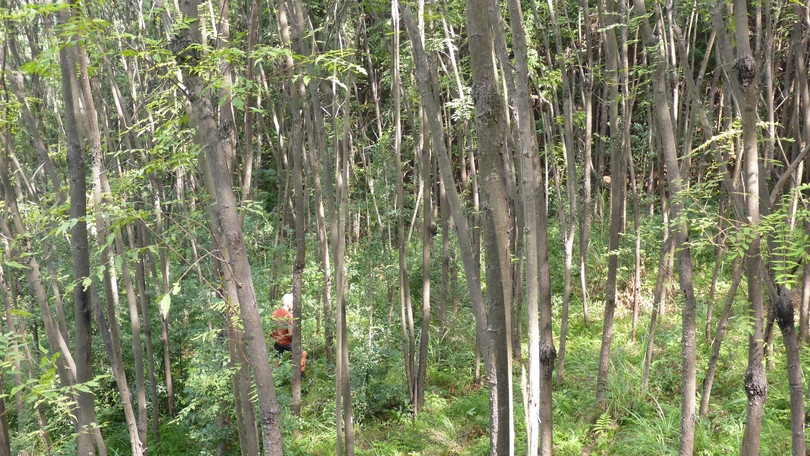
The DFG-funded research unit MultiTroph "Multi-trophic interactions in a forest biodiversity experiment in China" (FOR 5281) is investigating the role of tree diversity for multi-trophic interactions and dependent ecosystem functions. MultiTroph works on the BEF-China platform (https://bef-china.com/) that comprises the worldwide largest tree diversity experiment, located in subtropical southeast China (Jiangxi province).
The BEF-China experiment addresses the fundamental question whether tree diversity matters for the functioning of forest ecosystems. In 2009, a large-scale tree diversity experiment was established using a pool of 42 local subtropical tree species that are planted in plots with 1, 2, 4, 8, 16 and 24 tree species. Thus, it is possible to investigate the effects of tree diversity per se.
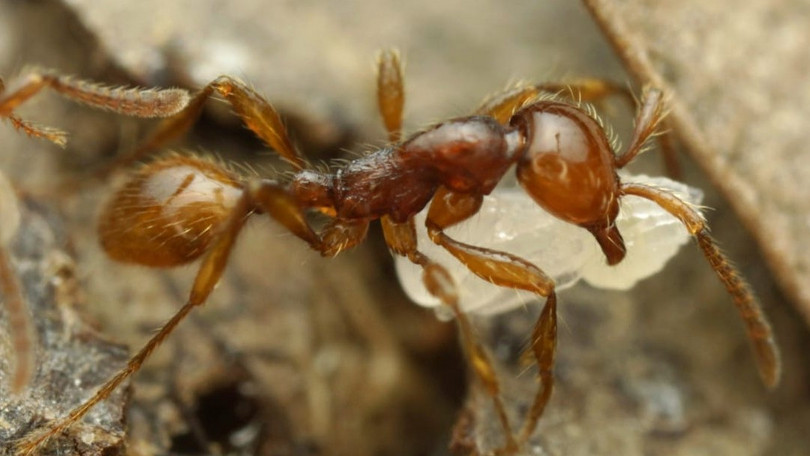
Within MultiTroph, Michael Staab leads subproject 6 on “Trophic interactions and ecological functions of ants”. The PhD student Joshua Spitz is busy quantifying ant diversity and trait distribution to functionally characterize ant communities. To investigate realized trophic niches, resource choice experiments are performed and stable isotopes (δ15N) measured in cooperation with researchers from the University of Bayreuth. By integrating across components of biological organization in a key arthropod taxon, our research helps to understand how the interplay among tree diversity, ant diversity, trait distribution and trophic interactions influences forest ecosystem functionality.
 ©Michael Staab
 ©Joshua Spitz
 ©DFG
©DFG
CORE PROJECT ARTHROPODS WITHIN THE BIODIVERSITY EXPLORATORIES
Funding: Infrastructure Priority Program SPP 1374 funded by the Deutsche Forschungsgemeinschaft (DFG, German Research Foundation)
Duration: 2026-2029
Institute staff involved: Julian Lunow (Postdoc), Simon Heitzler (Postdoc), Michael Staab (PI)
Website: https://www.biodiversity-exploratories.de/en/
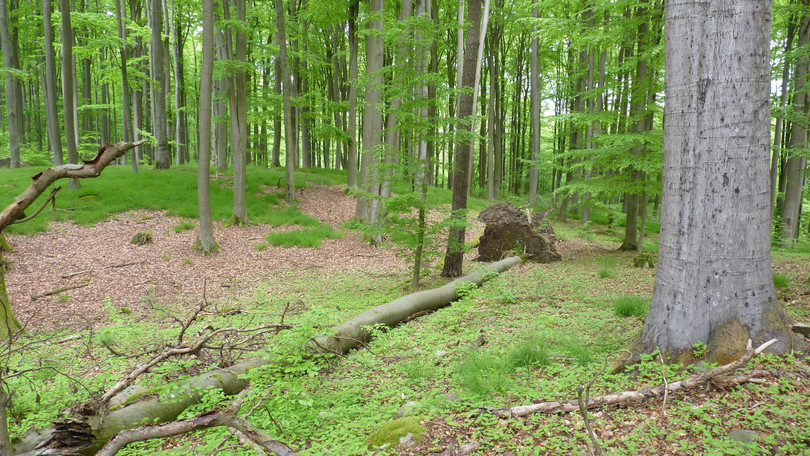
The Biodiversity Exploratories aim to understand the effects of land-use intensity on biodiversity and ecosystem functioning. Since 2008 this collaborative large-scale project involves researchers from various disciplines and universities. Key research objectives are the effects of different forms and intensities of land-use on biodiversity and ecosystem processes; the interactions between different components of biodiversity; and how biodiversity influences ecosystem processes.
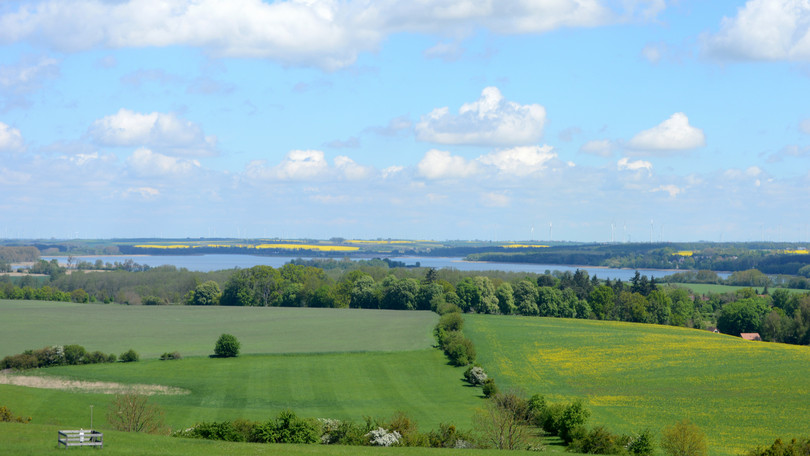
The research project includes three different regions (i.e., “Exploratories”) across Germany: Schwäbische Alb in the southwest, Hainich Dün in the center and Schorfheide Chorin in the northeast of Germany. Each exploratory consists of 50 grassland and 50 forest sites that can be ranked along gradients of land-use intensity (from low to very intensive land use).
Within the Biodiversity Exploratories consortium, Michael Staab leads the Core Arthropods (https://www.biodiversity-exploratories.de/en/projects/arthropods-and-arthropod-related-processes/) project together with Wolfgang Weisser (TU Munich). The Core project Arthropods conducts long-term monitoring of arthropods and arthropod related processes in forest and grassland ecosystems to disentangle the influence of land-use intensity on arthropod abundance and diversity and changes therein.
 ©Michael Staab
 ©Michael Staab
 ©DFG
©DFG
LAND-USE INTENSITY MEDIATED EFFECTS OF MICROCLIMATE ON INSECT DIVERSITY (LUMI)
Förderung: Infrastruktur-Schwerpunktprogramm SPP 1374 gefördert durch die Deutsche Forschungsgemeinschaft (DFG)
Laufzeit: 04.2026 – 03.2029
Beteiligte Mitarbeiterinnen und Mitarbeiter: Brigitte Ștreangă (Doktorandin), Michael Staab (PI)
Website:
Das DFG-geförderte Forschungsprojekt LUMI ("Land-use intensity mediated effects of microclimate on insect diversity") ist in die Biodiversitäts-Exploratorien eingebunden (Details zur Infrastruktur der Exploratorien finden sich beim Kernprojekt Arthropoden) und untersucht, wie das Mikroklima die Auswirkungen der Landnutzungsintensität auf die Insektenvielfalt im Grünland vermittelt.
Die Intensivierung der Landnutzung zählt zu den am besten belegten Ursachen für den Rückgang der Insektenvielfalt in mitteleuropäischem Grünland. Bei hoher Intensität führen Mahd und Düngung zu einer Verarmung der Pflanzenvielfalt und einer Homogenisierung der Vegetationsstruktur. Beweidung hingegen fördert bei geringer Intensität die Strukturheterogenität und Artenvielfalt, kann sich jedoch bei sehr hohem Beweidungsdruck nachteilig auswirken. Darüber hinaus beeinflusst die Landnutzung die mikroklimatischen Bedingungen, denen Insekten auf kleinstem Raum ausgesetzt sind. Dieser indirekte Einfluss der Landnutzung wurde bislang kaum erforscht. Da die Vegetationsstruktur den mikroklimatischen Nischenraum von Insekten maßgeblich beeinflusst, weisen strukturell homogene Habitate eine geringe mikroklimatische Variabilität auf, während extensiv bewirtschaftetes, heterogenes Grünland eine hohe mikroklimatische Variabilität bietet, die eine höhere Insektenvielfalt unterstützen kann. Es ist jedoch weitgehend unbekannt, wie Unterschiede im Mikroklima die Insektenvielfalt beeinflussen und wie dies durch die Landnutzungsintensität vermittelt wird. Wir untersuchen daher, ob Unterschiede im mikroklimatischen Nischenraum die Insektenvielfalt erklären, ob artspezifische thermische Nischen das Vorkommen entlang von Landnutzungsgradienten beeinflussen und ob intensive Landnutzung zu einer Verschiebung der Insektengemeinschaften hin zu wärmetoleranten Arten führt.
Unter der Betreuung von Michael Staab erfasst Doktorandin Brigitte Ștreangă die Insektengemeinschaften und Artenvielfalt auf allen 150 Grünland Plots der Biodiversitäts-Exploratorien mittels standardisierter Biozönometer-Saugprobenahme und charakterisiert artspezifische mikroklimatische Nischen. Darüber hinaus misst sie die oberen kritischen Temperaturgrenzen (CTmax) ausgewählter Insektenarten, um den Zusammenhang zwischen Wärmetoleranz, Landnutzungsintensität und lokalem Mikroklima zu untersuchen. Das Projekt wird in enger Zusammenarbeit mit Prof. Dr. Fabian Fassnacht und seinem Team an der BOKU Wien durchgeführt, welche die Erfassung und Modellierung der Mikroklimadaten übernehmen.
©DFG