
Luhmann Lecture: Does the Rule of Law still matter?
Dame Eleanor Sharpston on the Importance of the Rule of Law in an Uncertain World
2026-10-20 What is the relevance of the rule of law when democratic institutions come under pressure and international rules are disregarded? Dame Eleanor Sharpston KC addressed this question on October 20, 2026 in the Luhmann Lecture, which Leuphana Law School hosted for the second time this year. The former Advocate General at the Court of Justice of the European Union shed light on current challenges to the rule of law at both the national and international levels.
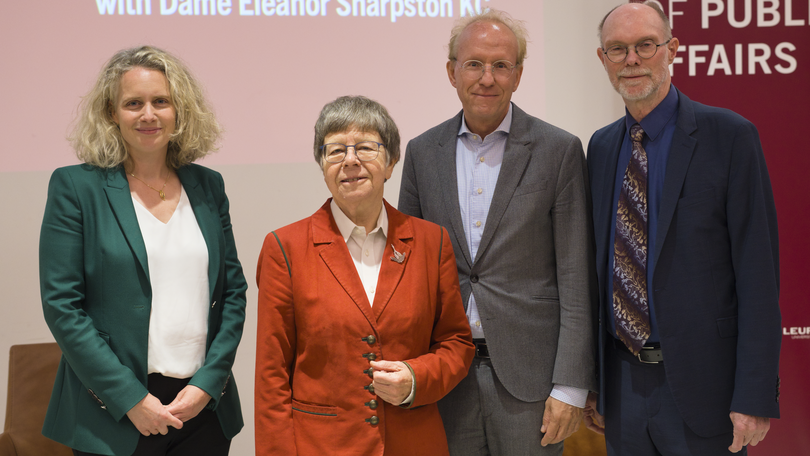
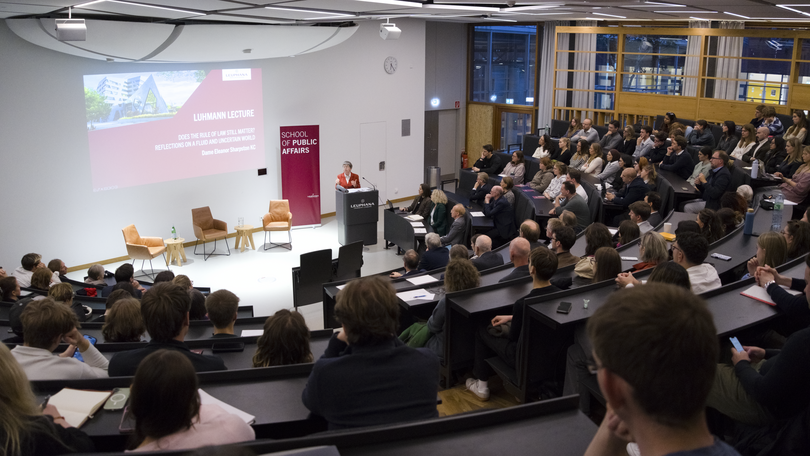
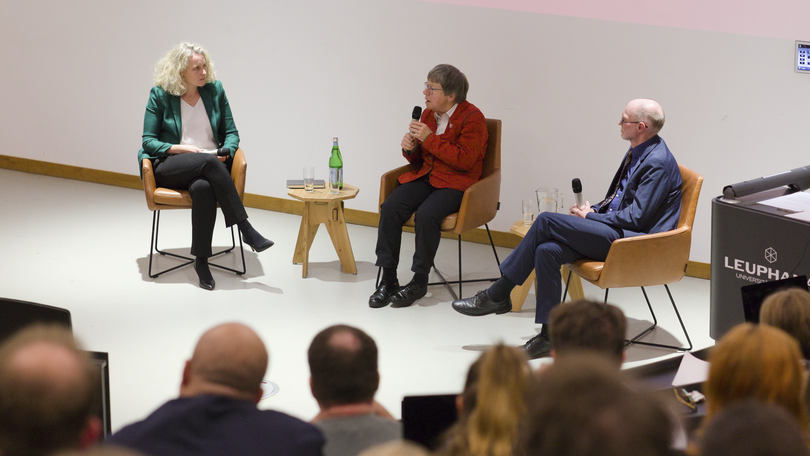

Drawing on the current protests in France and Italy, Sharpston began by explaining the traditions of the rule of law in Germany, France, and the United Kingdom. She emphasized the importance of the separation of powers, fundamental rights, and independent courts. The rule of law requires not only compliance with legal procedures but also the protection of fundamental human rights.
Sharpston saw a real danger in rising populism. She argued that whilst it sometimes addresses grievances that are indeed justified, generically it offers only seemingly simple, superficial solutions to complex problems and transforms certain groups into scapegoats. Democratic institutions must take legitimate concerns seriously and enable political participation. Otherwise, there is a risk that trust in the legal system will erode. At the same time, Sharpston warned against applying legal guarantees only when they serve one’s own interests.
She then turned her attention to the evident erosion of international law. From the Peace of Westphalia to European integration, she traced the development of an order based on common rules rather than the law of the strongest. She praised the European Union as a project in which States pool their sovereignty in favour of shared legal obligations.
Sharpston then took a critical look at US foreign policy under President Donald Trump. Referring to claims over Canada and Greenland, recent military interventions, and sanctions against the International Criminal Court, she warned of the consequences of a policy that treats international rules as non-binding. Reliable agreements between trustworthy partners, she stressed, are a prerequisite for international cooperation.
In closing, Sharpston referred to the sculpture by the British artist Banksy which had been erected on a plinth in London’s Waterloo Place. It depicts a flag-bearer striding forward with confidence, his own flag blocking his view as he is about to step off the plinth into the void. Sharpston offered this as a metaphor for the dangers of a policy that dismantles the structures of the rule of law without recognising the consequences. She concluded her lecture with powerful words:
“There are plenty of confident flag bearers beckoning us to follow. Their preferred paths blind them to the dangers inherent in dismantling the rule-based legal order on which our comfortable, civilised lives depend. Ladies and gentlemen, we do not want to step out into that void.”
The second Luhmann Lecture thus highlighted the importance of the rule of law for a liberal society and the international order. The subsequent panel discussion and a reception – made possible by financial support from the Leuphana University Alumni and Friends Association – provided a further opportunity for the guests in attendance from the worlds of academia, politics and the judiciary to exchange views.