
New at Leuphana: Prof. Dr.-Ing. Florian Stamer – How AI Is Transforming Industry
2026-04-13 Artificial intelligence is set to bring about a profound transformation in industrial production. However, Germany has a particular strength: deep engineering expertise and industrial experience. “When we combine this know-how with AI, enormous potential emerges,” says the new professor of production management.
What appears to be a small experiment exemplifies the profound transformation in industrial production: A ballpoint pen lies on the table in individual parts—nib, barrel, refill, cap. Until now, humans planned the assembly. But AI has long been capable of doing that as well: “The system recognizes the components, automatically creates a work plan for assembly, and suggests how many workstations are needed,” explains Florian Stamer. The AI calculates the optimal sequence of work steps and shows how lead time, quality, and costs change.
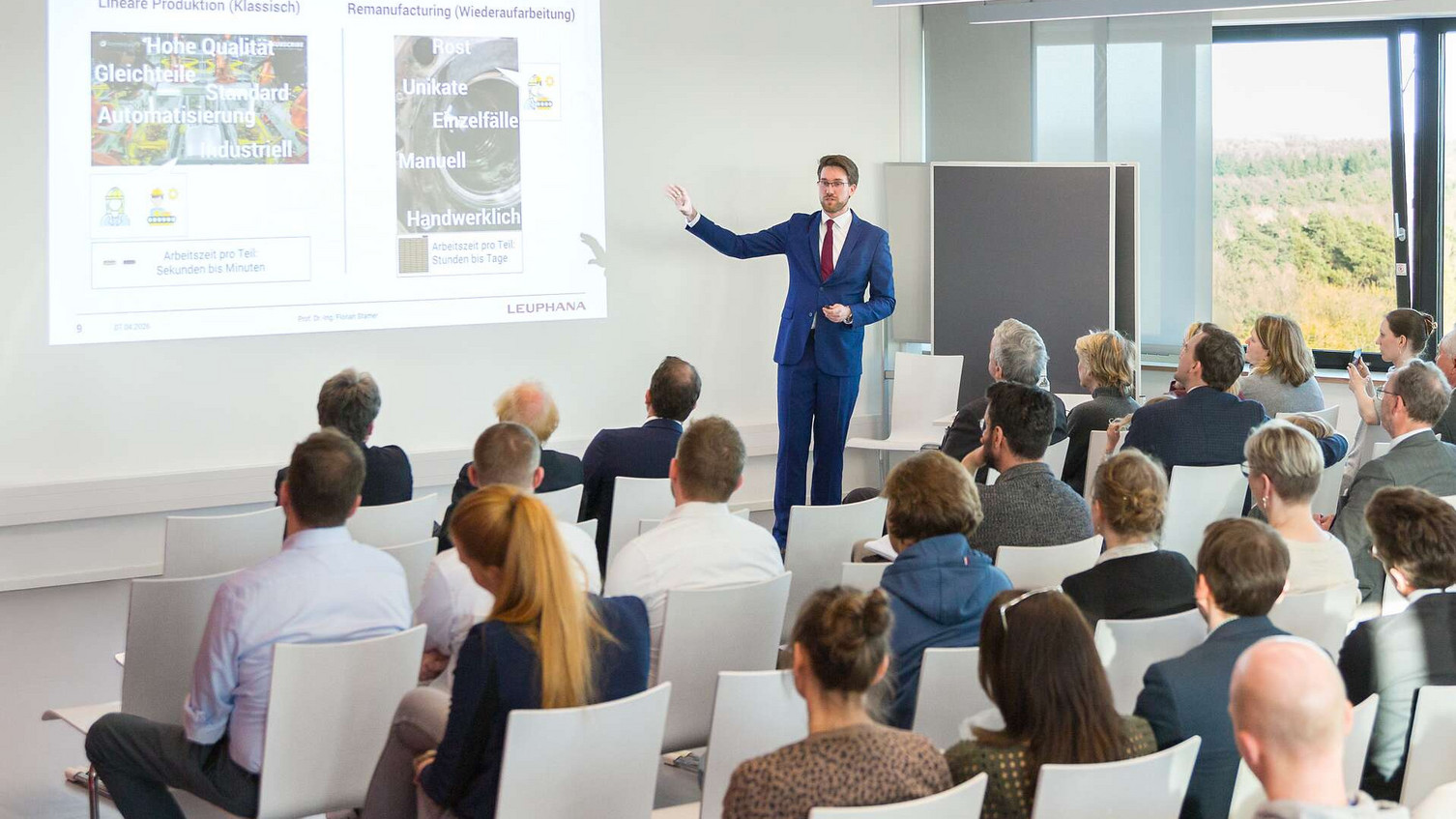
Industrial production is on the verge of a profound transformation driven by artificial intelligence. While AI is already being used extensively, particularly in Asia, and many foreign locations are less regulated, Germany has a different strength: “Our contribution can be contextual knowledge that goes beyond general knowledge. In-depth engineering expertise and industrial experience are highly complex. In Germany, we have that. That is our leverage,” explains Florian Stamer. This knowledge must now be transferred into scalable systems: “If we don’t use AI, we will no longer be competitive. We must not think too conservatively and try to hold back change. The goal is to use these systems to transform ourselves and secure our industry. Because if industry disappears, our prosperity is at risk.”
Florian Stamer’s research findings are particularly interesting in this context, because while AI can save costs, it is not error-free: “The biggest problem with today’s AI is robustness. The systems still make too many mistakes. In production, this can lead to significant additional costs in the worst-case scenario,” he emphasizes.
The Learning Factory at Leuphana can bring these issues to light: students, researchers, and companies test production processes in a realistic environment—without any financial risk. In the simulated production environment, for example, models from the Fischer Technik system are assembled, analyzed, and optimized. Key metrics such as quality and productivity can be measured directly. Changes to workstations or processes become immediately apparent.
Even if AI takes on more tasks in the future, that doesn’t have to be a disadvantage. “Companies may be able to get by with fewer people. What’s important is that value creation takes place here.”
He believes universities play a crucial role in this transformation: “Young people don’t need less knowledge—they need more. Universities must educate students more quickly and to a higher standard, for example through close cooperation with companies and by learning from real production data.”
He sees Leuphana as the ideal place for this: “I want to shape the future. Leuphana offers exactly the space needed to rethink and redesign things from scratch. It is a pioneer in this regard throughout Germany.” For him, interdisciplinarity is one of Leuphana’s greatest strengths: “The challenges are so great that they are best tackled by a network.”
Despite all the changes, the professor looks to the future with optimism: “Change has always been a part of life. What matters is that we actively shape it.”
Florian Stamer studied industrial engineering with a specialization in mechanical engineering at RWTH Aachen University. In 2017, he began working as a research assistant at the Institute of Production Engineering (wbk) at the Karlsruhe Institute of Technology (KIT). From January 2022 to June 2025, he served there as a senior engineer and group leader in the Quality Assurance department. Concurrently, he completed his doctorate in 2022. Until 2025, Florian Stamer also led a junior research group. Since July 2023, he has been a Research Affiliate at the International Academy for Production Engineering (CIRP). In 2025, Florian Stamer assumed the professorship for Production Management at Leuphana University Lüneburg.