
dies academicus 2026: Professor Vera Uppenkamp Honored for Outstanding Achievements in Gender and Diversity Research
2026-09-05 Queer and gender-theological issues are already fairly well established in systematic theology. In religious education, the assistant professor of Protestant religious education is setting new directions with her intensive research and publications. In this interview, she explains why Luther’s translation of the first creation story falls short, how social media shapes religious ideas, and why queer and feminist theologies are expressions of resistance.
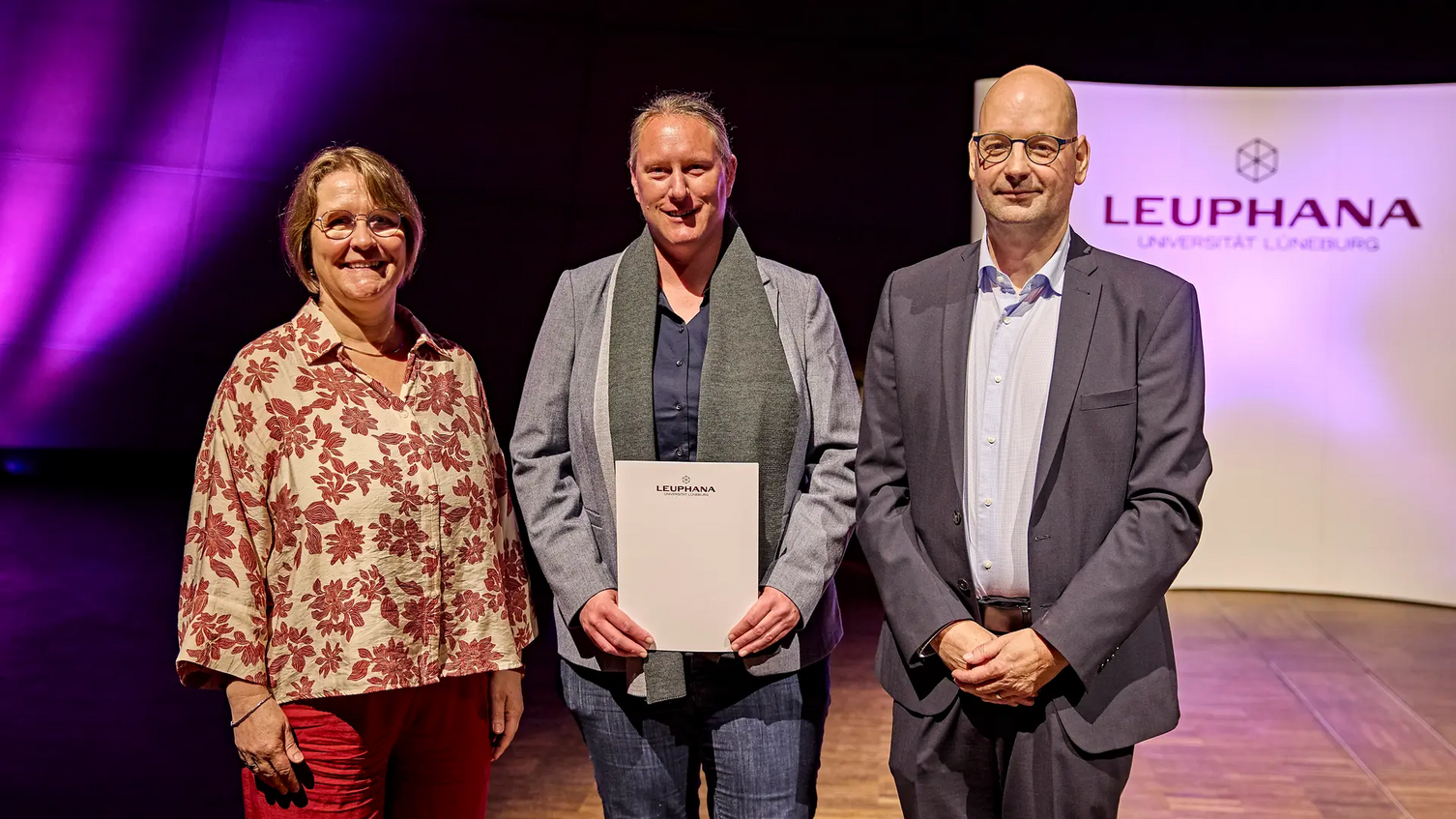 ©Brinkhoff-Moegenburg/Leuphana
Professor Uppenkamp, God created man and woman—is that what you were taught in school as well?
Yes. But I wouldn’t take Luther’s translation too literally. The original Hebrew is less clear-cut; it doesn’t have to be translated as “man and woman.” An additive reading of “male and female”—a possible translation—opens up a gender spectrum, on the other hand.
You say that God loves people precisely because of their diversity. What does that mean?
I believe that G*d is supremely creative. That’s why I find it problematic when people reduce G*d’s creation to rigid categories. Theology can help us critically question such social constructs.
Isn’t the history of the church and theology also a history of power?
Of course. We operate within patriarchal traditions. Reflecting on these traditions is an important task of religious education.
Why is the topic of sexual and gender diversity particularly important in schools?
Because adolescents develop their identities during puberty. At the same time, they encounter a wide range of religious interpretations on social media—from progressive approaches to a return to traditionalism. That’s why a historically critical approach to the Bible is needed, rather than a literal interpretation, in order to make sense of these interpretations.
So is the Bible not the Word of God?
I understand the Bible as the word of God insofar as people put their experiences with God’s revelation into words. It is not a dictate, but rather an attempt by people to make sense of their experiences with God.
How can religious education in particular offer a safe space for queer youth when anti-queer sentiment is often justified in the name of religion?
Theology deals with fundamental questions about what it means to be human and one’s place in the world. Religious education can help students question categories and navigate ambivalence. Religious pedagogy can encourage people to deal competently with complexity and help them interpret their own life experiences theologically as well. This applies to both queer and heteronormative people.
Why must religious education specifically address marginalized groups?
Because not all groups are equally visible. A study from North Rhine-Westphalia shows that over 90 percent of the LGBTIQ+ individuals surveyed do not feel represented in school textbooks or in the classroom with regard to their sexual or gender identity and life situation. When a group is so severely underrepresented, it is appropriate to focus specifically on that group.
And doesn’t it ultimately benefit everyone?
I’m often asked this question. Queer-sensitive education is, first and foremost, about protecting a minority from discrimination. A teacher can’t always take all perspectives into account at the same time, so decisions must constantly be made. However, a shift in perspective can also help heteronormative children and adolescents better understand themselves and the world in which they live.
Why do people find it so hard to tolerate diversity?
We live in an increasingly complex and unpredictable world. People have a need to make sense of things. Religion can help us cope with complexity—but it can also be used to impose strict rules and limitations. Complexity should not, at first, be understood as a threat. After all, the forced reduction of complexity ultimately affects people in very concrete ways. Even if inclusion means that dominant groups must relinquish privileges, it protects human rights and human diversity.
Now, there is another—and by no means small—group of marginalized people in the church and in theology: women. How do they benefit from queer theology?
I think the question is framed incorrectly. It sounds as if women are being given something they’ve been lacking until now. In reality, queer and feminist theology resists centuries of—at times violent—disempowerment of women, inter* and trans* people. People are reclaiming what has always been rightfully theirs.
Thank you very much for the interview!