
Cornelia Funke at the Utopia Conference: “Stories Are Creations”
2026-09-17 *The Thief Lord*, *Reckless*, or the *Inkworld* series: Cornelia Funke has shaped generations of readers with her extensive body of work. Her books have been translated into over 50 languages. At the Utopia Conference, she spoke about imagination, social change, and uncertainty as the elixir of life.
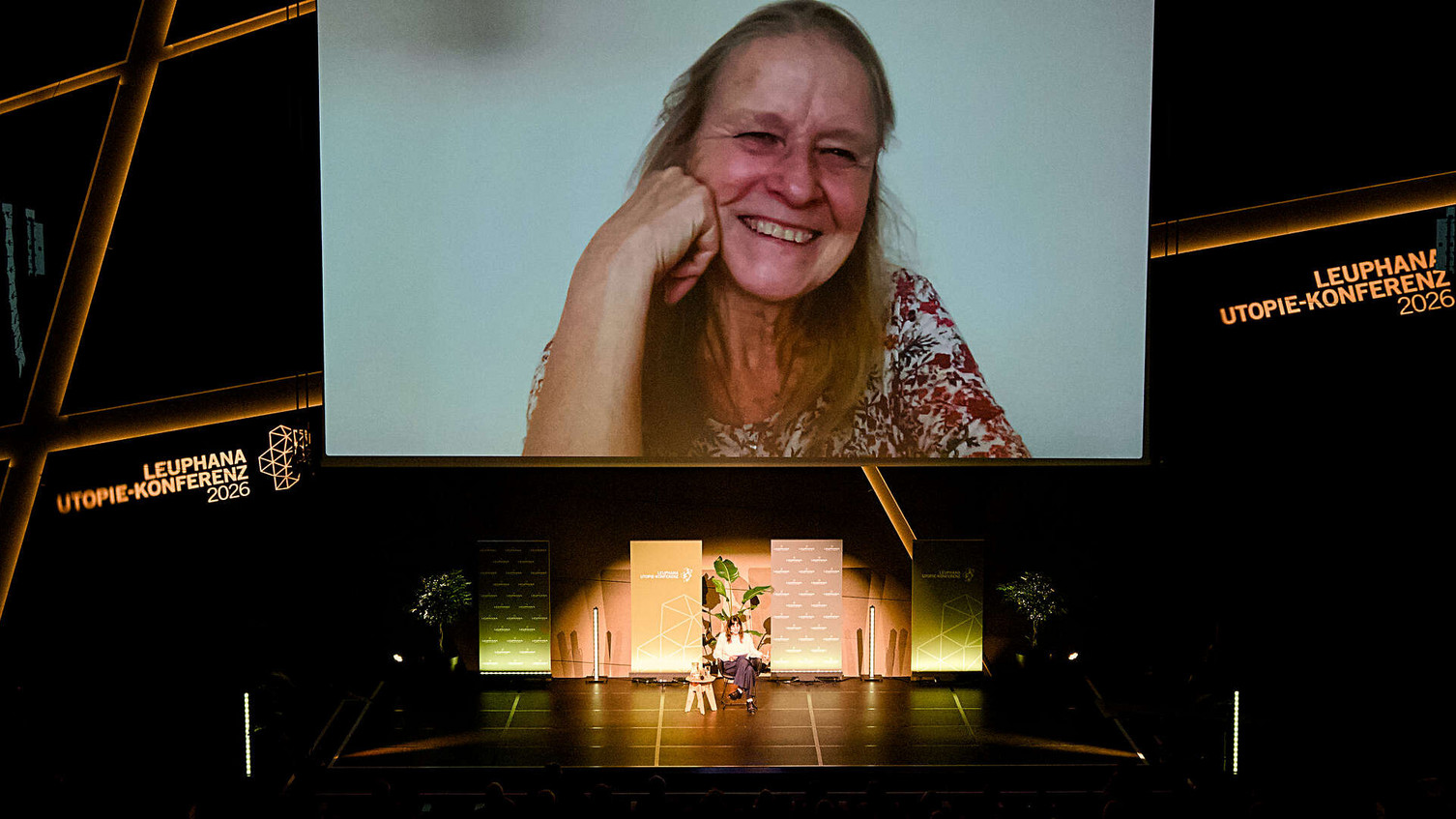
How much imagination does a utopia need? Cornelia Funke’s answer is clear: “If we can no longer imagine anything else, then the here and now is set in stone.” In a conversation during the “Long Night of Utopias,” she spoke with Leuphana alumna and long-time conference SHK Jelta Aden about the power of stories: She described the unknown as a kind of “elixir of life” and revealed just how open-ended her own creative process is: “When writing, I’d get bored if I knew how the story would end,” explained Cornelia Funke.
A native of North Rhine-Westphalia, she now lives in Tuscany. She has left city life behind; nature fuels her imagination. “There are a few things in the world that are absolutely certain—for example, plants and animals, everything that is more than human. A great deal of imagination can grow from them.”
Especially in a time marked by crises and uncertainty, imagination can take on special significance. On the one hand, society is experiencing major crises; on the other, everyday life is dictated by numerous obligations: emails, appointments, and constant availability. Fantastic stories can build an alternative world. A small corner of that world will be created next year in Lübeck: Right next to the Günther Grass House, Cornelia Funke is opening the “Tintenfleck”—a gathering place for creative people, bookworms, and their fans.
“A good storyteller always reflects the world in which they live. Hopefully, that’s also reflected in my stories,” said Cornelia Funke. One example: In *The Wild Chicks*, Wilma falls in love with her best friend. The novel was published in 2003. Today, Cornelia Funke would ask other questions—about things that hardly played a role in her own youth: What has colonialism wrought? How do we deal with gender roles? What does it mean to be a man or a woman—and what if someone doesn’t identify with these categories? “For me, love is love, no matter who you fall in love with. That’s the most precious thing.”
The author treats her stories with the same respect: “To me, a story is a creature that has a life of its own. I don’t feel like I invented it. The stories come to me.”