
New, freely available textbook: Sustainable Chemistry for Everyone
2026-03-17 From kindergarten to university: The new textbook "Chemistry Education for a Sustainable Future" aims to embed the fundamental principles of sustainable chemistry in education and training worldwide. It is designed for teachers and students alike—and offers concrete strategies for classroom instruction and teaching.
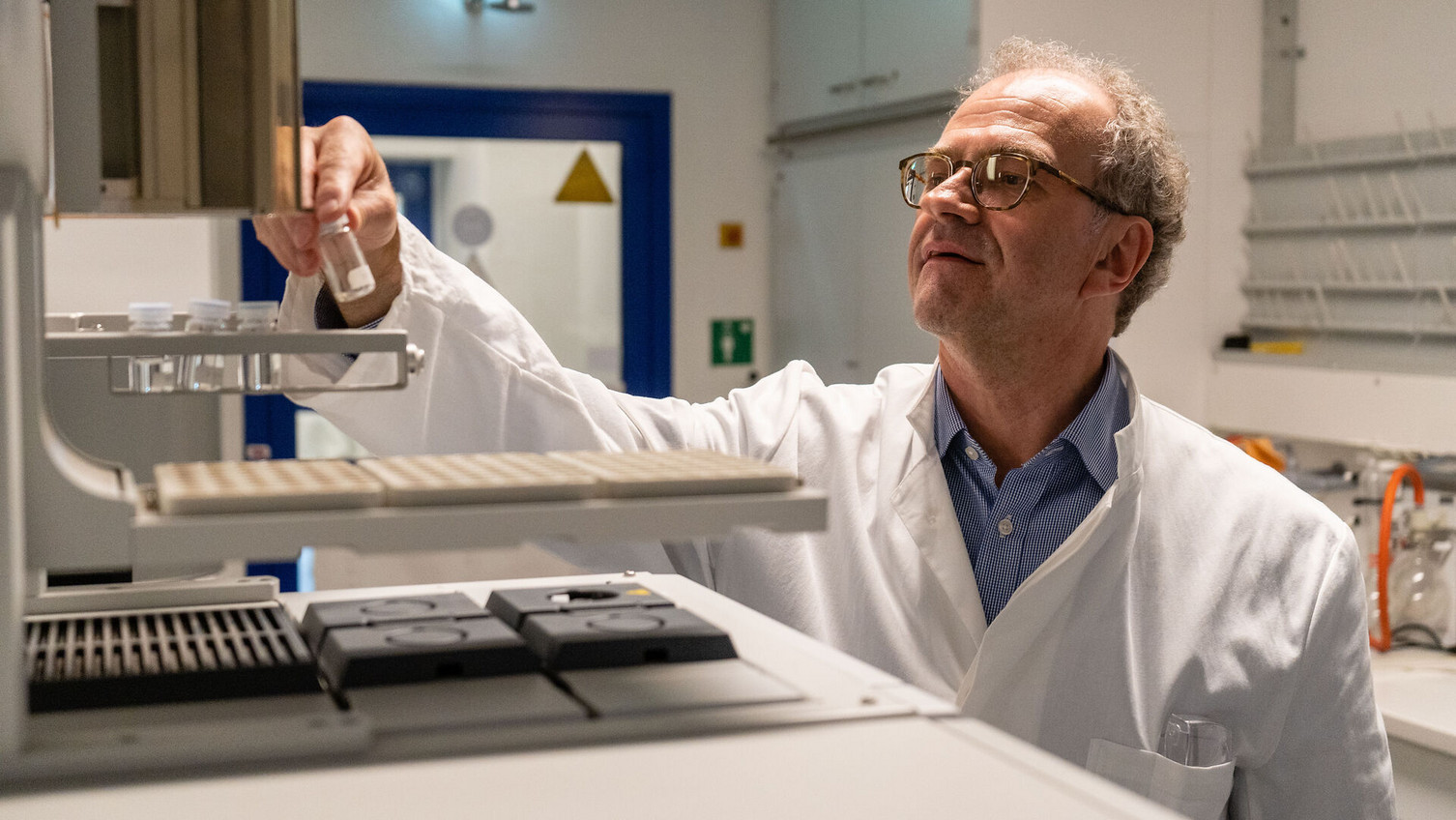
Professor Kümmerer, why another chemistry textbook?
Because we need a textbook and learning resource that doesn’t just treat sustainable chemistry as an add-on chapter. “Chemistry Education for a Sustainable Future” combines technical fundamentals with pedagogical concepts, numerous practical examples, and supplementary materials. Teachers will find concrete ideas for classroom instruction and teaching; students will find a structured introduction to sustainable chemistry.
What specific topics do you and the other authors address?
First, we clarify what sustainable chemistry fundamentally is. It is not synonymous with green chemistry. It goes further, considering from the outset how chemistry and sustainability must be linked. The textbook describes how chemical issues fit into broader contexts: the circular economy, systems thinking, planetary boundaries, or the UN Sustainable Development Goals. It uses concrete examples to show how such topics can be integrated didactically in schools and universities. On the other hand, the book emphasizes practical applicability. It contains many practical examples, discussion prompts, and historical and societal references.
The book is explicitly aimed at educators in universities, schools, and even kindergartens. How can this be achieved?
Sustainable chemistry should not be addressed only at the university level. The book contains many examples that can be applied to all levels of education. Take PFAS, for example. These are extremely stable carbon-fluorine compounds; they are found everywhere in the environment and remain stable there for a long time. That’s why they’re also called “forever chemicals.” They’re water- and grease-repellent, heat-resistant, and hardly break down in the environment. There are several thousand man-made compounds. Teflon is one of them. Many rain jackets are treated with it, as are coffee-to-go cups, fast-food packaging, and much more. They’re everywhere. I can already talk to children about this. Why isn’t the rain jacket as waterproof as it was last year? Is something perhaps leaching out of the fabric? Children learn at such an early age that materials have properties—and that their use also has consequences.
So the book aims to shift perspectives?
Correct. A simple example: No one has benzene at home because it’s toxic and has no practical use in everyday life. This raises the same question for other substances and products: Why and where do we use them? Take ski wax containing PFAS. It provides only a minimal speed advantage. If everyone stopped using it, there would be no disadvantage even in competitive sports; rather, success would depend more on the athlete’s ability than on who has the latest technology—bringing us closer to the true spirit of competitive sports. However, if a substance or material is actually necessary (e.g., for ski wax or a water-repellent outdoor jacket), then it must be designed so that it is easily and as fully as possible regulated or, if a component can enter the environment, rapidly and completely biodegradable in the environment (“Benign by Design”). Only then does the question of green synthesis arise. One goal of the textbook is to systematically convey these relationships and logical processes.
Why was the textbook published as open access?
Sustainable chemistry affects all regions of the world. That is why the textbook should also be freely accessible worldwide. Especially in the Global South, where enormous infrastructural developments, population growth, and rising living standards are on the horizon in the coming decades, sustainable chemistry can and must be integrated into education and practice from the very beginning. Open Access significantly facilitates this access while simultaneously ensuring greater educational equity.
Thank you very much for the interview!
The anthology “Chemistry Education for a Sustainable Future,” co-edited by Prof. Dr. Klaus Kümmerer, has been published by the Royal Society of Chemistry and is also the first fully open-access book from this renowned publisher.
The publication was funded by the Lower Saxony Open Access Publication Fund “NiedersachsenOPEN” and the Publication Fund of the Media and Information Center (MIZ) at Leuphana.