
Israel-Gaza: Between jurisdiction and political decisions
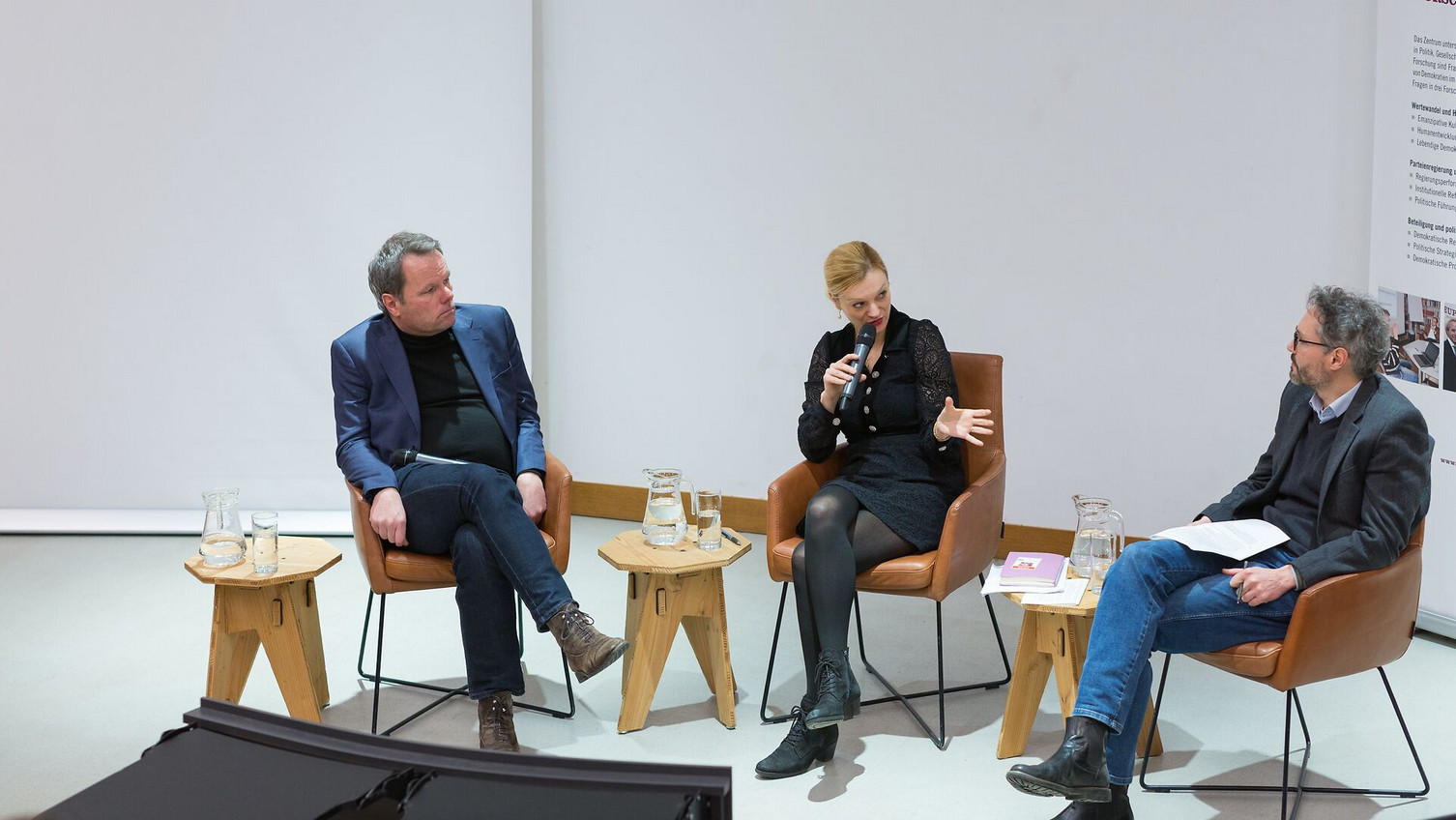
2026-02-05 Prof. Dr. Janina Dill, Professor of Global Security at the University of Oxford, and Prof. Dr. Eckart Woertz, Professor of Middle Eastern Politics at the University of Hamburg, in an interview on international law and historical background.
To what extent does the Gaza conflict reveal the actual enforceability of international law?
Janina Dill: Jurisdiction in international law differs from the ideal type we have in mind. Within certain limits, states can choose to what extent they accept the jurisdiction of this court. This is very relevant in the context of conflicts, because the International Court of Justice has jurisdiction to rule on genocide, but cannot, for example, determine whether Israel is committing war crimes or crimes against humanity in the Gaza war. Israel does not recognize the jurisdiction of the International Court of Justice in these matters.
When it comes to enforcement, there is a central enforcement authority in international law, but it is limited and politicized. The Security Council is supposed to act as an executive body when a state threatens peace and international security by violating international law. But there is no world police force that comes in when a state or a non-state armed organization attacks a country.
How can enforcement still succeed?
Janina Dill:There is talk of a horizontal enforcement model: states should hold each other accountable through sanctions, the severing of diplomatic relations and, in very limited circumstances, through the use of armed force. This has never worked reliably, as states always act politically.
In the context of this conflict, the limitations of this system are particularly evident because many Western states were not prepared to fulfill their obligations under international law when it became clear that Israel was violating international law. This has greatly damaged international law. The course of the conflict can only be understood against this background.
How do you assess the concept of raison d'état?
Eckart Woertz: raison d'état is a very German debate whose significance is overestimated. I don't believe that Israel would rely on Germany in a serious crisis. The debate about special responsibility and raison d'état is relatively recent, dating back to the 2000s, and was strongly influenced by Angela Merkel. The term did not come out of nowhere, but it was only ritualized during this period. In the 1950s and 1960s, German support for the young Israeli state was in fact much more decisive than it is today.
In 1948, the State of Israel was founded, while the West Bank was annexed by Jordan and the Gaza Strip was administered by Egypt. At that time, Germany was not yet an independent state, was not a member of the UN, and therefore had no say in the matter. In 1952, in Germany's own interest, the Luxembourg Agreement was signed, which negotiated reparations in order for Germany to be readmitted to the international community. However, diplomatic relations were not established until 1965.
In short: yes, there should be responsibility towards Jewish life, including in Israel, but not towards a state. The concept of raison d'état is problematic because it suggests that a state can place itself above the law in its own interests. I consider blank checks to other states to be problematic.
Janina Gill: Reasons of state are not a valid justification for violating international law. They are a political concept. This does not allow Germany to circumvent the contractual obligations it has entered into as an expression of its own sovereignty.
The Gaza conflict is receiving a lot of media attention, while other wars seem to have been forgotten. Why is that?
Janina Gill: From an international law perspective, no one claims that the parties to the conflict in Yemen or Sudan are complying with international law. The media attention in the context of Israel/Gaza is partly due to the continuing argument that Israel is complying with international law, which is why expert opinions are sought. Basically, we should be paying much more attention to conflicts in Sudan, Yemen, and the Democratic Republic of Congo, which also need our attention.
However, these references to "forgotten conflicts" should not be used as a distraction from the fact that there is a blatant need for action in German policy toward Israel. German taxpayer money and political support are involved here much more significantly and directly than in other conflicts, which is why there is a greater responsibility and a democratic need to address the issue. The German government cannot say on the one hand that it has no moral authority to judge Israel due to historical responsibility, and on the other hand take a clear military and diplomatic position in the conflict.
Eckart Woertz: This conflict is receiving enormous media attention and has great potential to stir up emotions. This cannot be explained solely by its brutality, because other conflicts are also brutal. We must therefore consider what it is that, for different reasons, binds people in the Arab world, in Germany, or in the US so emotionally to this conflict.
Self-defense and proportionality are terms defined in international law that are often politicized in public debates. What impact does this have on international law itself on the one hand and on political debates on the other?
Janina Dill: Self-defense and proportionality are legal terms with clear definitions, but their application is doctrinally complicated and sometimes controversial. There are good reasons to say that Israel does not have a right to self-defense within the meaning of Article 51 of the UN Charter, as it previously controlled Gaza as an occupying power. This debate under international law plays a role in the public question of whether Israel is "allowed" to do so, but it must be distinguished from it. International law is an important point of reference, but ethical, moral, and political intuitions also flow into the public debate. The discussion is only productive if a clear distinction is made between the legal concept and moral, ethical, and political approaches.
Eckart Woertz: A military response from Israel was to be expected after October 7. Any other state would also have taken measures to protect its population. However, Israel should have complied with international humanitarian law in its military response, which it clearly did not do with its unrestricted warfare. It is important to note that neither the Palestinians until 1988 nor Israel fully recognized the borders under international law. Although Israel recognized the UN Charter, the territorial borders were not bindingly accepted by either the Palestinian side or Israel. The 1967 border was established by a UN resolution based on the original 1949 armistice line, but was not legally recognized by the PLO until 1988 and has never been recognized by Israel – similar to the 1988 Hamas Charter, which defines occupation throughout the entire Mandate territory.
Empirically, neither party strictly adheres to international law. The question of territorial jurisdiction is not decisive for armed attacks against the population. Nevertheless, Israel has traditionally attempted to present detailed arguments in accordance with international law, more so than Russia, although states generally always find arguments to justify their actions.
Thank you very much for the interview!
Prof. Dr. Janina Dill is Professor of Global Security at the University of Oxford and a Fellow at Trinity College. She researches the intersection of international law, ethics, and armed conflict. She is Co-Director of the Oxford Institute for Ethics, Law, and Armed Conflict and has published extensively in this field.
Prof. Dr. Eckart Woertz is Professor of Middle Eastern Politics at the University of Hamburg and Director of the GIGA Institute for Middle East Studies, with which Leuphana University cooperates ( ). He researches political economy, energy and food security in the Middle East and North Africa and has published numerous works on these topics.