
New at Leuphana: Prof. Dr. Daria Bayer – What the Law Does Not See
2026-10-26 Social debates, experiences, and emotions have little place in court. The assistant professor of criminal law, criminal procedure, and legal philosophy brings invisible aspects of the law to light using an unusual medium: theater.
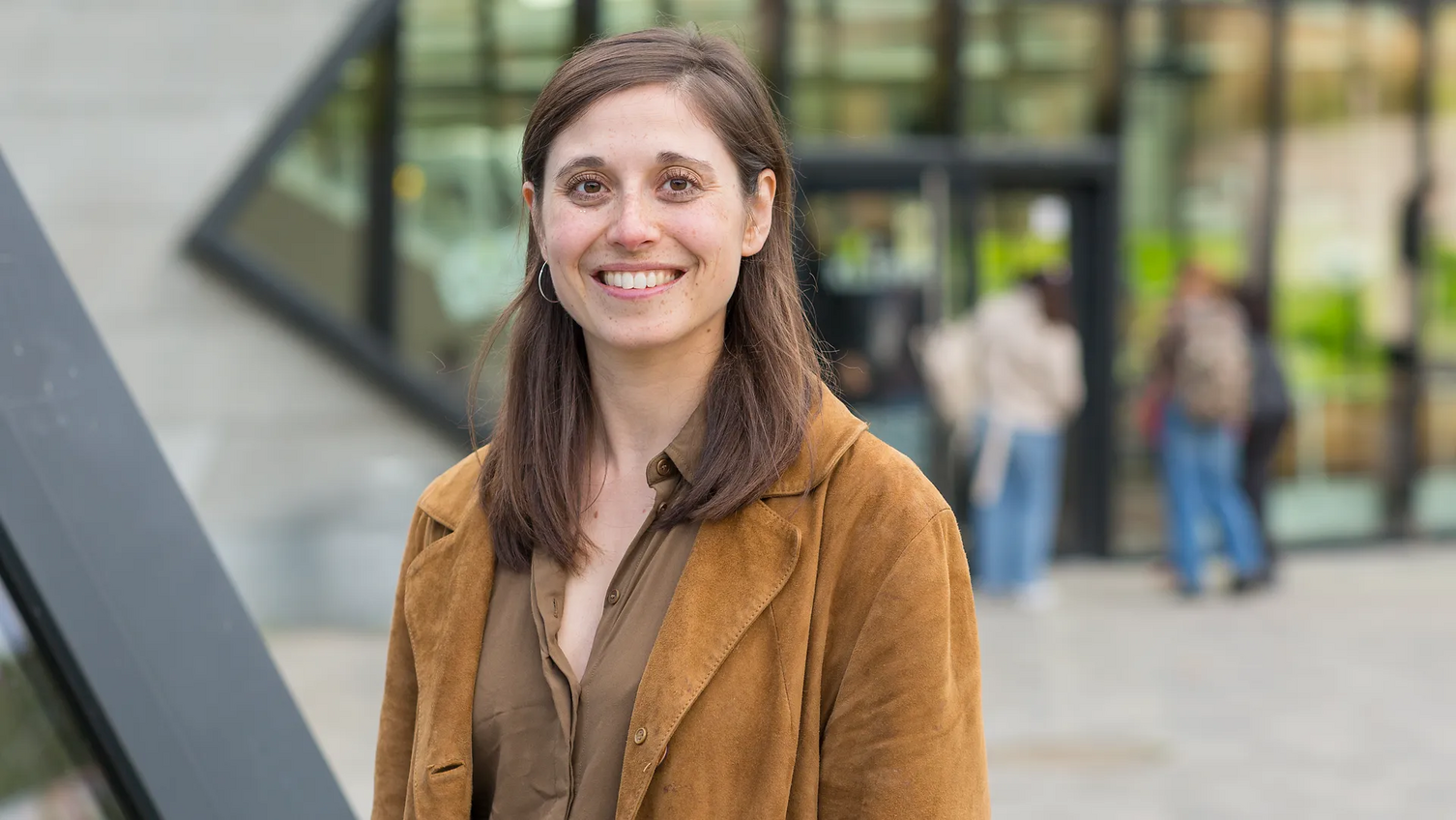
Guilty or not guilty. Criminal law operates with clear rules, established procedures, and precise language. Defendants, defense attorneys, prosecutors, victims, and witnesses all play fixed roles. What is indispensable for a procedure under the rule of law also has its limits: feelings, experiences, and social contexts are difficult to translate into legal language. In criminal law in particular, judgments cannot reflect ambivalence and gray areas. After all, a decision must ultimately be made regarding the defendant’s conviction or acquittal. If there is any doubt as to their guilt, they must be acquitted. This leaves little room for different perspectives, changing needs, or even a dialogue between defendants and victims. Daria Bayer explains: “In sexual criminal law in particular, theatrical exploration can help those affected articulate the harm they have experienced and bring moral nuances to light: Can a behavior be wrong even if it is not a criminal offense? Can two divergent perceptions of the same set of facts be true at the same time? Can the law produce new injustices, and how can these be addressed?”
In her award-winning dissertation “The Tragedy of Law,” she examines the relevance of materialist legal criticism, particularly the critique of legal form by the Soviet jurist Yevgeny Pashukanis. After he had developed the thesis of the “withering away of law” in a fully developed communist society, he himself was liquidated without trial in 1937 “as a public enemy.” He thus experienced firsthand and in a tragic way that criminal procedural rights are central to protecting the individual. What is extraordinary about Bayer’s dissertation is that Pashukanis himself becomes a dramatic figure within it. In an imagined trial of himself, he confronts his own complicity in the establishment of the Stalinist terror. “My aim is to find new approaches to the fundamental questions of democratic coexistence and punishment.” We invite audience members and performers to reflect on social conditions, as well as on the conditions of production within the academic system and the responsibility of academia. Theater thus becomes a central space for critical practice. For in theater, existing law can be fundamentally questioned without sacrificing its practical achievements. That is the idea of political theater,” explains the researcher.
Daria Bayer is a co-founder of the theater collective “kollektiv im Fenster” (kiF). The interdisciplinary group seeks to break down boundaries between legal criticism, politics, and theater. Instead of performing exclusively classical plays, the collective develops its own productions that artistically explore complex social contexts in collaboration with the audience. For example, the collective wrote the play “PubliCum Ex – A Public Inquiry Committee.” The play deals with the Cum-Ex tax scandal and premiered in 2024 at Hamburg City Hall. In its current project, “nest/foulers,” the collective addresses the abuse of power in the legal profession.
Exciting for students: In addition to traditional criminal law lectures, Daria Bayer develops teaching formats that combine legal theories with practical theater work. At Goethe University Frankfurt, she has already offered seminars of this kind in collaboration with theater director Henri Hüster: Students first engaged with criminal law and criminal procedure issues from an academic perspective and wrote seminar papers. They then spent several days moving from the seminar room to the theater stage: “At Leuphana, we have excellent conditions for seminars of this kind thanks to our strong cultural studies program and the Kunstraum,” she says. “In the theater, students, faculty, and practitioners can experiment with new forms of production together. The theater thus becomes a laboratory for utopias.”
Daria Bayer is interested in the boundaries of legal categories: The criminal law scholar also examines individual culpability in organized crime. One area of focus is the final Nazi criminal trials: In 2024, a former stenographer at the Stutthof concentration camp was convicted of aiding and abetting murder in over 10,000 cases. The case raises the legal-theoretical question of what contribution people make to a criminal system through seemingly “neutral” activities.
Daria Bayer hopes to engage people in conversation about these and other fundamental legal questions: Together with a colleague from the University of Hamburg, she regularly hosts the StrafrechtkomiTee. The idea behind this afternoon salon is to bring together students with guests from society, academia, and the arts. Over a cup of tea, fundamental questions of criminal law are discussed from an interdisciplinary perspective.
Daria Bayer studied law at Bucerius Law School and New York University School of Law and earned her Ph.D. from the University of Hamburg in 2021. In 2022, she was awarded the Research Prize of the German Section of the International Association for Philosophy of Law and Social Philosophy for her dissertation. Since August 2026, she has been serving as an assistant professor at Leuphana University Lüneburg.