
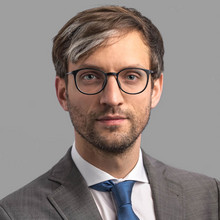
Prof. Dr. Valentin Schatz
Werdegang
Prof. Dr. Valentin Schatz ist Juniorprofessor für Öffentliches Recht, Europarecht und Völkerrecht, insbesondere Umwelt- und Seerecht an der Fakultät Nachhaltigkeit und dort am Institut für Nachhaltigkeitssteuerung (INSUGO). Seine Forschungsschwerpunkte liegen im internationalen, europäischen und nationalen Umweltrecht und Seerecht.
Prof. Dr. Valentin Schatz leitet den Studiengang Erasmus Mundus Joint Master in International Law of Security, Peace and Sustainable Development (ILSPSD).
Ein aktuelles Verzeichnis seiner Veröffentlichungen und Vorträge finden Sie hier.
In der internationalen Fachwelt engagiert sich Prof. Dr. Valentin Schatz derzeit unter anderem als stellvertretender Vorsitzender des Vorstands der International Foundation for the Law of the Sea (IFLOS), als Mitglied der IUCN World Commission on Environmental Law, und als deutsches Mitglied im International Law Association (ILA) Committee on Protection of People at Sea.
Prof. Dr. Valentin Schatz misst dem Wissenschaftstransfer besondere Bedeutung zu. Im Rahmen seiner Forschungsschwerpunkte berät Prof. Dr. Valentin Schatz NGOs (etwa zum Meeresumweltrecht, zur nachhaltigen Fischerei und zur zivilen Seenotrettung), staatliche Behörden (etwa zur Offshore-Windenergie und zur umweltgerechten Schifffahrt) und Think-Tanks (etwa zu hybriden Bedrohungen für die maritime Sicherheit) und fertigt regelmäßig rechtliche Gutachten und Expertisen an.
Zu den Seiten der Juniorprofessur für Öffentliches Recht, Europarecht und Völkerrecht, insbesondere Umwelt- und Seerecht geht es hier.
Lebenslauf/Werdegang:
- seit Juni 2025: Juniorprofessur (W1 mit Tenure Track auf W2) für Öffentliches Recht, Europarecht und Völkerrecht, insbesondere Umwelt- und Seerecht, Leuphana Universität Lüneburg
- September 2022 – Juni 2025: Juniorprofessur (W1 mit Tenure Track auf W2) für Öffentliches Recht und Europarecht mit Schwerpunkt Nachhaltigkeit, Leuphana Universität Lüneburg
- 2021 – 2022: Postdoktorand, Fakultät Rechtswissenschaft, Universität Hamburg
- 2020 – 2022: Rechtsreferendariat am Hanseatischen Oberlandesgericht Hamburg, 2. Staatsexamen
- 2021: Promotion (Dr. iur.) mit einer Dissertation zum Thema "Access to Fisheries within National Jurisdiction" (summa cum laude) an der Fakultät Rechtswissenschaft der Universität Hamburg
- 2018 – 2021: Wissenschaftlicher Mitarbeiter und Doktorand am Lehrstuhl für internationales Seerecht und Umweltrecht, Völkerrecht und Öffentliches Recht (Prof. Alexander Proelß), Universität Hamburg
- April 2017 und März 2018: Gastwissenschaftler, University of Adelaide, Australien
- Dezember 2016 – Februar 2017: Gastwissenschaftler, Max Planck Institute Luxembourg for International, European and Regulatory Procedural Law
- 2016 – 2018: Wissenschaftlicher Mitarbeiter und Doktorand am Lehrstuhl für Öffentliches Recht, inbesondere Völker- und Europarecht (Prof. Alexander Proelß), Universität Trier
- 2012 – 2013: ERASMUS Studium, University of Dundee, Schottland
- 2010 – 2016: Studium der Rechtswissenschaften an der Universität Passau, 1. Staatsexamen
Projekte
-
Integrative Kartierung und Priorisierung von Schutzgebieten im Atlantik - Leitlinien für die Abwägung von Naturschutzprioritäten mit wirtschaftlichen und rechtlichen Interessen auf Hoher See; Vorhaben: Rechtlich-institutionelle Analyse des Rechtsrahmens für Meeresschutzgebiete
Valentin J. Schatz (Wissenschaftliche Projektleiter*in) , Alice Bertram (Projektmitarbeiter*in)
→Projekt: Forschung
Publikationen
Bücher und Anthologien
- Workshop on impacts of the EU-UK Trade and Cooperation Agreement on fisheries and aquaculture in the EU: Part I: Legal aspects
Valentin J. Schatz (Autor*in) , Alexander Proelss (Autor*in) , 2021 Brüssel , 72 S.Publikation: Bücher und Anthologien › Studien- und Unterrichtsmaterial › Transfer
- Rechtliche Vorgaben zum Umgang mit Schiffsabwasser: Völker-, unions- und nationalrechtliche Anforderungen an Einleitungen von Scrubber-Abwasser, Ballastwasser und häuslichem Abwasser durch Schiffe
Alexander Proelss (Autor*in) , Valentin J. Schatz (Autor*in) , 2019 Dessau-Roßlau , 129 S.Publikation: Bücher und Anthologien › Studien- und Unterrichtsmaterial › Transfer
Beiträge in Zeitschriften
- Potential and pitfalls of the advisory function of ITLOS under the BBNJ Agreement
Alice Bertram (Autor*in) , Valentin J. Schatz (Autor*in) , Johannes Ipsen (Autor*in) , 22.10.2026 , in: Leiden Journal of International Law, 39, 3 , 24 S.Publikation: Beiträge in Zeitschriften › Zeitschriftenaufsätze › Forschung › begutachtet
- Review of Objections to RFMO Conservation and Management Measures under EU Law: Bloom v. Commission
Valentin J. Schatz (Autor*in) , 01.06.2026 , in: International Journal of Marine and Coastal Law, 41, 2 , S. 472-483 , 12 S.Publikation: Beiträge in Zeitschriften › Zeitschriftenaufsätze › Forschung › begutachtet
- International regulation of commercially exploited sharks: challenging the notion of shark “bycatch” in tuna RFMOs
Valentin J. Schatz (Autor*in) , Daniel Kachelriess (Autor*in) , 01.03.2026 , in: International Environmental Agreements: Politics, Law and Economics, 26, 1 , S. 1-18 , 18 S.Publikation: Beiträge in Zeitschriften › Zeitschriftenaufsätze › Forschung
- Leugnung des Existenzrechts Israels: Zur Verfassungsmäßigkeit einer potenziellen Verschärfung des § 130 StGB
Valentin J. Schatz (Autor*in) , Alice Bertram (Autor*in) , Emma Bartmann (Autor*in) , 01.12.2025 , in: Recht und Politik, 62, 1 , S. 24-34 , 11 S.Publikation: Beiträge in Zeitschriften › Zeitschriftenaufsätze › Forschung › begutachtet
- Die unionsrechtliche Regulierung von Hafenauffangeinrichtungen für Schiffsabfälle durch die PRF-Richtlinie
Valentin J. Schatz (Autor*in) , Laura Wanner (Autor*in) , 01.01.2025 , in: Natur und Recht, 47, 1 , S. 13-19 , 7 S.Publikation: Beiträge in Zeitschriften › Zeitschriftenaufsätze › Forschung › begutachtet
Beiträge in Sammelwerken
- The procedure for the prompt release of vessels and crews: Pragmatic? Predictable? Passé?
Camille Goodman (Autor*in) , Valentin J. Schatz (Autor*in) , 12.02.2026 , S. 330-355 , 26 S.Publikation: Beiträge in Sammelwerken › Kapitel › Forschung › begutachtet
- Decolonizing RFMOs: The Case of The United Kingdom’s IOTC Membership on Behalf of the Chagos Archipelago
Valentin J. Schatz (Autor*in) , 14.10.2024 London , S. 17-33 , 17 S.Publikation: Beiträge in Sammelwerken › Kapitel › Forschung › begutachtet
- Seeanlagengesetz (SeeAnlG)
Valentin J. Schatz (Autor*in) , Emma Bartmann (Autor*in) , 01.09.2024 1. Aufl. Baden-BadenPublikation: Beiträge in Sammelwerken › Beiträge in Kommentarsammlungen › Forschung
- Artikel 9 Umweltziele
Valentin J. Schatz (Autor*in) , Miriam Köster (Autor*in) , 01.01.2024 1. Aufl. München , S. 165-174 , 10 S.Publikation: Beiträge in Sammelwerken › Beiträge in Kommentarsammlungen › Forschung
- Planung/Zulassung von Energieanlagen Seeanlagengesetz (Rn 1-17) Einführung
Valentin J. Schatz (Autor*in) , Emma Bartmann (Autor*in) , 01.01.2024 MünchenPublikation: Beiträge in Sammelwerken › Beiträge in Kommentarsammlungen › Forschung
Aktivitäten
-
“Legal Implications of the Designation of Area-Based Management Tools under the BBNJ Agreement in High Seas Areas above Extended Continental Shelves of Coastal States”
Valentin J. Schatz (Sprecher*in) , Alice Bertram (Sprecher*in)
Aktivität: Konferenzvorträge › Forschung
-
Opinion on the Conformity of the European Union’s Position with the UNFSA concerning the Conservation and Management of North Atlantic Shortfin Mako Shark at ICCAT
Mercedes Rosello (Gutachter/-in) , Valentin J. Schatz (Gutachter/-in) , Eva van der Marel (Gutachter/-in)
Aktivität: wissenschaftliche Gutachtertätigkeiten › Transfer
Auszeichnungen
-
Promotionspreis 2020-2022
Valentin J. Schatz (Empfänger/-in) ,Auszeichnung: Externe Preise, Stipendien, Auszeichnungen, Ernennungen › Forschung
Lehrveranstaltungen
This lecture series explores the relationship between security, international law, and power in the 21st century. As states increasingly perceive a wide range of developments as security challenges and geopolitical power relations continue to shift, this triangular relationship calls for its rethinking. Therefore, across different fields of international law, the lecture series examines how these changes shape the development and application of international law and how international law, in turn, affects security and power.
Bringing together scholars and practitioners, the lecture series covers topics including collective and regional peace and security, peacemaking, maritime security, international criminal accountability, international trade and investment, counter-terrorism, and environmental security.
The seminar begins by providing a general introduction to the main pillars and tenets of the global order of the oceans (particularly the 1982 United Nations Convention on the Law of the Sea (UNCLOS) as well as the concepts of ocean governance and ocean sustainability. Thereafter, the seminar analyzes specific persistent and/or contemporary challenges and recent or ongoing developments with respect to sustainable ocean governance. These topical sessions and the examples and/or case-studies examined in them highlight the importance not only of international law and institutions but also of its implementation through the prescription and enforcement of regional (for example, European) and domestic (for example, German) law.