
Blended Learning Programme Lehre am Start
Lehre am Start is a 56 working units (WU) continuing professional development programme delivered via blended learning, designed for lecturers who wish to begin teaching at Leuphana and are currently running their own course or planning to do so in the near future. In a compact format, participants acquire fundamental knowledge of university teaching methodology for planning and delivering their own courses, assessing examination performance, and providing feedback and communication in teaching. The programme meets the requirements of the Lower Saxony State Certificate in Higher Education Teaching. Completion of the programme is recognised as Module 1 of the qualification ‘Further Training in Higher Education Teaching’ (WindH), which leads to the State Certificate, meaning you can proceed directly to that programme.
The programme starts in June 2026 and ends in February 2027 and is entirely in German.
We look forward to receiving your registrations for the full programme by 31 May 2026 at: lehrservice.weiterbildung@leuphana.de.
For individual modules, you can also enrol via Workshop Portal of the Teaching Service.
Participants in the full programme will be given priority for places.
We are happy to answer any queries at lehrservice.weiterbildung@leuphana.de.
Your Teaching Services Team
Upon completing the course, participants will have
- explored the formulation of learning objectives, fundamental aspects of effective media-enhanced teaching, and the use of AI in teaching,
- become familiar with a range of planning models, methods and tools to support active and collaborative learning, and applied these to their course planning,
- acquired the fundamentals of learning-objective-oriented assessment and implemented them in an assessment grid for their course,
- explored various options for feedback and communication as design elements of teaching and reflected on their own communication and feedback preferences,
- gained insights into supporting heterogeneous groups,
- gained an overview of key pedagogical decisions in the planning and delivery of teaching
- have developed materials for their own teaching and are able to take their first reflective steps in teaching.
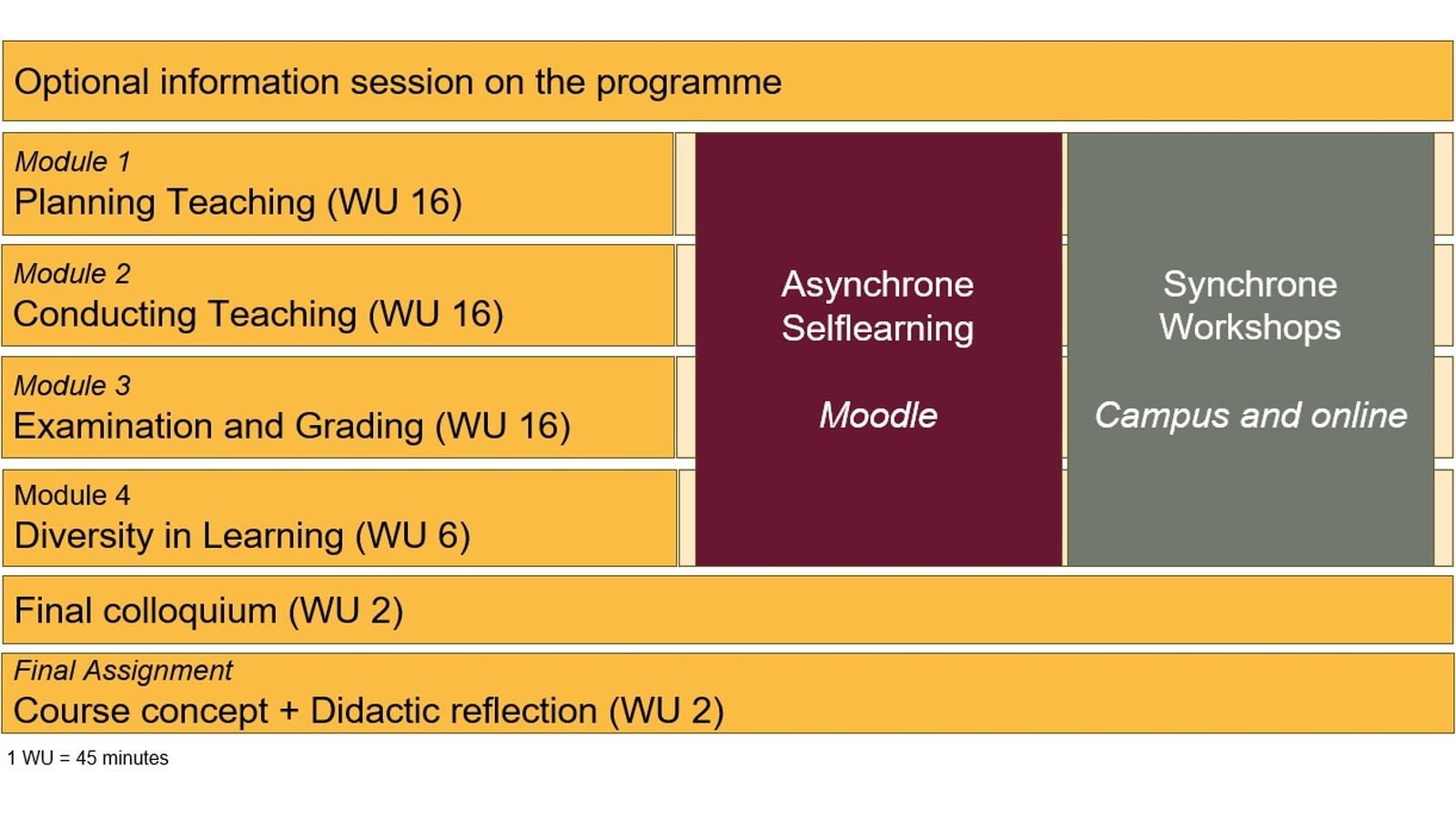
The programme has a modular structure and addresses key aspects of instructional design. Synchronous workshops, held on campus or online, are supplemented by asynchronous, task-based preparatory and/or follow-up work. A Moodle course is available for this purpose, which also serves as the central communication platform. One to three sessions are offered per module, each taking place on Fridays, either half-day or full-day.
The programme can be taken in full – all four modules plus the final project and colloquium – or on a module-by-module basis.
The final project for the programme involves the creation of a course concept for one’s own teaching (e.g. a syllabus), including a reflection on the pedagogical decisions that informed its development.
| Information on the programme | 12.06.2026 | 10-11 h | online |
| Planning Teaching I - Preliminary planning: Part 1 | 19.06.2026 | 9.30-16 h | on-campus |
| Planning Teaching II - Preliminary planning: Part 2 | 03.07.2026 | 9.30-13 h | online |
| Planning Teaching III - Detailed planning | 02.10.2026 | 9.30-13 h | online |
| Conducting Teaching I - Methods, Tools and AI + Workshop | 16.10.2026 | 10-16.30 h | online |
| Conducting Teaching I - Dealing with difficult situations | 30.10.2026 | 9.30-13 h | on-campus |
| Examination and Grading I - Assessment and Evaluation in Practice | 13.11.2026 | 9.30-13 h | on-campus |
| Examination and Grading II - Task design and AI-resistant tasks | 04.12.2026 | 9.30-13 h | on-campus |
| Examination and Grading III - Educational feedback | 22.01.2027 | 9.30-13 h | on-campus |
| Diversity in Learning | 05.02.2027 | 9.30-13 h | on-campus |
| Final colloquium | 19.02.2027 | 9.30-11 h | on-campus |
Planning Teaching (16 WU)
In the ‘Planning Teaching’ module, participants work with selected planning models and practise formulating learning objectives in a competence-oriented manner, taking constructive alignment into account. Participants familiarise themselves with the various levels of design and didactic decision-making concepts, and apply these to their own course description. This also involves reflecting on their role as a teacher.
The module also focuses on the detailed planning of individual learning units. Based on their teaching objectives, participants examine a didactically sound structure for sessions. This includes the effective use of methods and the deliberate design of social interactions. During a practical phase, participants will apply the content to their own teaching and have the opportunity for feedback and discussion on the topic of teaching and session planning.
Conducting Teaching (16 WU)
In the ‘Conducting’ module, participants receive guidance on how to translate their objectives into the methodological design of their teaching. Participants are given an overview of blended learning and the integration of synchronous and asynchronous sessions. In addition, they will gain inspiration on how to use Leuphana’s digital and AI tools in their own teaching in a way that promotes learning. In a workshop phase, they will practise applying these tools with a focus on pedagogical reflection.
Participants will also receive guidance on challenging teaching situations, which they will reflect on against the backdrop of their own teaching experience. Using peer counselling methods, they will develop strategies for dealing with their own challenges.
Examination and Grading (16 WU)
In the ‘Examination and Grading’ module, participants learn about various assessment criteria, their weighting and the operationalisation of learning objectives, based on examples of assessment grids for written and combined academic work. They apply this to their own course and design an assessment grid. At the same time, participants are encouraged to reflect on subject-specific cultural characteristics when conducting examinations. Fundamental to this is the concept of competence-based assessment.
Participants also receive guidance on instructional design and on conducting AI-resistant examinations.
Participants learn to recognise feedback as a fundamental component of teaching and learning and are able to implement suitable methods effectively to support learning. This involves designing feedback for students that promotes learning and fostering peer feedback as a learning tool.
Learning Diversity (6 WU)
The broad field of diversity is broken down into teaching and learning in heterogeneous groups. Participants receive guidance on dealing with learning diversity and their own role in supporting learning.
Final Colloquium (2 WU)