
Teaching Profile & Examination Concept
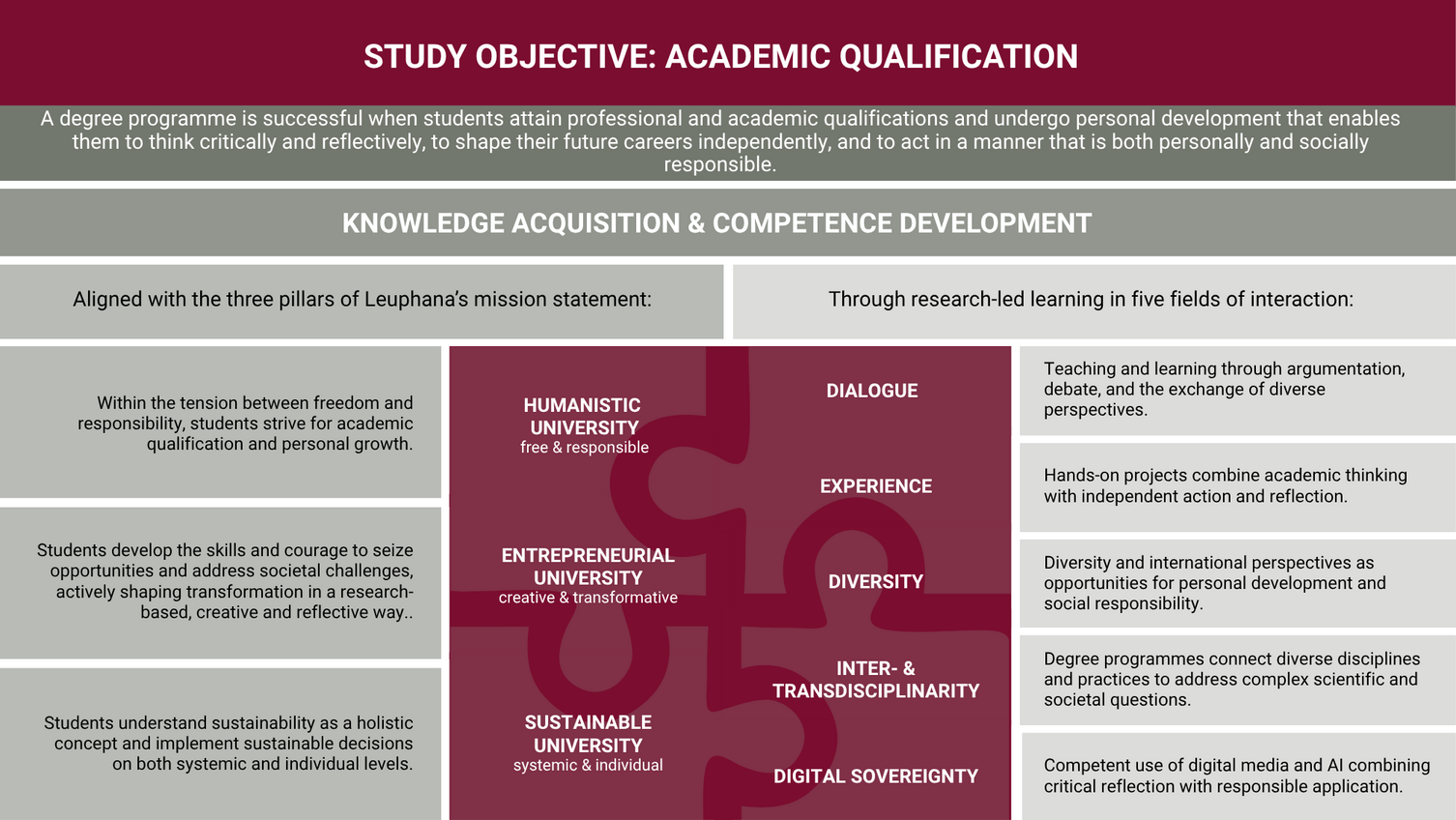
Leuphana’s teaching profile is derived from the educational philosophy—anchored in Leuphana’s mission statement—of a humanistic, sustainable, and action-oriented university. In keeping with its self-image as a university of transformation, Leuphana strives to provide its students with an academic qualification that empowers them to think critically, act independently, and behave responsibly in a society undergoing profound change. In its teaching, Leuphana is guided by the principle of inquiry-based learning across five fields of interaction: dialogue, experience, diversity, inter- and transdisciplinarity, and digital sovereignty (see diagram).
This understanding of education and teaching also forms the basis for the university’s approach to examinations. Examinations are an integral part of academic learning processes in the spirit of constructive alignment. They provide feedback on the acquisition of competencies and are intended to offer reliable information about achieved learning outcomes and qualification goals. The examination concept, adopted by the Presidential Board following consultation with and recommendation from the Senate, establishes a common framework for this and outlines the requirements for transparent, fair, manageable, and non-overlapping examinations, as well as a learning-oriented and agile examination culture—particularly in the context of AI.
Download: Examination Concept (in German)
 ©Lehrservice
Dialogue
Participation, reflection and shared responsibility are essential elements of Leuphana's teaching and learning culture. This culture and Leuphana's opportunities as a presence university open up spaces for encounter and dialogue. Dialogue – understood not only as a form of communication, but also as an attitude – serves as a starting point for joint development and shared awareness. In shaping these interactions, teachers and students share responsibility for the success of teaching and learning. Dialogue orientation as a field of interaction in educational development is intended to provide opportunities and impulses to initiate development and awareness.
Experience
The design of teaching requires special forms of learning to promote interaction between theory, academic and social practice. However, experiential learning means more than the collection of practical work experience. Rather, it places students at the centre of their own learning and transfer process through reflection on their individual experiences and personal development. Since learning processes take place not only in traditional courses, but also in many aspects of campus life, experiential teaching provides a framework in which teaching can be thought together with Leuphana's extracurricular offerings - from student counselling and the Social Change Hub to the Career Service and alumni networks.
Diversity
Diversity as a learning opportunity fosters the growth of knowledge and competence, it strengthens the personal development to which Leuphana as a humanistic university is committed in its mission statement, and through the training of diversity competence can promote the ability to solve social problems and the willingness to assume social responsibility in a pluralistic society, which Leuphana as a sustainable and action-oriented university strives to achieve.
A broad understanding of diversity is pursued in the development of teaching. Diversity in terms of personnel as well as differences in access and prerequisites for study and teaching are taken into account. Diversity has many facets and manifests itself in different ways; it encompasses differences as well as similarities.
Interdisciplinarity and transdisciplinarity
Interdisciplinarity and transdisciplinarity are prominent concepts not only in research but also in teaching at Leuphana University of Lüneburg. Interdisciplinarity and transdisciplinarity are at the heart of the university's strategy through its specific study model with its inherent interdisciplinary courses in the schools. This is based on the conviction that the established academic subjects (disciplines) require interdisciplinary supplementation in order to do justice to the complexity of academic topics and social challenges.
Digital sovereignty
Digital technologies are shaping scientific processes of knowledge acquisition, forms of communication and societal developments, and are thus becoming both the subject matter and the medium of teaching at Leuphana.
This is not merely a question of using digital tools, but of the pedagogical design of teaching and learning processes in the context of digital transformation. This also includes engagement with artificial intelligence, which opens up new forms of knowledge production and acquisition whilst simultaneously raising questions of responsibility and academic practice.
Digital sovereignty thus represents a central focus area for teaching development, in which digital and AI-related aspects are addressed and reflected upon in terms of their potential and areas of tension.
Leuphana’s teaching profile is derived from the educational philosophy—anchored in Leuphana’s mission statement—of a humanistic, sustainable, and action-oriented university. In keeping with its self-image as a university of transformation, Leuphana strives to provide its students with an academic qualification that empowers them to think critically, act independently, and behave responsibly in a society undergoing profound change. In its teaching, Leuphana is guided by the principle of inquiry-based learning across five fields of interaction: dialogue, experience, diversity, inter- and transdisciplinarity, and digital sovereignty (see diagram).
This understanding of education and teaching also forms the basis for the university’s approach to examinations. Examinations are an integral part of academic learning processes in the spirit of constructive alignment. They provide feedback on the acquisition of competencies and are intended to offer reliable information about achieved learning outcomes and qualification goals. The examination concept, adopted by the Presidential Board following consultation with and recommendation from the Senate, establishes a common framework for this and outlines the requirements for transparent, fair, manageable, and non-overlapping examinations, as well as a learning-oriented and agile examination culture—particularly in the context of AI.