

Prof. Dr. Szilvia Gellai from Vienna and Prof. Dr. Kevin Drews of Leuphana are researching movements across, transgressions of, and violations of borders in literature. Through the university’s Visiting Scholars Program, the two are able to exchange ideas for a semester at the University of Lüneburg.
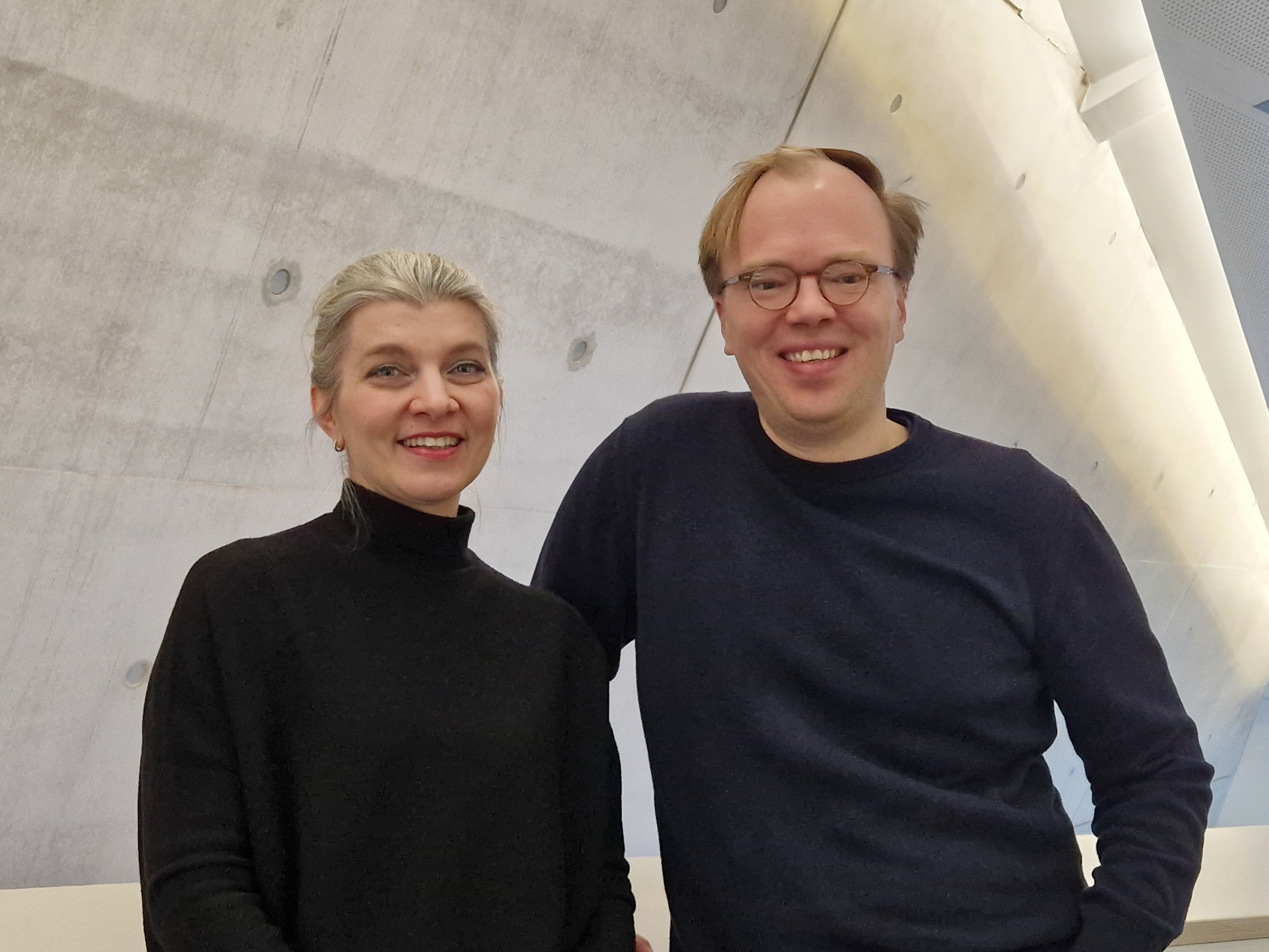
Humor and scholarship are not typically associated with one another. For Professors Szilvia Gellai and Kevin Drews, however, research on this very connection became the starting point of their fruitful collaboration: several years ago, their contact began with a scholarly paper on humor in the work of Walter Benjamin. Since then, the literary scholar from the University of Vienna and the Junior Professor of Literature and Theory at Leuphana have exchanged ideas primarily online or by phone. Now Szilvia Gellai has come to Leuphana for a semester.
During her stay, the two have completed their research on Walter Benjamin with a joint publication. Szilvia Gellai has also developed additional projects specifically for her time at Leuphana, including two seminars: “One is designed for bachelor’s students and focuses on border movements, on cultural-theoretical and literary negotiations of the liminal - that is, of boundaries,” she explains, adding: “In my readings on intersectionality, I repeatedly encountered the concept of the border - border crossings, border violations, transgressions of all kinds.” In the seminar, she plans to explore these concepts in depth with her students.
For master’s students, Szilvia Gellai has titled her seminar ‘Experiments in Living Otherwise.’ “It centers very much on the lives of Black people around 1900. They were not able to experiment with alternative forms of life from a position of privilege, but rather out of necessity - out of constraints, out of experiences at and across boundaries.”
These two courses already align seamlessly with the focus of Leuphana’s Visiting Scholars Program, administered by the Equal Opportunity Office. Kevin Drews invited her, however, on the basis of her 2023 book Glass Scenographies: Notes on Spaces of One’s Own. The book examines women writers in glass houses. “What particularly fascinates me about Szilvia Gellai’s work is her inspiring perspective on the interstitial field between literature on the one hand and architectural history on the other. She addresses media-theoretical questions in a distinctly interdisciplinary way,” Kevin Drews emphasizes. “Where glass and glass architecture are concerned, the focus is typically on men - men who researched them, constructed the buildings, or used them in literature as surfaces of imagination.”
According to Kevin Drews, the interdisciplinary approach employed by Szilvia Gellai is likewise practiced at Leuphana’s School of Cultural Studies: “Accordingly, we discovered substantial overlaps and multiple contact zones - not only with my own research, but also with that of colleagues in the School.” For Szilvia Gellai, this form of exchange is particularly valuable: “It is a wonderful opportunity to step out of what is often a very solitary mode inherent in research, and especially in writing.” After a brief pause, she adds: “I believe that collaborations like this are an excellent inoculation within academia, which is so strongly structured by hierarchical dependencies and tends to incentivize competitive behavior.”
Kevin Drews notes that he himself benefits from the Visiting Scholars Program primarily because “it allows me to pose questions together with Szilvia. The workshop we offered jointly at the end of January might well have been organized with similar guests, but the themes, questions, and problematics would have been different.” He continues: “One should not underestimate, in the routines of university life, the value of being able to continue conversations over coffee or lunch. Over time, an ongoing dialogue emerges in which we also develop new research questions. We have this opportunity only because of the Visiting Scholars Program.” He describes this as a significant source of motivation.
Szilvia Gellai came to research by an indirect path. After completing her master’s degree, she initially left academia. “There were, however, recurring words of encouragement - and a professor’s prediction that one day I would grow bored in professional life.” That is precisely what happened. Because teaching had always been important to her, she ultimately returned to the university in the context of a lecture series on world literature - an experience that also rekindled her enthusiasm for research.
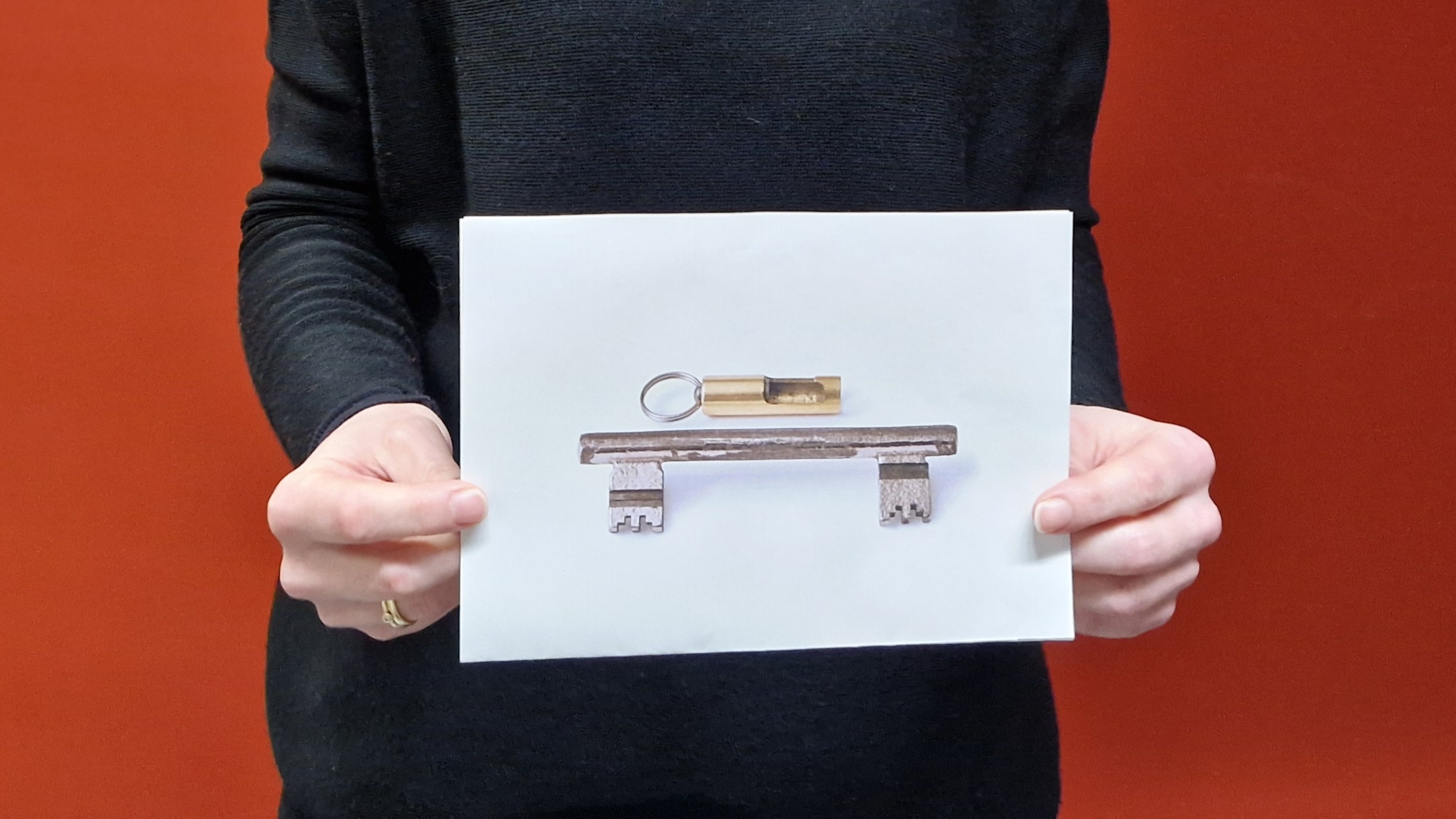
Her fascination with material culture was sparked by a small gift. Upon completing her doctorate, her best friend gave her a so-called Berlin key. The gift referred back to a seminar she had attended titled ‘Clever Objects: The Obstinacy of Things.’ One of the texts discussed there centered on the Berlin key. It is a pass-through key with two identical bits. After unlocking a door, the key must be pushed entirely through the lock. On the other side, it must be turned again and removed - thereby locking the door once more. This simple mechanism compels users always to keep the door closed. Because she finds such “clever objects” fascinating, Szilvia Gellai brought a photograph of her Berlin key to the interview.
Walter Benjamin, incidentally, regarded humor as essential to thinking - the very foundation of research. He wrote: “Let it be noted in passing that there is no better starting point for thought than laughter. In particular, the shaking of the diaphragm generally offers thought better opportunities than the stirrings of the soul.” (Fragment “Humor,” ca. 1917/18)
Further Information
Szilvia Gellai at the University of Vienna (in German): https://www.germ.univie.ac.at/szilvia-gellai/
The book Glass Scenographies: http://fox.leuphana.de/portal/en/publications/glassscenographies(cd2ee87e-2282-4b76-bdc9-823ee158051a).html
Kevin Drews at Leuphana: https://www.leuphana.de/en/institutes/igl/team/kevin-drews.html