
AI Skills & Self-Learning
The competent use of AI is no longer merely a technical issue. The effective use of AI is no longer merely a technical issue. Whilst good teaching does not depend on the use of AI, a thoughtful approach to AI can open up new perspectives for designing teaching methods that are legally sound and pedagogically effective. Building expertise is becoming increasingly important, particularly in light of the EU AI Act: The regulation calls for a solid foundation in AI literacy to minimize risks and safeguard transparency and fundamental rights in the education sector.
The guidance document “AI Competencies under Article 4 of the AI Regulation” published by the Federal Network Agency (in German) provides guidance on implementing this requirement. It explains which knowledge and skills are relevant and how organizations can structure their competency development based on the AI systems used, the associated risks, and the prior knowledge of the individuals involved.
As educators, you face the challenge of not only using AI systems as tools but also critically evaluating their results and preparing students for a work environment shaped by AI.
To help you prepare and provide support, this page offers various self-paced professional development resources. These resources are available online and/or via the Leuphana Moodle system (login via your Leuphana account).
How can AI tools be effectively used in teaching, learning, and assessment, and what skills do students and instructors need to do so? AI competency models provide practical guidance and help instructors integrate AI into their courses in a pedagogically sound, thoughtful, and forward-looking manner.
- UNESCO AI competency Framework for Teachers
- UNESCO AI competency Framework for Students
The frameworks are intended to serve as a guide for countries to help students and educators understand both the potential and the risks of AI, so that they can use it safely, ethically, and responsibly in education and beyond.
- A concise competency framework developed by the Digital Teaching Hub of Lower Saxony, based on foundational and advanced competencies. (in German)
- The AIComp model defines twelve essential competency areas that enable people to use artificial intelligence in a reflective, ethical, and productive manner in their daily lives and careers. It serves as a holistic framework for actively shaping the digital transformation rather than merely reacting to it passively.
- A practice-oriented collection of materials for professional development on the topic of artificial intelligence. It brings together ready-to-use tools, guides on prompt techniques, and resources for ethical reflection to support teachers and educational staff in integrating AI into their daily work. (in German)
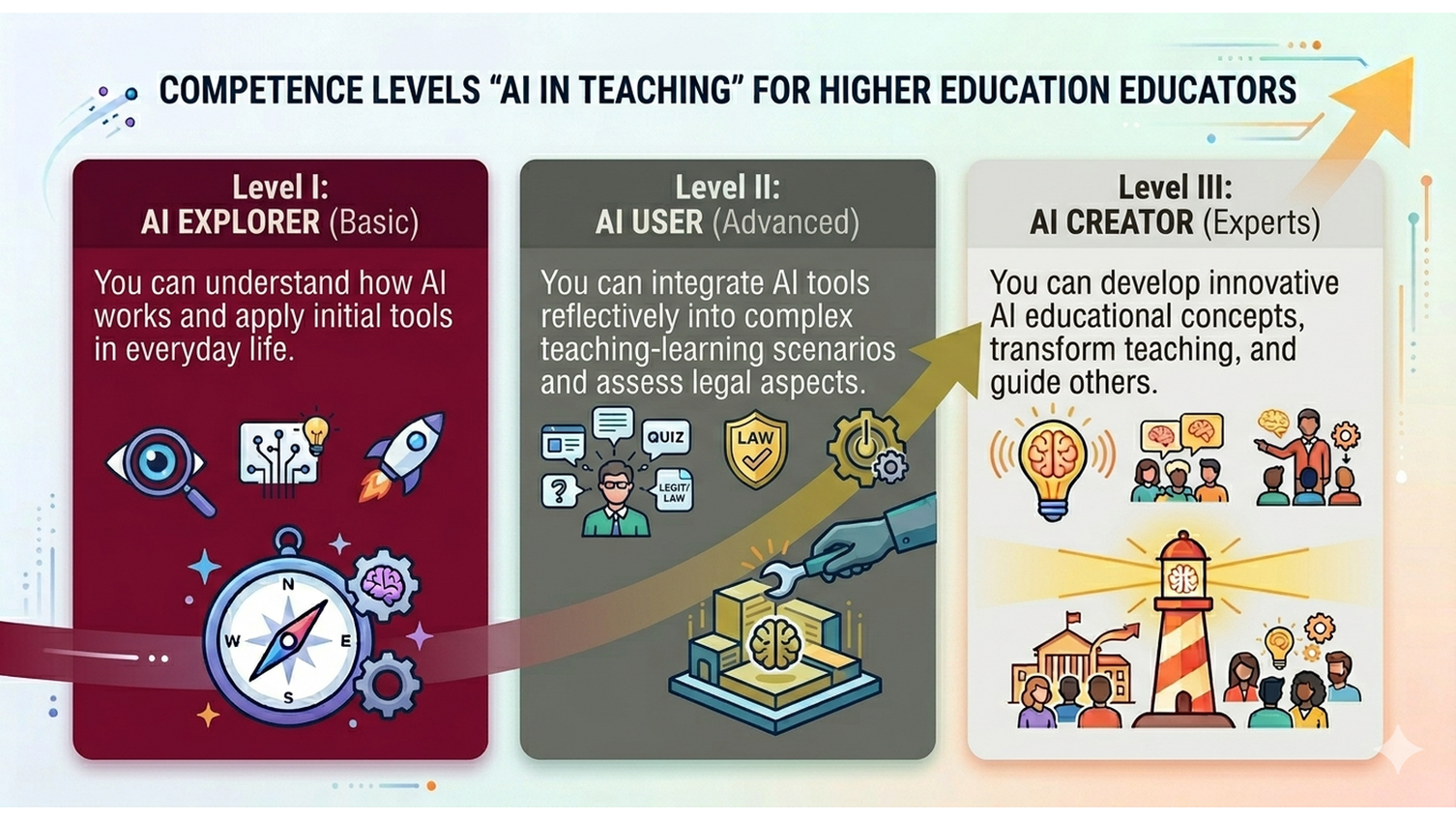
To find the resources that best match your current level of knowledge, use our three competency levels (based on Alles et al.) as a guide:
- AI Explorer: Understand the basics and the legal framework.
- AI User: Thoughtfully integrate tools into your teaching and learning scenarios.
- AI Creator: Develop innovative educational concepts and support the digital transformation.
- Basic Training: Self-Study Course on AI Competence
In four sections, you’ll learn everything you need to know about working with AI in your day-to-day work—including the technology, its applications (with prompting tips, among other things), legal and ethical frameworks, and key considerations when using AI.
Level: AI Explorer
Target Audience: faculty, students, and staff
Duration: approx. 1 hour
- GenAI Driver’s License for Teaching (bilingual)
This compact Moodle course helps faculty overcome their uncertainty when working with generative AI and offers practical guidance for teaching and exam contexts. In addition to technical functionality and effective prompting, this bilingual course addresses key legal, ethical, and environmental issues. Using concrete teaching scenarios, educators learn how to integrate AI tools efficiently, with an awareness of risks, and responsibly into their courses and how to adapt assessment formats. Interactive H5P elements and quiz questions support flexible self-study.
Level: AI Explorer
Target Audience: Educators
Duration: approx. 2 hours
- GenAI Licence - Using ChatGPT & Co. Safely in Your Studies (English)
This compact Moodle course offers students practical guidance on the responsible use of AI during their studies. It provides a basic understanding of how AI works, as well as covering data protection, copyright, environmental impacts, ethical principles and the legal framework governing examinations. In addition, students learn how to make effective use of AI through targeted prompting and receive guidance on using AI for literature reviews, text editing and document analysis, or to support their own learning process. The focus is on a reflective, competent and responsible approach to AI.
Level: AI Explorer
Target Audience: Students
Duration: approx. 1 hour
- AI for Educators
In this course, you’ll learn how GenAI can support your work as an educator: creating semester plans, exam questions, lesson plans, and teaching materials. Finally, the course explores the possibilities and limitations of feedback and grading using generative AI. Each module includes videos that you can watch at your own pace, as well as some accompanying materials available for download.
Level: AI User
Target Audience: Educators
Duration: approx. 2.5 hours
- Teaching with and about AI
This course is designed to help you use AI tools confidently and effectively in your teaching. You’ll receive practical guidance on how to integrate AI effectively into your daily teaching while fostering your students’ AI literacy. Each module includes videos that you can watch at your own pace, as well as some accompanying materials available for download.
Level: AI User
Target Audience: Educators
Duration: approx. 1.5 hours
- University of Helsinki: AI Basics in English - Elements of AI
The goal of this English-language program is to make artificial intelligence understandable and accessible. Courses such as Elements of AI—developed by MinnaLearn and the University of Helsinki—explain what lies behind AI, its potential, and its limitations. The self-paced courses combine foundational knowledge with practical exercises and can be completed flexibly at your own pace. The goal is to develop a solid understanding of AI and to enable learners to take their first steps in applying it. The courses are presented in an engaging way with text and graphics; registration is required to save your results when taking quizzes to assess your knowledge.
Two courses are included:
Introduction to AI
A free online course - Elements of AI
Level: AI Explorer, AI User
Duration: approx. 3 hours
Building AI
Course Overview - Building AI
Level: AI Designer
Duration: approx. 2.5 hours
AI Proficiency in Higher Ed Institutions
How is Artificial Intelligence changing work at universities - from teaching to administration? This course shows you: practical, understandable, and with many examples from everyday university life. You will get a compact overview of the AI Act, learn about key requirements and opportunities, and find out what responsible AI use can look like in practice. Interactive tasks will help you apply what you have learned directly to your own university practice.
Level: AI Explorer
Duration: approx. 3 hours
You can find more courses in German on the German version of this website.
- Hard Fork - The New York Times
Hosted by tech journalists Kevin Roose and Casey Newton, this weekly podcast explores how artificial intelligence and emerging technologies are rapidly reshaping our daily lives, jobs, and society. It cuts through the tech hype by delivering sharp, human-centric analysis wrapped in deep journalistic rigor and witty, conversational humor.
- Teaching in Higher Education
“Teaching in Higher Education” explores practical and research-informed approaches to effective teaching and learning in higher education. The podcast also shares strategies for improving personal productivity and achieving a healthier work–life balance, helping educators create meaningful learning experiences while staying present for their students.