
Utopia Conference: “Generosity, a Utopia?”
2026-09-02 From August 26 to 28, 2026, the Utopia Conference at Leuphana centered on the question, “Generosity: A Utopia?” Frederic Kohlhase and Charlotte von Wulffen participated on behalf of the Leuphana Social Innovation Community as moderators and facilitators, and returned with new questions to apply to their own work.
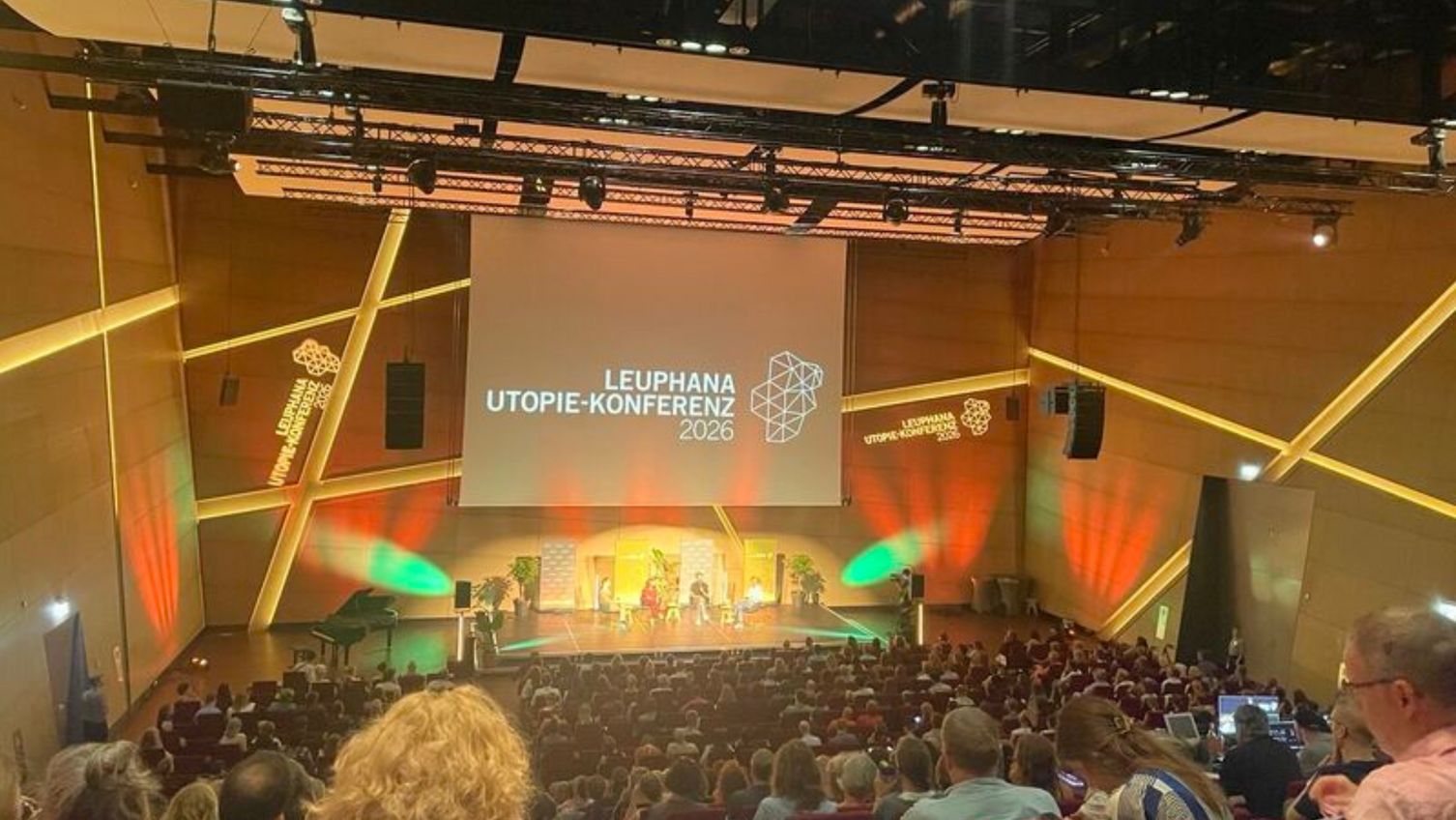
What does generosity mean in times of loss? For three days, the Utopia Conference revolved around a concept that initially seems familiar. A generous person is someone who gives, shares, and does more than is necessary. But in the discussions, this apparent clarity quickly began to crumble.
Where does generosity end and justice begin? Who can even afford to be generous? And who would have to go without if resources become scarce? The question of scarcity itself also came up repeatedly: What is actually scarce, and where is scarcity first created - socially or economically? In interpersonal relationships, doing more than is necessary can be an act of generosity. At the societal level, however, this logic is not always sufficient. When existing rights are upheld, that is not generosity. And if care, participation, or the protection of our basic means of life are to be taken for granted, the question arises as to whether we need, above all, more generous individuals - or different societal conditions.
The conference did not resolve these tensions. Rather, it created space to endure them for a while and reflect further: to venture into ideas that may seem distant at first, and not to immediately reduce every question to a feasible solution. All these questions touched us as participants and prompted us to reflect: What can we take with us as we continue developing and holding the Social Innovation Community?
Generosity Needs Space
We explore how social change can emerge - through social enterprises, new forms of cooperation, alternative economic models, or new relationships between different actors. In doing so, our focus quickly turns to solutions: What works? What can be replicated? What can we actually implement? But from the Utopia Conference, we also take away an understanding of the importance of spaces. Spaces where different perspectives come together, where familiar assumptions can be questioned, and where a question doesn’t have to be answered immediately.
Perhaps this is one of the connections between generosity and social innovation: initially making space for other ideas. Not knowing in advance what the end result should be. And creating contexts in which something can become conceivable - something that is rarely discussed within existing routines.
Who represents nature?
In the “Rights of Nature” workshop, the question of whom we give space to and whose perspectives matter became very concrete. If companies can be legal entities and assert their rights in court, why does the idea that a river, a forest, or an ecosystem might also have rights of its own seem so unfamiliar to us?
At first glance, this is a legal question. As the discussion unfolded, other questions quickly arose: Who represents nature? Who decides which of its interests matter? What even counts as nature? And is it enough to simply protect nature better, or does something more fundamental change when nature is no longer viewed in law merely as an object of human decision-making?
The workshop therefore addressed two interrelated levels: the question of enforceable rights and the question of how we perceive nature in the first place and relate to it. It was precisely here that the conference theme of generosity came up again - and at the same time reached a limit. For generosity can mean giving others space or taking their interests more fully into account. But where something is supposed to be a right, its recognition must not depend on our generosity.
For the Social Innovation Community, this raises a fundamental question: Who or what actually has a voice in our institutions, and who has been left out so far?
Listening Generously
Some of these questions can only be addressed to a limited extent around a table. That’s why the “Nature Walk: Listening Generously” took us out to the Wilschenbruch. The invitation was deliberately simple: slow down, don’t speak for a while, and simply observe. For a moment, nature was meant to be not just a setting or a resource, but a counterpart.
The participants first walked alone and without a specific destination. What catches my attention? What changes when I stay in one place longer? And what might this living being or this place need if its own interests were what mattered?
What we take away from this for our work is therefore less a ready-made answer than an attitude. Not every change begins with a new solution. Sometimes it begins by creating a different framework, listening more closely, and giving space to someone or something that wasn’t previously at the table.