
LÜNALE 2026: Leuphana Talents Impress with Practical Innovations
2026-11-09 A European payment app that automatically contributes to climate protection, and three master’s theses with concrete benefits for businesses: At this year’s LÜNALE, the spotlight was once again on the ideas and achievements of young talent at Leuphana. The awards demonstrate how students tackle entrepreneurial challenges and put scientific findings into practice. The team behind Climpa received the award for Leuphana’s Startup Idea of the Year. Three additional awards went to graduates who had developed their master’s theses in collaboration with companies.
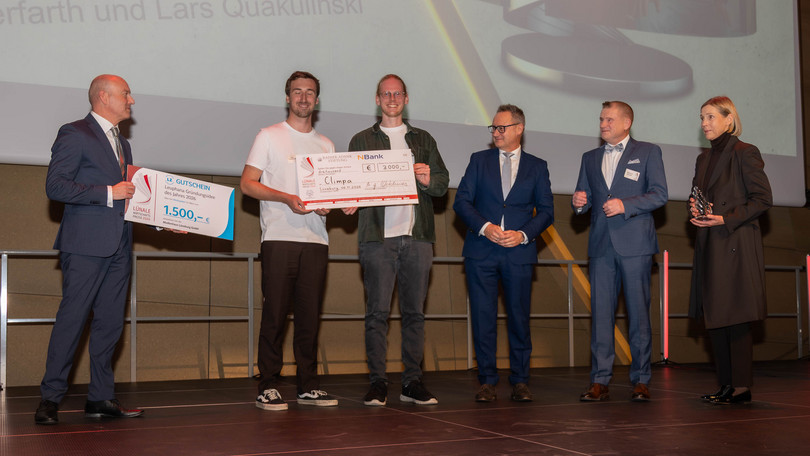
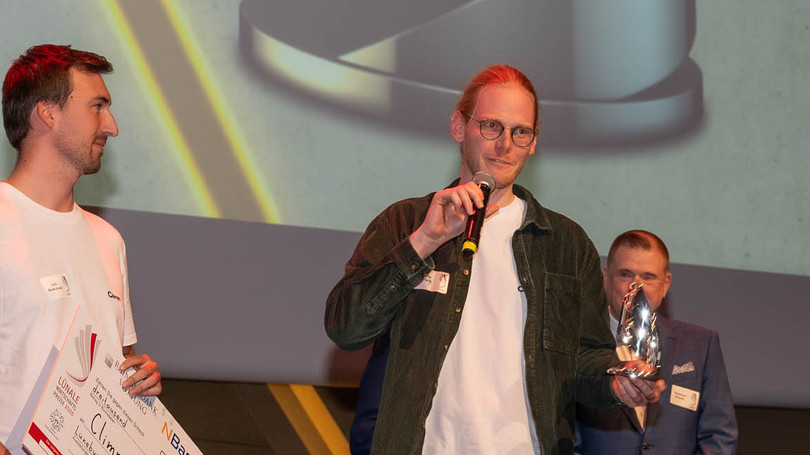
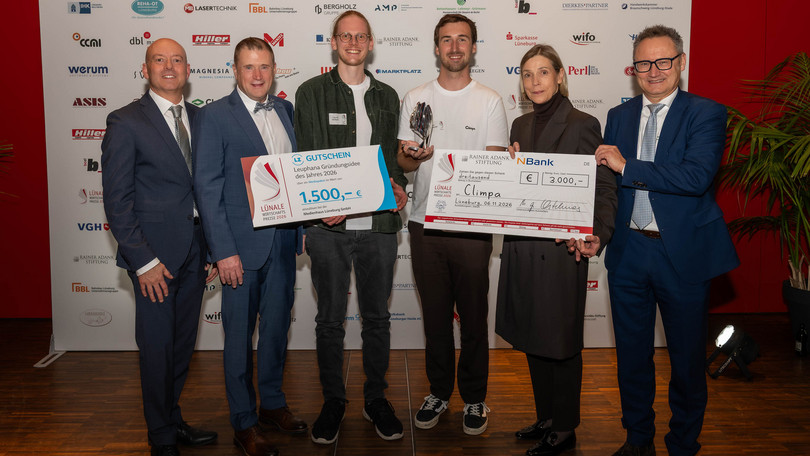
Startup Idea of the Year: Climpa Combines Payments with Climate Protection
Doing your part for climate protection with every payment, without paying more for it: That’s the idea behind Climpa. Founders Lauritz Herfarth and Lars Quakulinski are developing a European payment app that lets customers pay at stores using a QR code. To use it, users simply link their existing bank account to the app. There’s no need to switch banks. A portion of the fees that are incurred anyway with digital payments goes toward certified climate protection projects. This way, every payment automatically contributes to nature conservation. At the same time, Climpa creates a European alternative to the major international payment networks.
The app is initially set to be used in university cafeterias. A planned pilot integration with the Studierendenwerk Ostniedersachsen in Lüneburg marks the first concrete step in this direction. In the long term, the founders plan to expand the service with additional features. The founding team’s skills complement each other perfectly in the development process: Lauritz Herfarth brings business management experience and expertise from the payments industry. As a software architect, Lars Quakulinski is responsible for technical development and programmed the Climpa prototype himself.
The jury particularly praised the innovative combination of European payments and automatically funded climate protection. The concept is clear and addresses two relevant trends: the desire for more sustainable consumption and the question of how Europe can become more independent in the realm of digital payment services. In his laudatory speech, Prof. Dr. Reinhard Schulte—Leuphana Professor of Startup Management and head of the Startup Award—also praised the speed of implementation as well as the well-thought-out market entry strategy via the student services organizations. This approach gives the team the opportunity to first test the app under real-world conditions in a clearly defined market. The jury also highlighted the diverse skills that the founders bring to their project as a key foundation for the initiative.
The Leuphana Startup Idea Award comes with a prize of 3,000 euros, provided by the Rainer Adank Foundation with support from NBank.
Master's Thesis Awards: Research Papers with Direct Benefits for Businesses
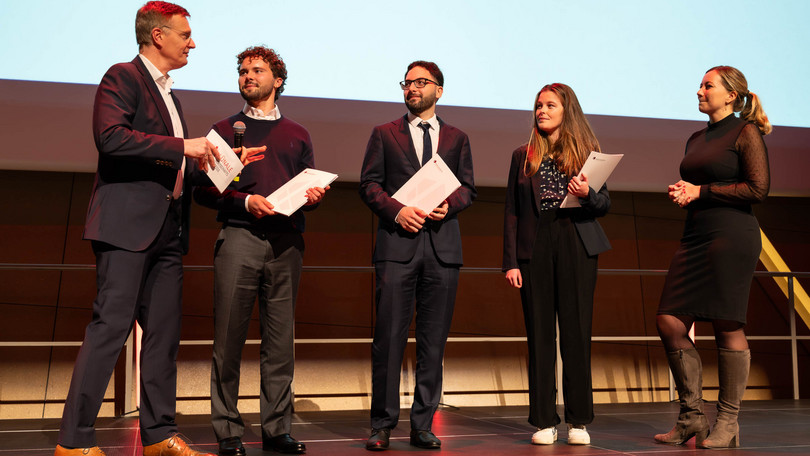
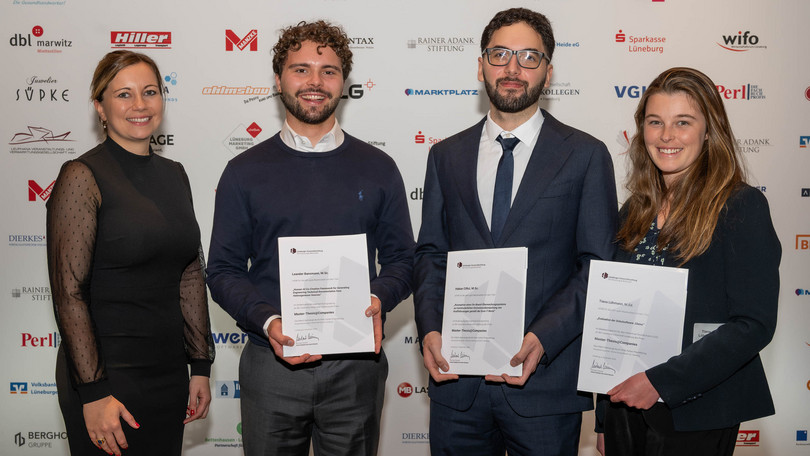
The awards for outstanding master’s theses developed in collaboration with companies went to graduates Hakan Ciftci, Leander Bansmann, and Tiana Lühmann. The prize, worth 1,000 euros each, was awarded by the Lüneburg University Foundation for Research and Business. The honored theses address specific challenges from the business world. They demonstrate how scientific methods and new technologies can contribute to the development of practical solutions. At the same time, as laudator and foundation curator Jule Grunau expressed her conviction, the students would certainly enjoy their academic work even more if the impact they could generate were directly visible.
Artificial Intelligence Improves Emissions Measurement
In his master’s thesis for the Management & Engineering program, Hakan Ciftci investigated how vehicle emissions can be measured more accurately while driving. In collaboration with Deckma Hamburg GmbH, he developed an approach that combines low-cost sensors with data from vehicle diagnostics and the vehicle’s surroundings. With the help of machine learning, this allows measurement values to be determined with significantly greater accuracy. The study tested the system under real-world traffic conditions. The results show that measurement accuracy can be significantly improved by combining different data sources. Thus, the thesis provides an approach for the continuous monitoring of vehicle emissions and a potential application in light of the future Euro 7 standard.
AI Preserves Technical Knowledge Within the Company
In his master’s thesis for the Management & Engineering program, Leander Bansmann collaborated with SIEB & MEYER AG in Lüneburg to develop a system that supports the creation of technical documentation using artificial intelligence. The system asks developers specific questions about changes to software, compares their responses with existing documentation, and fills in missing information. Every statement can be traced back to a verifiable source. Testing within the company showed that the process brings to light knowledge that had not previously been documented. At the same time, the time required for this task was significantly reduced. The thesis thus combines concrete time savings with an important contribution to the long-term preservation of technical knowledge.
School Software Put to the Scientific Test
As part of her Master of Education program, Tiana Lühmann examined a school software application. The digital application developed by Clama Schulsoftware UG in Hamburg helps teachers document challenging student behavior and develop appropriate recommendations for action. The master’s thesis was the first systematic evaluation of how teachers use and rate the software. Based on her findings, the graduate derived recommendations for the software’s further development and its use in everyday school life. The results have already been incorporated into adjustments to the user interface and the training program.
The award-winning theses illustrate how closely academic research and business practice can interact at Leuphana. Students and graduates tackle issues that directly concern companies. This collaboration gives companies access to scientific methods and new approaches to problem-solving. At the same time, young researchers have the opportunity to test their knowledge against real-world challenges and use their findings to drive concrete change.
LÜNALE: A Stage for Entrepreneurial Success
Once a year, the LÜNALE brings together the business community of the Lüneburg region and honors successful startups, dedicated craft businesses, and high-performing small and medium-sized enterprises in various categories. Organized by the Economic Development Corporation for the City and District of Lüneburg, it shines a spotlight on entrepreneurial commitment and fosters networking within the regional business community.
Lower Saxony’s Minister of Economic Affairs, Grant Hendrik Tonne, summed this up with a catchy comparison in his opening remarks: He had heard that the awards ceremony is considered the “Oscars of the Lüneburg business community.” With a twinkle in his eye, he expressed his hope that the LÜNALE would become so significant in the future that one day the Oscars would be called the “LÜNALE of the film industry.”
The recognition of Leuphana’s talented students fits right into this vision: It demonstrates the potential inherent in the ideas and research of young people and highlights the university’s contribution to the region’s economic and social development.